
Street Poster Campaigns for Film Releases
A film release is not only a media buy. It is a public event, and public events need public presence. That is why street poster campaigns still matter.
When a title appears on walls, construction barriers, storefront corridors, and dense nightlife blocks, it stops feeling like a distant ad campaign. It becomes part of the city’s rhythm. People pass it on the way to work, photograph it after dinner, send it to friends, and carry the image with them longer than many paid impressions ever manage.
For film marketers, that shift is powerful. Street posters can build anticipation, sharpen recall, and give a release a physical identity before opening weekend arrives. For studios, distributors, indie producers, festivals, and agencies, the appeal is clear: high visibility, fast deployment, and a format that can feel bold rather than corporate.
Why street posters still hit hard
Out-of-home media continues to perform well on one metric that matters to every release campaign: memory. Industry studies have consistently shown stronger ad recall for out-of-home than for many other media channels, including several digital formats. For films, recall is not a soft metric. It is the bridge between hearing about a title and deciding to watch the trailer, tell a friend, or buy a ticket.
Street posters also work because they carry atmosphere. A horror film can feel ominous on a dim block with repetition and stark color. A comedy can feel witty when the copy lands like an inside joke. A prestige drama can signal taste and seriousness with restraint. Placement and design do not just spread awareness. They shape the emotional tone of the release.
There is also a cultural advantage. Digital ads are easy to skip, mute, or forget. A strong wheatpaste wall or stencil trail catches people in motion, in context, and without asking permission from a feed algorithm. That tangible quality gives films something rare: presence.
After that initial impact, street campaigns often create a second wave online.
Photo-worthy visuals
Local buzz near theaters and transit
Social sharing from fans and passersby
Repeat exposure across daily routes
What makes a release campaign work on the street
A good film poster in the wrong place is still the wrong campaign. Street media works best when placement is based on sightlines, pedestrian flow, cultural fit, and timing. The strongest locations are not always the biggest walls. Often, they are the surfaces people cannot help but notice because they sit directly in the path of movement.
That is why experienced teams treat a city like a mapped narrative. Teaser posters may appear first in dense entertainment zones or near campuses. Full creative may expand into commuter corridors and nightlife districts as opening night gets closer. If the release includes a premiere, festival screening, or cast appearance, the physical media can be concentrated around those touchpoints to amplify the moment.
Timing matters just as much as geography. A poster drop three to four weeks before release can seed recognition. A refresh in the final week can sharpen urgency. For event films, a concentrated burst over one to three nights can create the feeling that the movie is suddenly everywhere.
Here is a practical view of how street posters often fit into a film rollout:
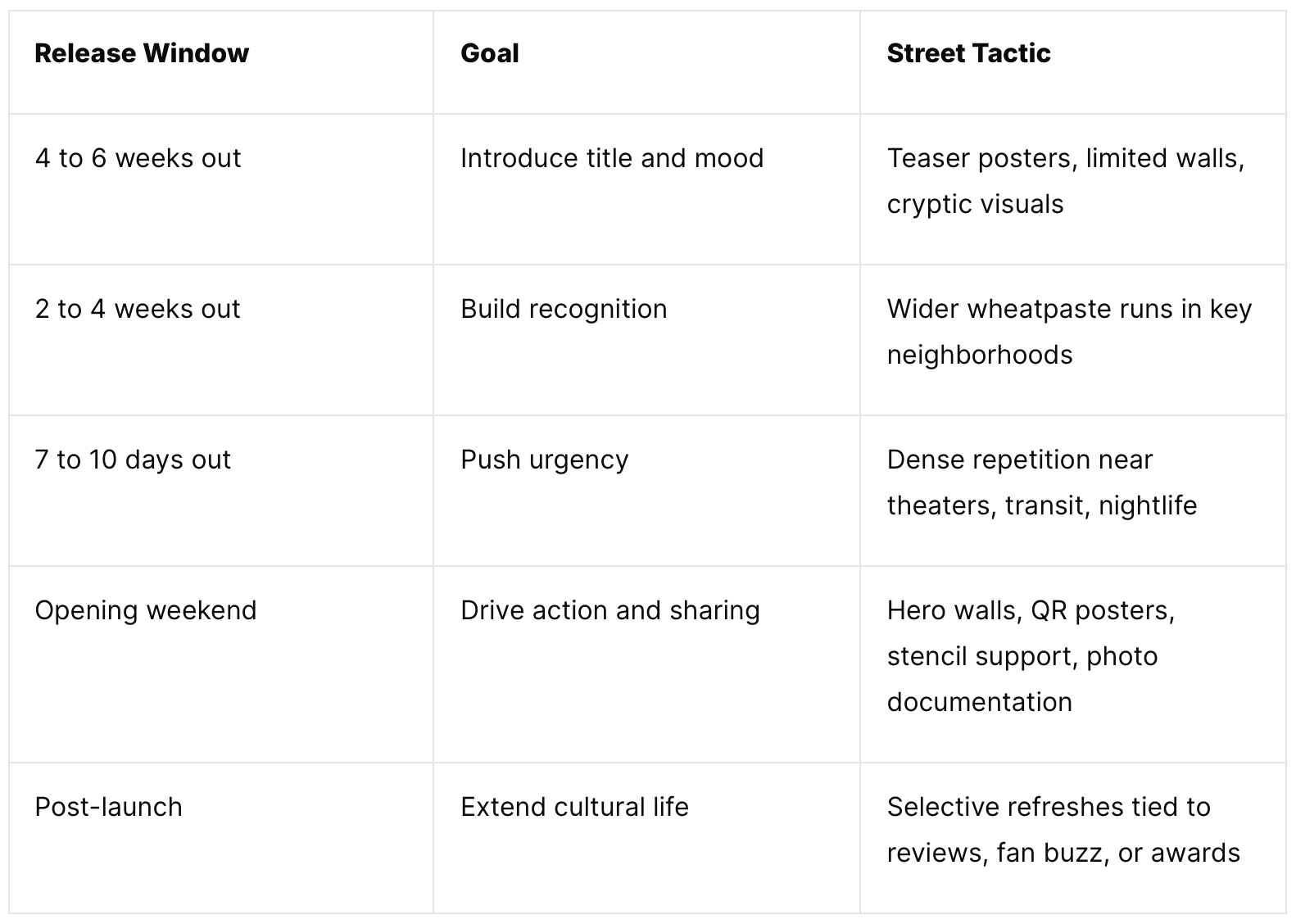
view of how street posters often fit into a film rollout
Design should follow the same discipline. Street posters are not mini billboards. They have to read fast, often at a distance, with distractions everywhere. High contrast, one dominant image, disciplined typography, and a clear emotional cue will usually outperform cluttered key art.
Lessons from memorable film promotions
Some of the most talked-about film campaigns in recent years used street-level ideas not as decoration, but as a core part of the marketing voice.
Take It. The red balloon placements and street-side warnings worked because they translated the film’s imagery into real space. The campaign did not simply announce the release. It created unease in public, which matched the promise of the movie. People photographed it because it felt eerie, immediate, and unexpected.
Deadpool took the opposite tonal route and proved the same principle. The outdoor creative leaned into irreverence, jokes, and visual absurdity. That made the campaign feel native to the character. The posters and outdoor stunts were not just media placements. They were extensions of the film’s personality.
Smaller releases can benefit even more. A niche horror title, festival darling, or indie drama may not win a spending contest against mass media. It can still win attention in the right neighborhoods. A smart local takeover near arthouse theaters, bars, campuses, or gallery districts can create density where it matters most.
Interactive layers can help when used with discipline. QR-enabled posters, alternate art drops, or a stencil trail leading to a screening can turn passive views into active participation. The key is restraint. The street should never feel overloaded with instructions. The visual idea has to lead.
How Sidewalk Tattoos approaches film-style activations
For brands and entertainment campaigns that need city-level visibility fast, Sidewalk Tattoos builds around a simple idea: visibility is earned block by block. That means careful mapping, strong surfaces, and installations placed for actual human sightlines rather than vanity counts.
The agency’s format range is especially useful for film releases because movies respond well to saturation. Wheatpastingcan create repeated visual rhythm along a corridor. Sidewalk stencil activations can extend the narrative onto the pavement. Custom poster installations can turn a wall into a launch moment instead of a single placement.
That combination matters. A film campaign often needs both scale and texture. Posters deliver the hero image. Stencils add direction, repetition, and local flavor. Geo-tagged documentation gives marketers proof of execution. Fast rollout timelines keep campaigns relevant when trailer drops, premiere dates, or review embargoes shift.
A strong street campaign usually depends on a few operational choices being made well.
Mapping: choosing corridors by sightline, audience fit, and daily foot traffic
Format mix: combining wheatpaste posters with stencils or custom installs when the concept needs more depth
Documentation: capturing photo proof and geo-tagged records for reporting and internal review
Speed: activating quickly when release calendars, festival windows, or publicity beats move
That approach is especially effective for films because release marketing is built around momentum. A campaign that takes weeks to organize can miss the cultural moment. Street media works best when the creative lands while people are already hearing about the film from trailers, social clips, cast interviews, or premiere coverage.
Street posters do more than announce a movie
They can also define where the movie belongs.
A youth-driven thriller may need dense placements near colleges, music venues, and late-night retail strips. A fashion-forward arthouse release may feel stronger in gallery districts and style-conscious neighborhoods. A broad studio title may benefit from commuter routes and entertainment hubs where frequency builds quickly. The point is not to paste everywhere. The point is to appear where the audience already lives.
That local fit gives the campaign credibility. It tells people the film understands its crowd. Street media can feel culturally fluent in a way broad national media often cannot.
How the channel fits into the larger release mix
Street posters are rarely a standalone answer. Their best role is to make other channels work harder. A viewer sees a teaser wall on Tuesday, the trailer on Thursday, and a fan post on Friday. By then, the title feels familiar. Awareness has become momentum.
This is where integration pays off. A QR code can point to a trailer, ticket page, or timed microsite. A branded hashtag can organize user-generated content. A poster wall can serve as a photo backdrop during a premiere week or festival run. Publicity teams, social teams, and street teams all benefit when the visual language stays consistent.
Budget-wise, street posters usually take a smaller share than digital video or mass-reach media, yet they can punch above that share when the creative is right. They are also accessible for smaller films. A focused neighborhood run can create density without requiring a national buy. That makes the channel attractive for indie releases, documentaries, festival titles, and event screenings that need impact before they need scale.
A few conditions tend to make street posters especially valuable:
Local relevance: urban density, active pedestrian zones, and a clear geographic audience
Strong visual identity: art direction that reads instantly and rewards repetition
Time-sensitive momentum: upcoming release dates, premieres, opening weekends, or limited runs
Social potential: imagery people will want to photograph and share
Measuring what the street actually did
One reason some marketers hesitate on street media is measurement. Digital dashboards feel cleaner. Street campaigns can seem harder to quantify. That gap has narrowed.
Execution photos, geo-tagged reporting, unique QR links, promo codes by location, and social listening can all help connect physical placements to response. If one corridor drives scans while another drives tagged posts, the next wave can be adjusted. If a poster cluster near a theater performs well, that area can be refreshed closer to opening weekend.
The smartest approach combines hard and soft signals. Hard signals include scans, site visits, promo use, and time-stamped proof of installation. Soft signals include social mentions, fan photos, and changes in local chatter around the title. Film marketing has always involved momentum that cannot be reduced to one number. Street media should be judged the same way: by direct response where possible, and by visible lift in cultural presence.
There is also value in the simple fact of being seen repeatedly in public. A film that occupies the street feels larger, closer, and more imminent. That feeling can support ticket sales, but it also does something bigger. It turns release marketing into part of city life for a while.
For movies built on anticipation, identity, and conversation, that is not a minor advantage. It is the point.
Contact us: info@sidewalktattoos.com Website: www.sidewalktattoos.com