
The Street Marketing Agency With a 24 Hour Turnaround
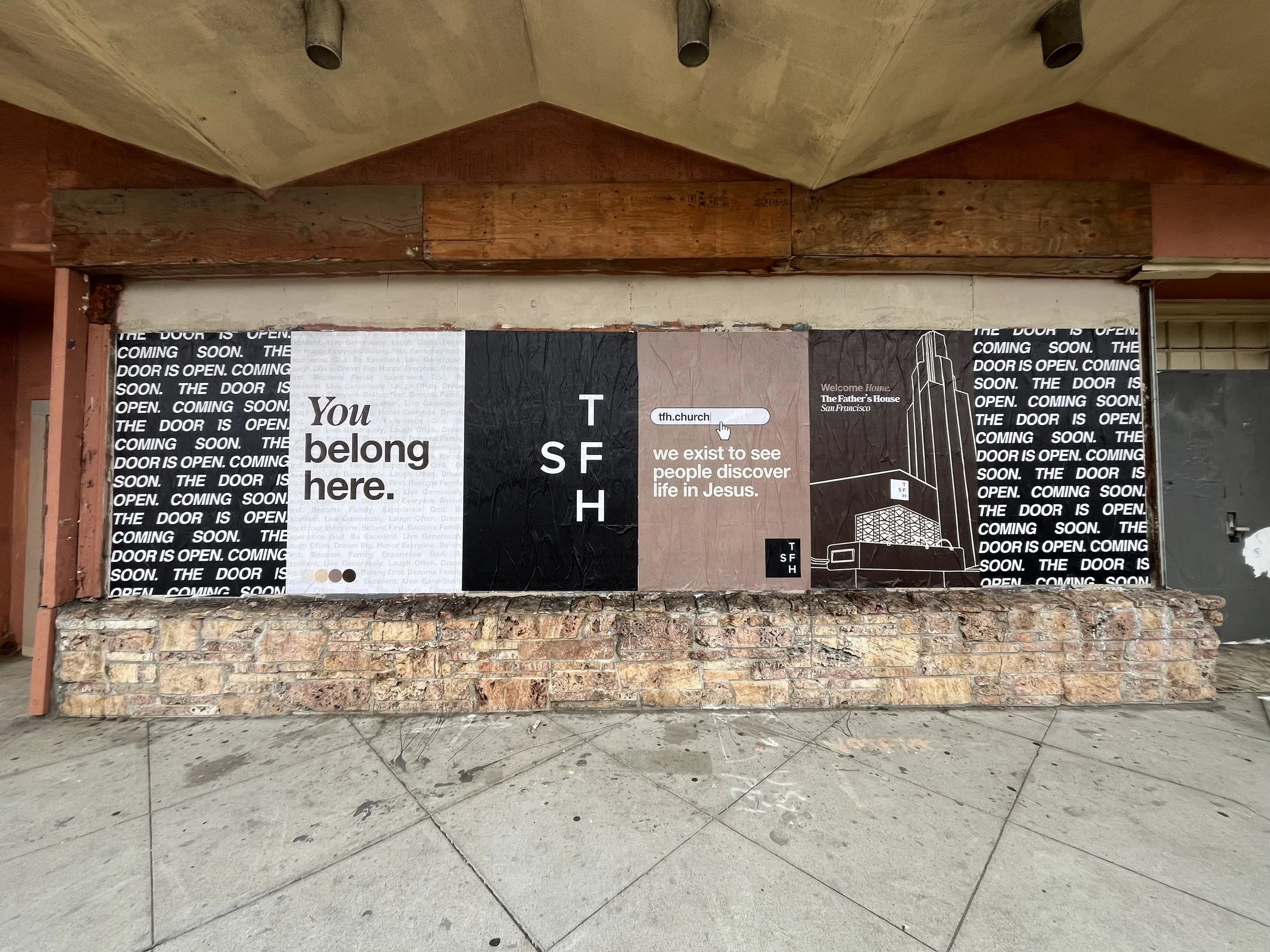
wheat pasting installation by sidewalk tattoos in San Francisco
Some campaigns get months of planning. Others get a day.
When a launch date moves up, a pop-up gets approved late, or a brand wants to own a weekend conversation, speed becomes part of the media itself. Street marketing is one of the few channels that can move that quickly while still feeling physical, visible, and hard to ignore.
A 24-hour turnaround sounds extreme because it is. Yet it becomes realistic when printing, mapping, field crews, and documentation are already built into one operating system. At Sidewalk Tattoos, that is the point: print fast, install fast, document everything, and keep the work grounded in the streets where people actually walk, wait, shop, and talk.
Why 24-hour street marketing turnaround matters
Fast street campaigns are not only about urgency. They are about timing.
Street visibility works best when it lands close to the moment that matters: a product drop, an event, a store opening, a film release, a music weekend, a funding announcement, a major collab, or a cultural flashpoint that has a very short shelf life. If the campaign shows up three days late, the media may still be visible, but the energy is gone.
That is why a short turnaround can change the value of the buy. A wheatpaste wall near nightlife corridors the night before a launch can feel current. Sidewalk stencils leading into a pop-up on opening day can feel intentional. The same placements a week later may still look good, but they do not carry the same force.
A recent Sidewalk Tattoos case points to what this can look like in practice. The company reports installing a True Religion wheatpaste campaign in Houston within 24 hours of receiving final artwork, while also coordinating a campaign across 18 U.S. cities with a 24-hour turnaround target. That kind of speed does not happen because people simply move faster. It happens because the system is built for compressed timelines.
What a 24-hour wheatpaste and stencil campaign includes
A fast campaign still needs structure. The difference is that every step is tightened up, preplanned, and handed off with almost no dead time between teams.
In most cases, a 24-hour activation includes more than print and installation. It also includes location planning, local production decisions, field coordination, and proof that the work actually happened where it was supposed to happen.
A typical rush activation covers:
Creative intake: final artwork, dimensions, quantity, city list, and timing
Print coordination: local or regional output based on deadline, volume, and format
Street execution: wheatpaste crews, stencil teams, or both
Proof of placement: photo documentation and geo-tagged reporting
This matters because speed without control is just chaos. Brands do not need a vague promise that posters are “out there somewhere.” They need confidence that the right neighborhoods were hit, the installation looked sharp, and the campaign can be reviewed internally the next morning.
The 24-hour street campaign workflow from artwork to installation
The fastest campaigns usually feel calm from the outside. Inside the operation, the clock is moving.
A rush street campaign works best when each step starts before the previous step is fully “finished” in the traditional sense. Mapping can begin while files are being checked. Crews can be held while print is being scheduled. Reporting folders can be opened before the first poster is hung.
Here is what a condensed workflow often looks like:
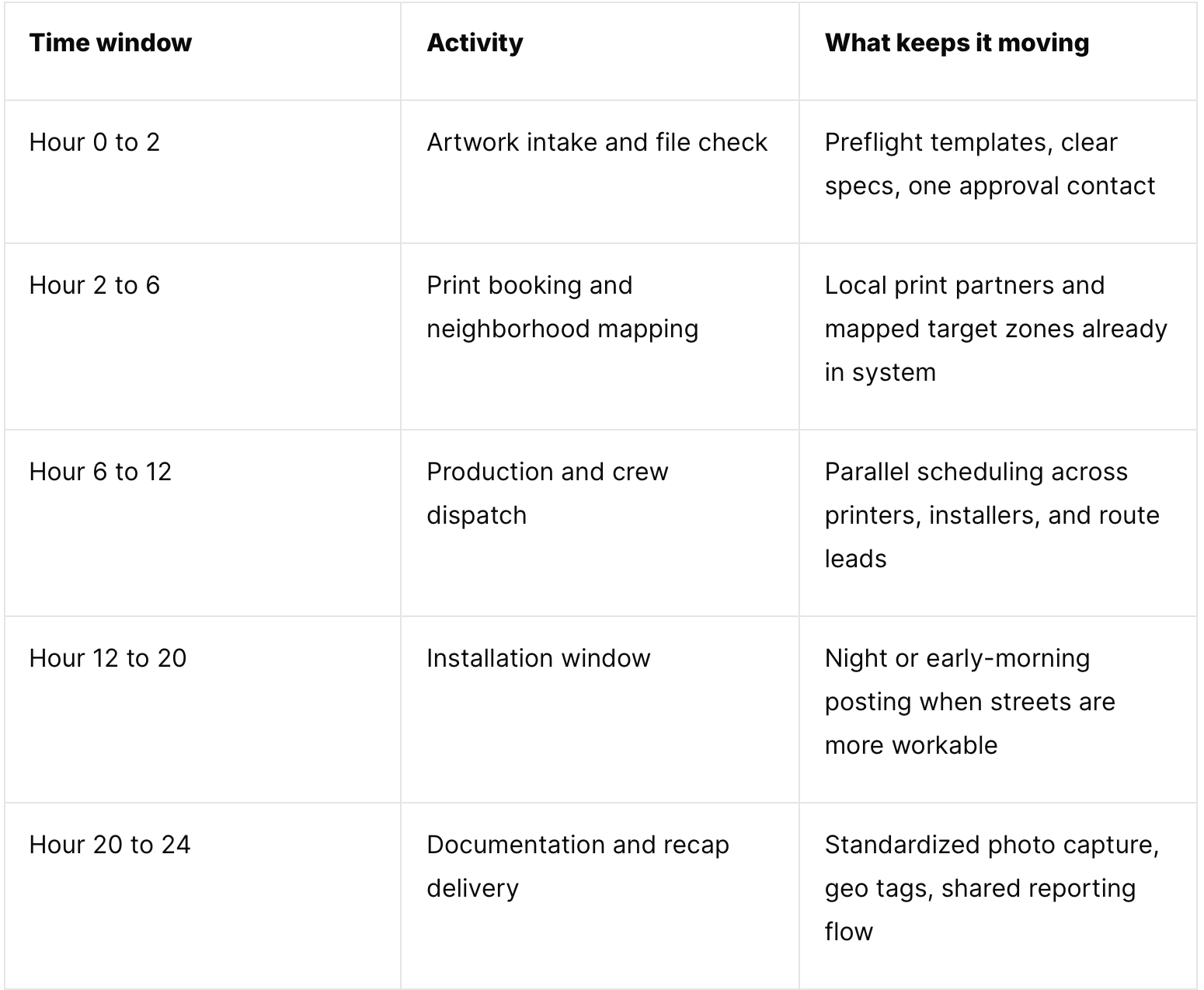
Installation timeline by Sidewalktattoos
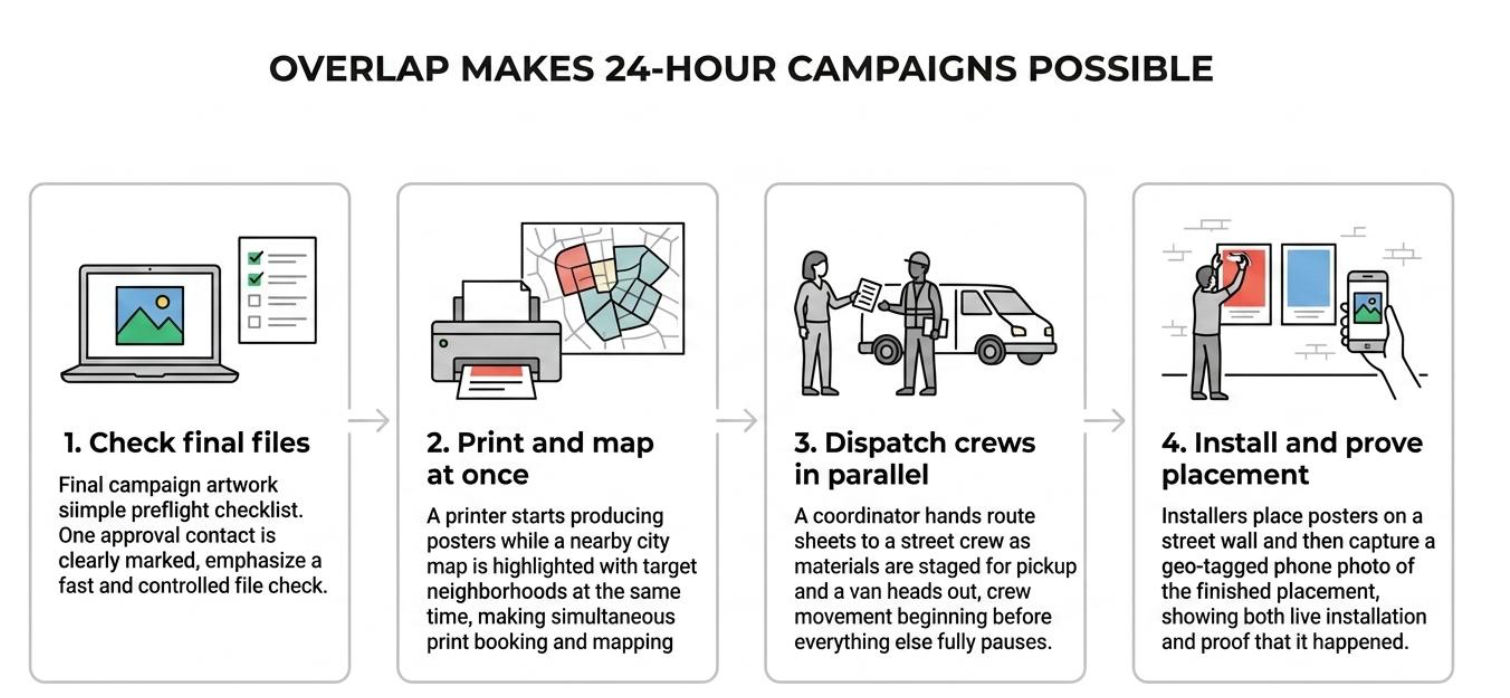
Step by step wheatpaste processing
The most important part is not any one row in the table. It is the overlap.
When the process is built well, printing does not wait on mapping, and crews do not wait on a long chain of approvals unless there is a real creative issue. That overlap is where the 24-hour promise becomes possible.
Timeline showing a 24-hour street marketing campaign from artwork intake and print booking to installation, documentation, and recap delivery.
How multi-city street marketing happens without losing control
Single-city speed is one thing. Multi-city speed is a different discipline.
The challenge is not only geographic spread. It is consistency. A campaign needs to feel like one campaign whether it appears in Houston, New York, Los Angeles, Chicago, Miami, or a smaller market with a very different street layout and print environment.
That is why fast national work depends on a distributed model. Local print shops matter because they cut shipping time. Local crews matter because they know pedestrian routes, posting patterns, and block-by-block reality. Central coordination still matters because the creative, timing, and reporting need to stay unified.
At Sidewalk Tattoos, the stated approach includes coordinating with local print shops, installation crews, and city compliance teams in each target market. That is the practical version of scale. It is not one giant warehouse trying to control every wall from a distance. It is a managed local network built around one launch window.
This is also where format choice matters. A city may need a poster-heavy rollout in entertainment districts, while another may perform better with stencil clusters near transit and retail corridors. The campaign can still feel consistent while the street plan changes by market.
Why compliance and documentation still matter in fast street advertising
Speed is impressive only when the work holds up after installation.
Rush campaigns can go wrong in familiar ways: bad files, weak posting surfaces, poor weather timing, low-traffic placement, inconsistent print color, or missing proof of performance. A serious street marketing agency reduces those risks before the crews leave the shop.
That means city-specific judgment, disciplined quality control, and reporting that does not leave the client guessing.
A strong rush process usually depends on three client-side inputs:
Ready-to-print files: correct sizing, bleed, color setup, and approved copy
Clear geography: target neighborhoods, venue radius, or priority blocks
Fast approvals: one decision maker who can respond in minutes, not half a day
Documentation is just as important as installation. Sidewalk stencils, according to the company’s own service information, are documented hit by hit so clients know exactly where the campaign lives. That matters in any activation, but it matters even more in rush work, where internal teams often need proof fast for recaps, screenshots, investor updates, and campaign reporting.
And yes, materials matter too. Temporary, eco-conscious formats make quick activations more practical in many street environments, especially when paired with experienced crews who know how to execute cleanly.
Choosing wheatpaste posters, sidewalk stencils, or a combined street campaign
Not every message should be pushed through the same format.
Wheatpaste posters and sidewalk stencils solve different problems, even when they are part of the same street push. Posters create visual mass. Stencils create repetition at foot level. Together, they can turn a neighborhood into a message sequence rather than a single impression.
A simple way to think about the choice:
Posters for visual dominance
Stencils for directional repetition
Combined formats for launches, pop-ups, and short-window takeovers
A Sidewalk Tattoos case in SoHo shows what this can look like at full scale. The company reports deploying 100 sidewalk stencil hits around busy intersections, subway exits, and shopping streets for a Yonex pop-up, while also placing 600 jumbo 48x72 posters across the neighborhood. The goal was to build anticipation, curiosity, and foot traffic. That pairing makes sense because each format does a different job. The posters announce. The stencils guide and repeat.
Stencil volume can also scale up or down based on the objective. According to the company’s service information, some brands run 25 to 50 hits for a local activation, while others go to 100, 200, or more for a citywide push.
Why fast guerrilla marketing can still deliver strong brand effects
There is a temptation to think of fast street work as purely tactical, almost like a last-minute patch. That misses the bigger value.
Street marketing can move quickly and still carry meaningful brand effect because the format is public, visual, and often surprising. Those qualities have been studied in guerrilla and out-of-home contexts, and the findings support what many marketers already feel in practice.
Research from Monash University found that creativity, defined as novelty plus relevance, had the strongest direct and indirect effect on word-of-mouth intention in guerrilla advertising, with surprise also influencing consumer behavior through message credibility. That fits street campaigns well. A wall takeover or a dense stencil cluster does not work because it is random. It works when the creative feels fresh and right for the audience in that place.
Another study published through ScienceDirect found that guerrilla marketing in social media had a positive effect on both functional and symbolic brand image. That matters because street activations rarely stay confined to the sidewalk. Strong executions are photographed, reposted, and folded into digital conversation, even when the original media was placed offline.
The broader out-of-home picture is strong too. OAAA reported in 2026, citing a study with Kochava across hundreds of campaigns and seven verticals, that out-of-home delivered 2x the performance lift of TV. Street formats sit inside that wider public-media logic: high visibility, repeated exposure, and real-world presence in high-traffic environments.
Fast does not mean shallow.
Done well, a 24-hour street campaign can be timely, memorable, and measurable at once.
What brands need before requesting a same-day or next-day street campaign
The shortest turnarounds come from clean decisions, not panic.
If a brand already knows the market, the neighborhood, the launch date, and the creative direction, the campaign can move almost immediately. If those decisions are still floating, even the fastest agency will spend precious hours waiting for clarity.
Highlighted quote reading, “The shortest turnarounds come from clean decisions, not panic.”
The brands that get the most from a 24-hour push usually share a few traits. They know the moment they want to own. They accept that street media works best when it is direct. And they trust the street plan enough to move while the opportunity is still hot.
That is where a fast-turnaround street marketing agency earns its place. Not by rushing for the sake of it, but by turning urgency into visible presence before the moment passes.
