
When Wheat pasting Gets Controversial: Posters, Politics, and the Street
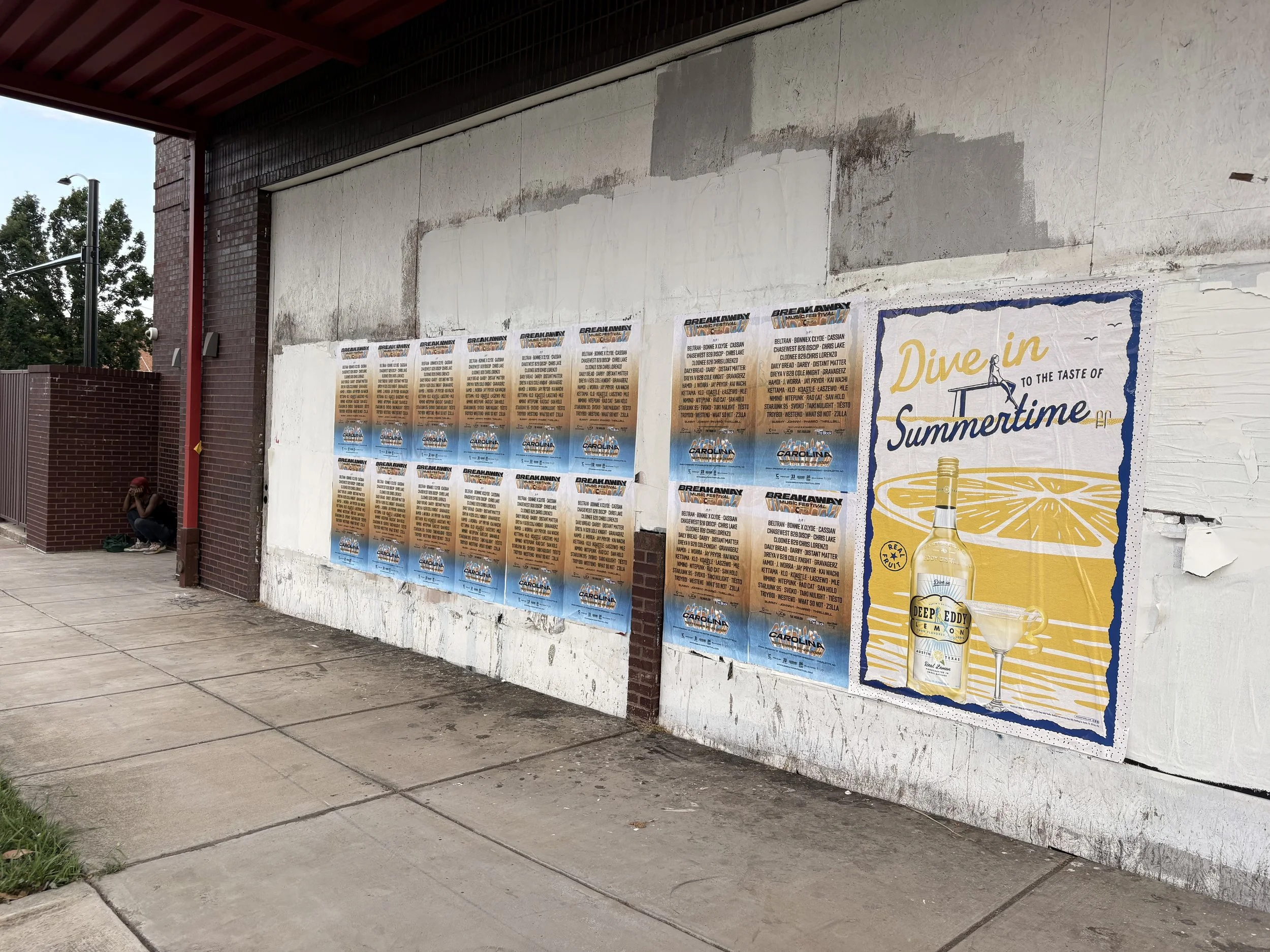
We put your brand right in front of the public with high-impact street poster campaigns that target the busiest blocks in the city
Wheat pasting has always carried a double meaning. It is an advertising method, an art form, a protest tool, and a public interruption all at once. That layered identity is exactly why it remains compelling and why it so often sparks debate.
A poster pasted to a wall does not wait for an invitation. It appears in the path of commuters, voters, tourists, activists, and city workers. When the message is political, ideological, or tied to a flashpoint issue, the medium becomes more than visual media. It becomes a claim on public attention.
That is the friction at the center of street postering: who gets to speak, where they get to speak, and who absorbs the cost of that speech.
Wheat pasting and political street messaging
Long before brands adopted paste as a way to cut through crowded media channels, posters on walls carried dissent, agitation, cultural critique, and movement-building. Political wheatpasting still works for the same reason it always has. It is fast, visible, local, and hard to ignore when placed well.
A feed-based message can be filtered out. A poster at eye level on a block with heavy foot traffic asks for a reaction right now. That directness gives wheatpasting unusual force during elections, protests, labor actions, issue campaigns, and moments of civic tension.
It also explains why the format can feel controversial even before anyone reads the copy. The act of placing a poster in the street suggests urgency. It signals that the message belongs in shared space, not only in paid media or sanctioned venues.
In that sense, controversy is not a side effect. It is often built into the logic of the medium.
Why wheat paste posters trigger controversy in the street
The public response to wheatpasting usually has less to do with paper and paste than with competing ideas about space. One group sees a living street and a democratic surface. Another sees vandalism, clutter, or unauthorized occupation. Both reactions can be sincere.
That tension gets sharper when political content enters the picture. A fashion drop may irritate a property owner. A poster about policing, war, housing, immigration, or elections can draw praise, anger, reporting, removal, and media coverage in the same afternoon.
Several factors tend to drive the backlash:
visibility at street level
unauthorized placement
use of public-facing surfaces
perceived defacement
partisan or activist messaging
rapid spread across multiple blocks
The result is a medium that can generate real cultural presence while also inviting legal exposure and reputational risk.
City rules on wheatpasting and illegal postings
Many cities make a clear distinction between permitted postering and illegal posting on public structures. That line matters more than many first-time advertisers assume.
Official guidance in Toronto is a useful example. The city’s Graffiti Management Plan combines enforcement against illegal graffiti with support for street art in approved areas. For postering, Toronto directs people toward permitted City kiosks and message boards rather than traffic poles, transit shelters, and other public structures. The city also allows a graffiti art or mural exemption process when work has property-owner permission and meets city requirements.
New York takes a similarly practical approach. NYC311 allows residents to report illegal postings, including flyers, decals, stickers, and posters, when they appear on public or City-owned property. If those postings are accessible, the sanitation department removes them. If a responsible party can be identified, a violation may follow. Transit spaces can be even more restrictive. New York regulations cited by Cornell’s Legal Information Institute prohibit posting signs, posters, notices, or advertisements on authority facilities or conveyances without permission of the authority.
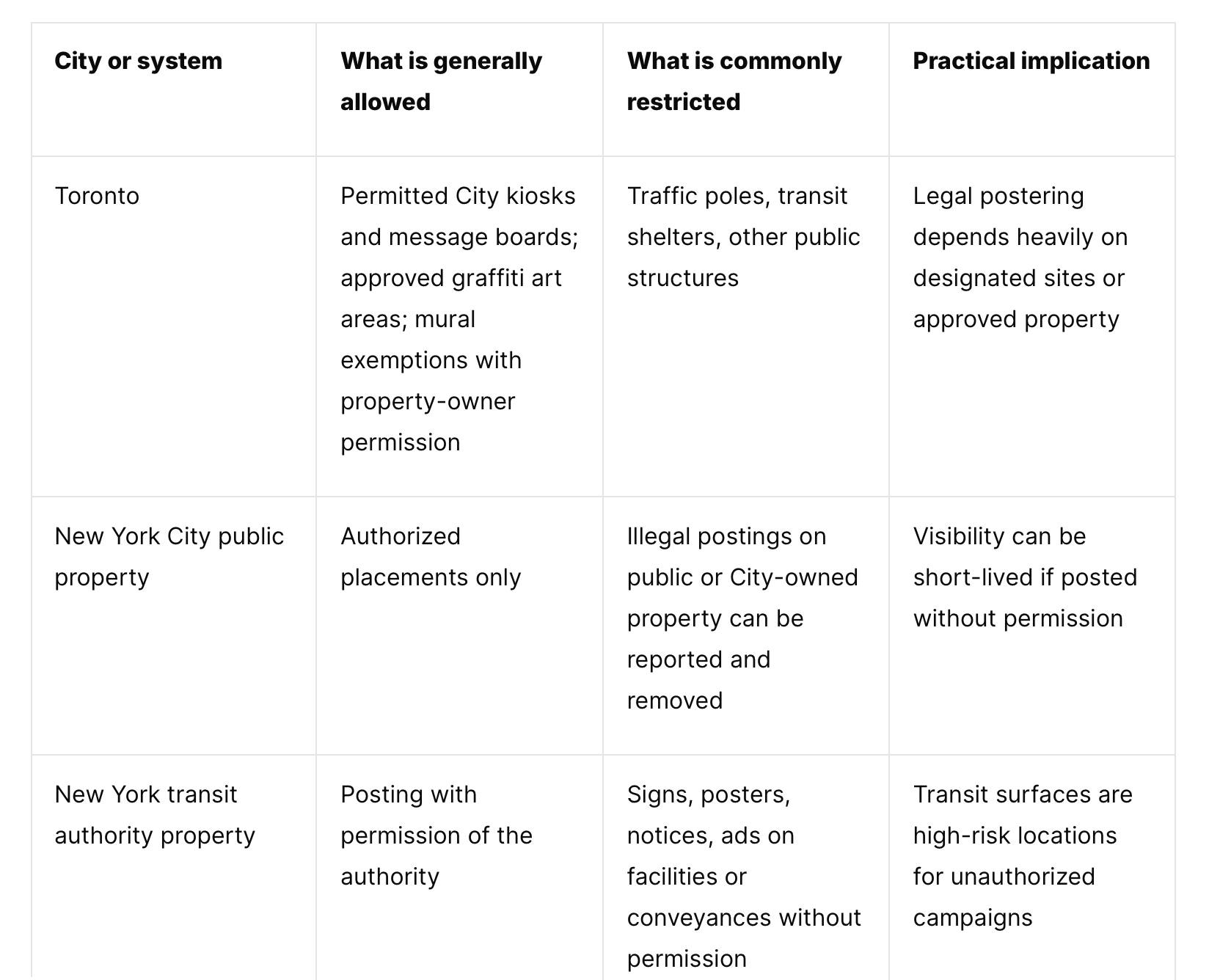
Wildposting regulations comparison table by side walk tattoos
This is one reason wheatpasting remains both attractive and unstable. The same visibility that makes it powerful also puts it in the path of enforcement.
Property-owner permission and the legal gray area
Not every campaign fits neatly into a clean legal category. Some cities have formal approved spaces. Others have tolerated zones, inconsistent enforcement, or local customs that create a gray area between what is technically restricted and what is commonly seen on the street.
That gray area is familiar to operators who work across markets. Sidewalk Tattoos has described Washington, D.C. as a city where wheat pasting operates in that kind of in-between space, with careful wall selection used to maximize exposure while minimizing risk. That framing is useful because it avoids a common mistake: assuming that because posters are visible across a city, every placement is accepted or protected.
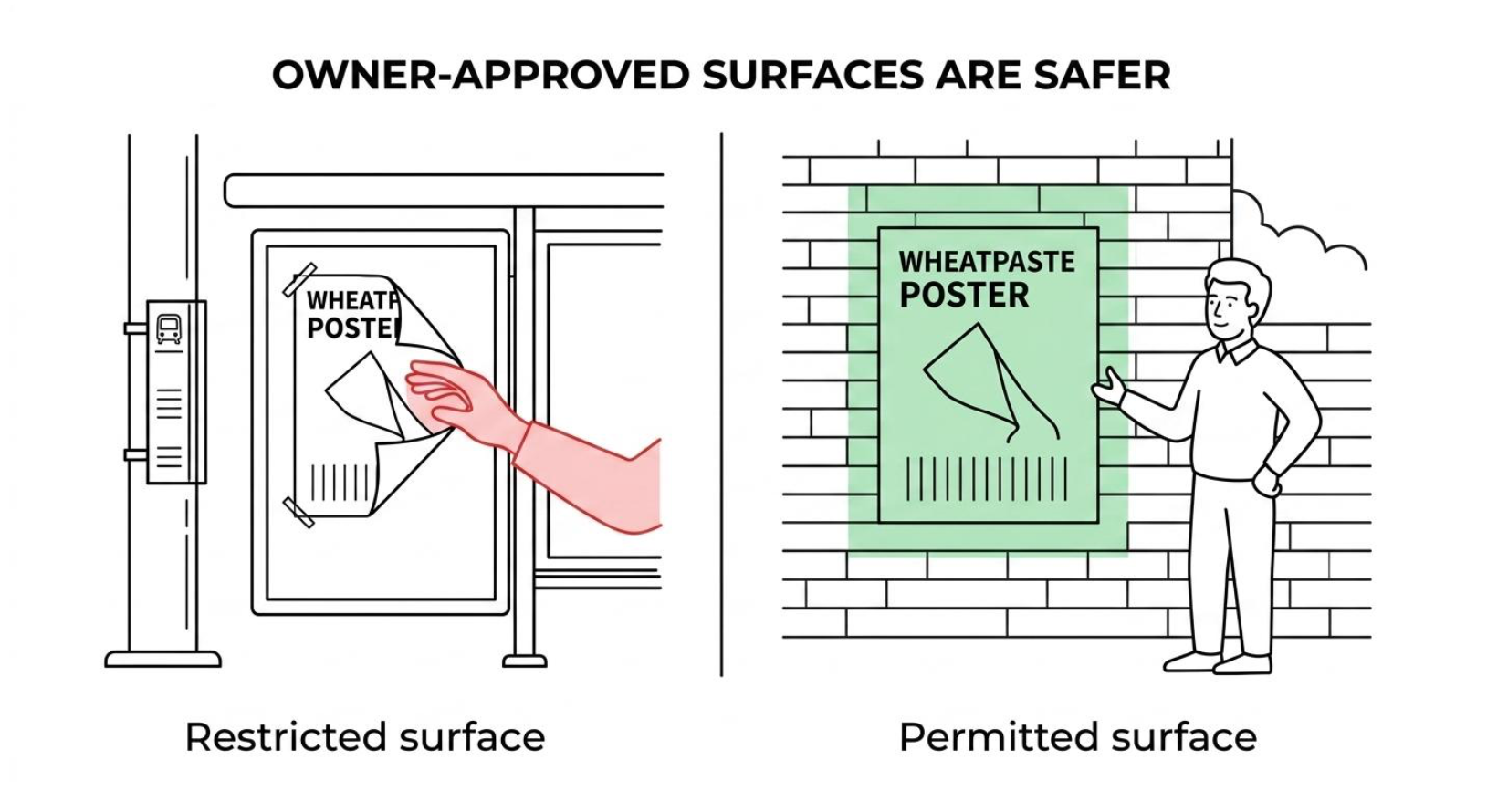
Permitted vs restricted wildposting locations by sidewalk tattoos
The strongest campaigns usually start with a sober read of the surface, the owner, the neighborhood, and the likely response.
Public property: Commonly subject to removal, reporting, and municipal enforcement.
Private property with owner permission: Far more defensible, especially when the owner has clearly approved the installation.
Transit infrastructure: Often subject to stricter rules than nearby commercial walls.
Political content: More likely to trigger complaints even when the placement itself is temporary.
High-profile districts: More valuable for reach, but often watched more closely.
The phrase “gray area” should never be treated as a strategy by itself. It is a condition, not a shield.
Street authenticity versus civic order
Part of the cultural force of wheatpasting comes from its refusal to feel overly polished. A poster wall can look alive, layered, and current in a way that paid digital inventory rarely does. That quality matters to brands trying to enter culture rather than merely buy impressions.
Still, cities are not blank canvases. They have maintenance budgets, public safety concerns, sign ordinances, transit rules, and pressure from residents who do not want every available surface turned into a free-for-all. Civic order is not a trivial argument, even when street work carries genuine artistic or political value.
This is why debates around wheat-pasting often go nowhere when framed too simply. “It’s art” does not resolve property rights. “It’s illegal” does not resolve the public’s appetite for unsanctioned cultural expression. The street has always held both ideas at once
That complexity is also why wheatpasting keeps returning. The medium sits exactly where commerce, dissent, aesthetics, and urban control meet.
Brands, politics, and the risk of backlash
For brands, controversy around wheatpasting is not limited to municipal rules. There is also the question of meaning. A street poster campaign can look culturally fluent, but audiences are quick to notice when a commercial message borrows the visual language of protest without earning it.
That risk rises when campaigns imitate activist design, use politically loaded neighborhoods as backdrops, or position products next to community grievances. The street is a context-rich environment. Placement changes interpretation.
A few recurring issues deserve careful review before launch:
Message fit: Does the creative belong in a street setting, or is it forcing urgency it has not earned?
Neighborhood context: What local tensions, events, or sensitivities could alter the reading of the poster?
Attribution: Is the sponsor clearly identifiable, or does the campaign invite confusion about who is speaking?
Removal reality: How will the campaign perform if pieces are torn down within hours?
Documentation: Is there a plan to verify installations quickly and accurately?
This is where operational discipline matters. Sidewalk Tattoos notes that campaigns are documented with high-resolution photos and video, often delivered quickly after installation, and that maintenance runs can refresh key pieces during the campaign. Those practices are not just reporting tools. They are part of responsible campaign management in a medium with short lifespans and uneven durability.
In Washington, D.C., the company has also noted that wheatpaste runs often last one to two weeks depending on weather and placement. That kind of realism is healthy. Wheatpasting is powerful partly because it is temporary. Anyone treating it like permanent outdoor inventory is likely to misjudge both risk and value.
How temporary materials shape the debate
The temporary nature of wheatpaste changes how many people judge it. Some see that impermanence as a mitigating factor. Paper posters weather, tear, get covered, and disappear. They are not the same as permanent paint or structural signage.
That distinction can help, but it does not erase the core questions around permission and placement. Temporary does not always mean permitted. Eco-friendly materials do not automatically make a posting lawful on a restricted surface. Still, the temporary character of wheatpasting is one reason it remains useful for launches, events, political moments, and short-cycle cultural releases.
It is also one reason the medium can feel honest. The poster knows it may not last. It competes in real time.
Better wheat pasting practices for sensitive campaigns
The controversial side of wheatpasting does not mean the format should be avoided. It means it should be handled with more care, sharper judgment, and better planning.
Campaign teams that respect both the street and the legal environment tend to make stronger choices. They think about owner permission, map placements carefully, document installs fast, and avoid turning “edgy” into careless.
Good practice usually includes:
clear property review
local rule checks
documented permissions where possible
mapped placements
fast post-install reporting
maintenance expectations tied to campaign goals
For political, activist-adjacent, or socially charged work, the standard should be even higher. The format may be raw, but the planning should not be.
A poster on a wall can still do what few other media formats can do: create immediacy, cultural texture, and a sense that the message belongs to the city’s present tense. That is why wheatpasting remains relevant. Not because it is risk-free, and not because controversy is always desirable, but because the street is still one of the few places where media can feel lived-in, contested, and fully awake.
Reach out for more information :
929.678.0235
