
Why Wheat pasting Is the Go To of Street Marketing
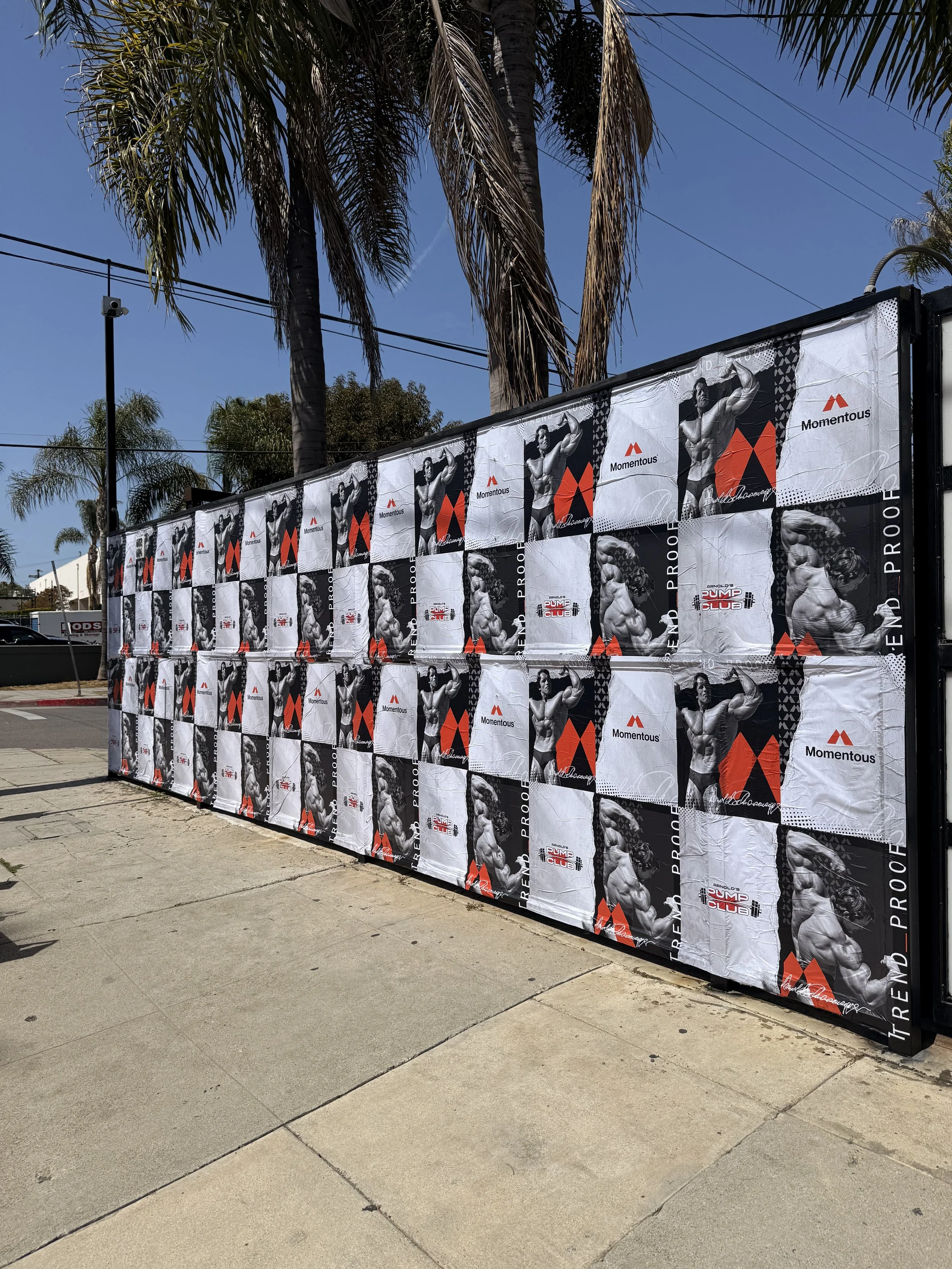
Outdoor wildposting advertisement installation for Arnold's Pump Club and Momentous on an urban street wall, showcasing a repeating checkerboard poster grid pattern
Street marketing keeps changing, yet one format continues to hold its ground: wheat pasting.
There is a simple reason for that staying power. Wheatpasting puts a message where city life is already happening, at eye level, on routes people actually walk, in neighborhoods where culture, commerce, nightlife, and attention meet. It turns walls, construction barriers, and other temporary surfaces into brand moments that feel immediate rather than inserted.
That combination of visibility, speed, and urban credibility is hard to match. While many media channels compete for fragmented attention, wheatpasting offers a physical presence that feels public, timely, and memorable.
Wheat pasting creates street-level visibility
Wheat pasting works because it is built for how cities function. People move through blocks, intersections, storefront corridors, transit paths, and entertainment districts in repeated patterns. A well-placed poster campaign meets that movement rather than interrupting it from a distance.
This matters because street marketing is not just about exposure. It is about exposure in context. A poster outside a venue, near a retail corridor, beside a nightlife strip, or along a commuter route lands differently than a message seen in a crowded feed. The city itself becomes part of the communication.
That street-level placement is one of the format’s biggest advantages. The Out of Home Advertising Association of America has long described pedestrian-facing formats as especially effective in high-density urban areas, near shopping, tourist, and downtown zones. Wheatpasting taps into the same principle, but with more flexibility and a more organic visual impact.
A campaign does not need a giant billboard footprint to dominate attention. It needs the right surfaces, the right density, and the right neighborhood logic.
Wheat pasting benefits from context and repetition in dense urban areas
A single poster can spark interest. A cluster of posters across a neighborhood creates recognition.
That is where wheatpasting becomes more than decoration. Repetition across a few blocks builds the feeling that a launch, event, artist, or brand is present in the city right now. It creates ambient momentum. People do not just notice one placement. They start seeing the campaign as part of the urban atmosphere.
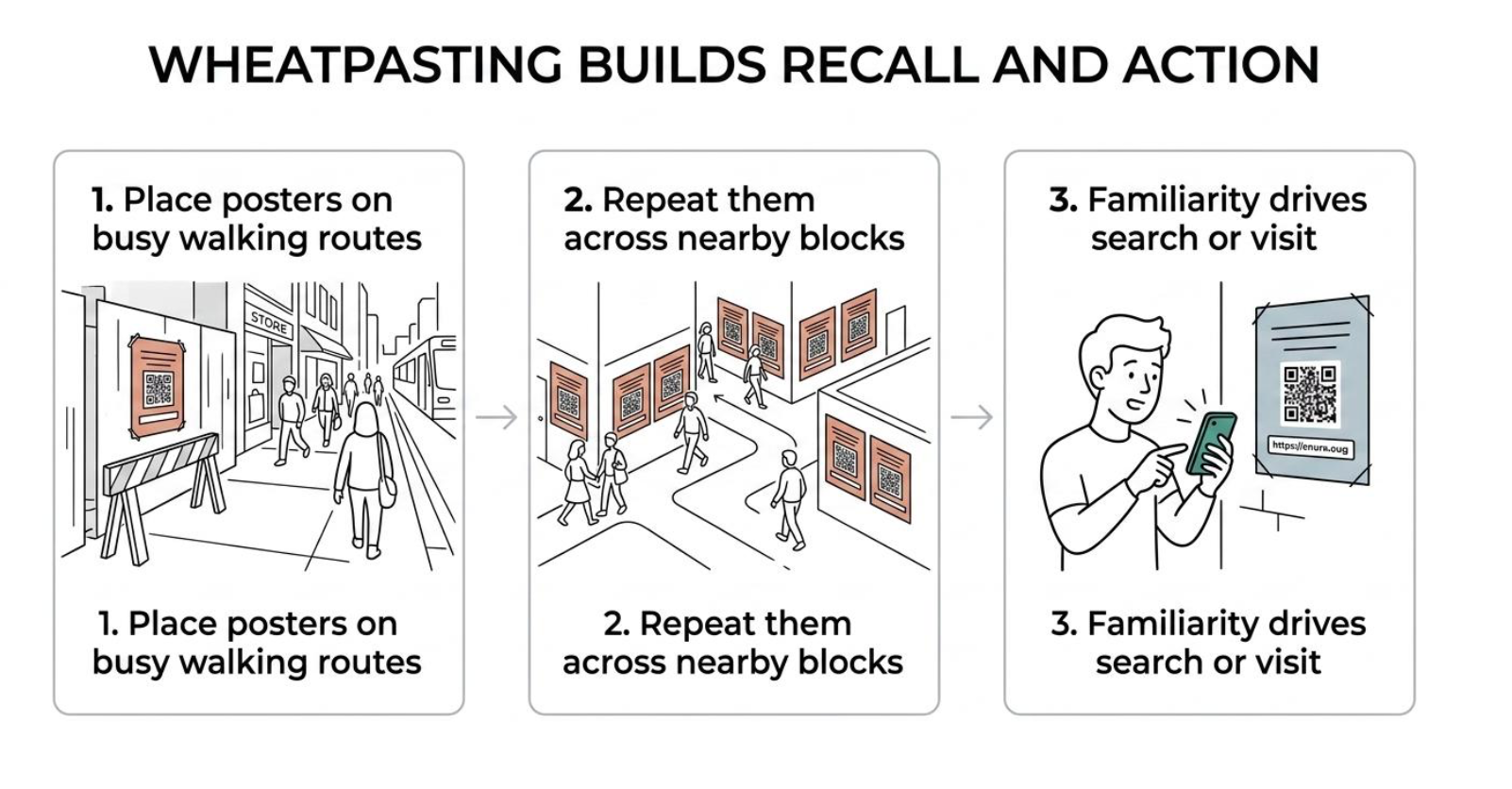
Install and prove placement by Sidewalk tattoos
This is especially effective in districts where foot traffic is steady and mixed. Residents, commuters, tourists, students, shoppers, and nightlife crowds all move through the same space, often multiple times in a week. A poster campaign gains strength from that repeated contact.
After a few sightings, the message starts to feel familiar, and familiarity is often what turns awareness into action.
Wheatpasting delivers strong ad recall and real consumer action
Street marketing is often praised for its energy, though its real value is not just aesthetic. It can drive memory and response.
According to OAAA reporting on U.S. advertising recall research, out-of-home advertising produced higher ad recall than live and streaming television, podcasts and radio, print, and online executions in the analysis it cited. Wheatpasting sits within that broader out-of-home logic, with the added benefit of street-culture relevance and neighborhood concentration.
Recall matters because remembered campaigns perform differently. They are more likely to be searched, shared, discussed, and acted on later. OAAA and Comscore also reported that out-of-home exposure was tied to measurable online behaviors, including search, website visits, app downloads, and online purchases.
That makes wheatpasting stronger than the old stereotype of “just awareness.” It can support the full path from recognition to curiosity to action, especially when the creative includes a clean URL, event date, product drop, QR code, or strong visual identity.
A few reasons that happens repeatedly in the field:
High pedestrian proximity
Repeated neighborhood exposure
Visual scale without screen clutter
Cultural credibility
Easy social sharing
Wheat pasting campaign sizes, poster formats, and city takeovers
One reason brands return to wheatpasting is that the format scales well. It can support a focused local push or a much larger citywide takeover without losing its character.
Agencies that specialize in this channel often use standard poster sizes that balance visibility and install efficiency. Sidewalk Tattoos, for example, notes common formats like 24x36 and 48x72 posters, placed in busy neighborhoods where street traffic is strongest. Smaller activations may use 50 to 100 posters, while larger takeovers can extend into the 300 to 600 range.
Those numbers matter because they show how wheatpasting behaves operationally. It is not a single wall stunt by default. It is a networked placement strategy.
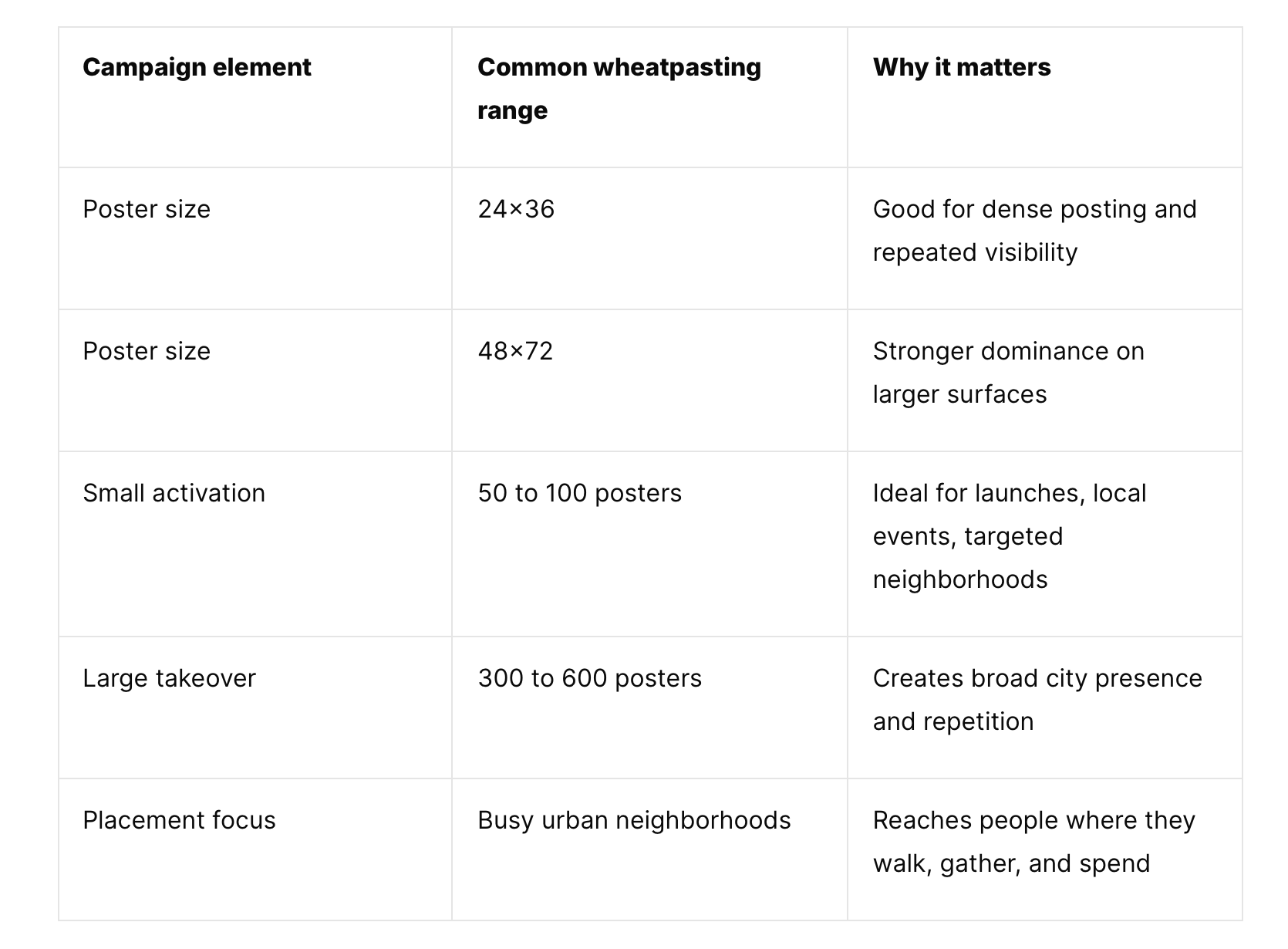
Common wheat pasting range and why it matters by Side walk tattoos
The smartest campaigns usually match scale to objective. A gallery opening, product pop-up, nightlife event, or neighborhood retail launch may benefit from concentrated coverage in a few high-energy districts. A national brand entering a major market may want larger saturation across multiple zones.
Wheatpasting remains culturally relevant for brands, artists, and events
Wheatpasting has history, and that history still matters.
Its roots in street culture give it an authority that many polished ad formats cannot replicate. In New York, the practice gained traction in the late 1970s and early 1980s as underground artists and musicians needed a fast, low-cost way to spread the word. Over time, it became part of the city’s visual language.
That legacy gives the format unusual elasticity. It can promote a fashion label, a festival, an album, a startup, a film release, a cause, or a neighborhood event without feeling out of place. The medium accepts both raw graphic energy and refined brand systems.
For marketers, that means wheatpasting can do two jobs at once. It can widen reach, and it can signal taste. The campaign does not just say “we are here.” It says “we belong in this conversation.”
This is one reason event promoters and artists keep choosing it, even as digital channels become more crowded. Ballonmand.dk has similarly pointed out that when a live activation is documented well before, during, and after an event, the physical moment keeps working across social and PR channels, which helps explain why street formats still matter in broader campaign ecosystems.
A city takeover still carries emotional weight. It suggests relevance, movement, and cultural timing.
Wheat pasting supports creative that is bold, direct, and fast to read
Great wheatpasting creative respects the pace of the street. People are walking, crossing, commuting, scanning, meeting friends, heading to work, or stepping out of a store. The message has to land in seconds.
That does not mean the work has to be simplistic. It means the hierarchy has to be sharp. Strong image, clear type, one central idea, and a reason to remember it. The best poster campaigns are disciplined enough to be understood at a glance and distinctive enough to reward a second look.
In practice, the most effective creative usually shares a few traits:
Visual priority: one dominant image or graphic move
Message economy: short copy with a single clear point
Brand recognition: logo, name, or product cue that reads quickly
Action path: URL, QR code, date, or social handle people can use later
Neighborhood fit: creative that feels natural in the districts where it appears
When those elements are in place, wheatpasting becomes more than decoration on a wall. It becomes a repeatable attention system.
Wheatpasting execution now combines speed, mapping, and documentation
Modern wheatpasting is not only about putting posters up quickly. The strongest campaigns combine field execution with planning and proof.
That means mapping neighborhoods before install, selecting surfaces based on traffic logic, spacing placements to build repetition, and documenting the campaign once live. For brands and agencies, that documentation matters. Photo reports and geo-tagged records turn an urban activation into something measurable and reviewable.
It also allows a more strategic conversation about performance. Was the campaign concentrated near nightlife corridors? Around venue clusters? Along shopping routes? Near campuses or launch-event locations? Wheat pasting works best when placement is treated as media planning, not random coverage.
Speed is part of the appeal as well. Specialized teams can often move from creative readiness to live installation in a short window, sometimes within 48 to 72 hours. That makes the format attractive for event promotion, last-minute drops, market tests, touring campaigns, and timed announcements.
A modern execution model often includes:
Strategic mapping: neighborhood selection based on traffic, culture, and timing
Installation at scale: concentrated posting across targeted blocks or districts
Documentation and reporting: photo proof and geo-tagged tracking
Material choices: eco-conscious posting methods where appropriate
That mix of agility and accountability is a big reason wheatpasting continues to win business from both emerging brands and established marketers.
Wheatpasting works especially well with other street marketing formats
Wheatpasting rarely has to work alone.
Some of the most effective campaigns combine posters with sidewalk stencil activations, custom installations, event flyering, or digital amplification. A poster sighting can build awareness; a stencil can create surprise near the point of gathering; a social post can extend reach after the street moment happens.
This kind of layering is valuable because each format does a slightly different job. Posters create presence across an area. Stencils can sharpen local impact around sidewalks and entry points. Documentation then gives the campaign a second life across brand channels.
For agencies like Sidewalk Tattoos, that integrated approach is part of the value. Wheat pasting plus stencil takeovers, street-level documentation, and multi-city deployment create a format that feels local in execution but scalable in planning.
The result is a street campaign that feels alive in the city and organized behind the scenes.
Wheatpasting fits a market that wants visibility without distance
A lot of advertising today is optimized for efficiency, targeting, and trackability. Those matter. Still, brands also need public presence. They need to be seen somewhere real, by real people, in shared space.
Wheatpasting answers that need with unusual clarity. It is visible without feeling remote. It is flexible without feeling disposable. It is rooted in urban culture without being limited to one audience type.
That is why it remains a go-to format for launches, fashion drops, cultural campaigns, ticketed events, artist promotion, startup awareness pushes, and city-by-city rollouts. It takes a wall and turns it into a signal. It takes a neighborhood and turns it into media.
And when the placement is thoughtful, the creative is disciplined, and the scale matches the objective, that signal can be hard to ignore.
Reach out for more information :
929.678.0235
