
How People React to Sidewalk Stencils in New York
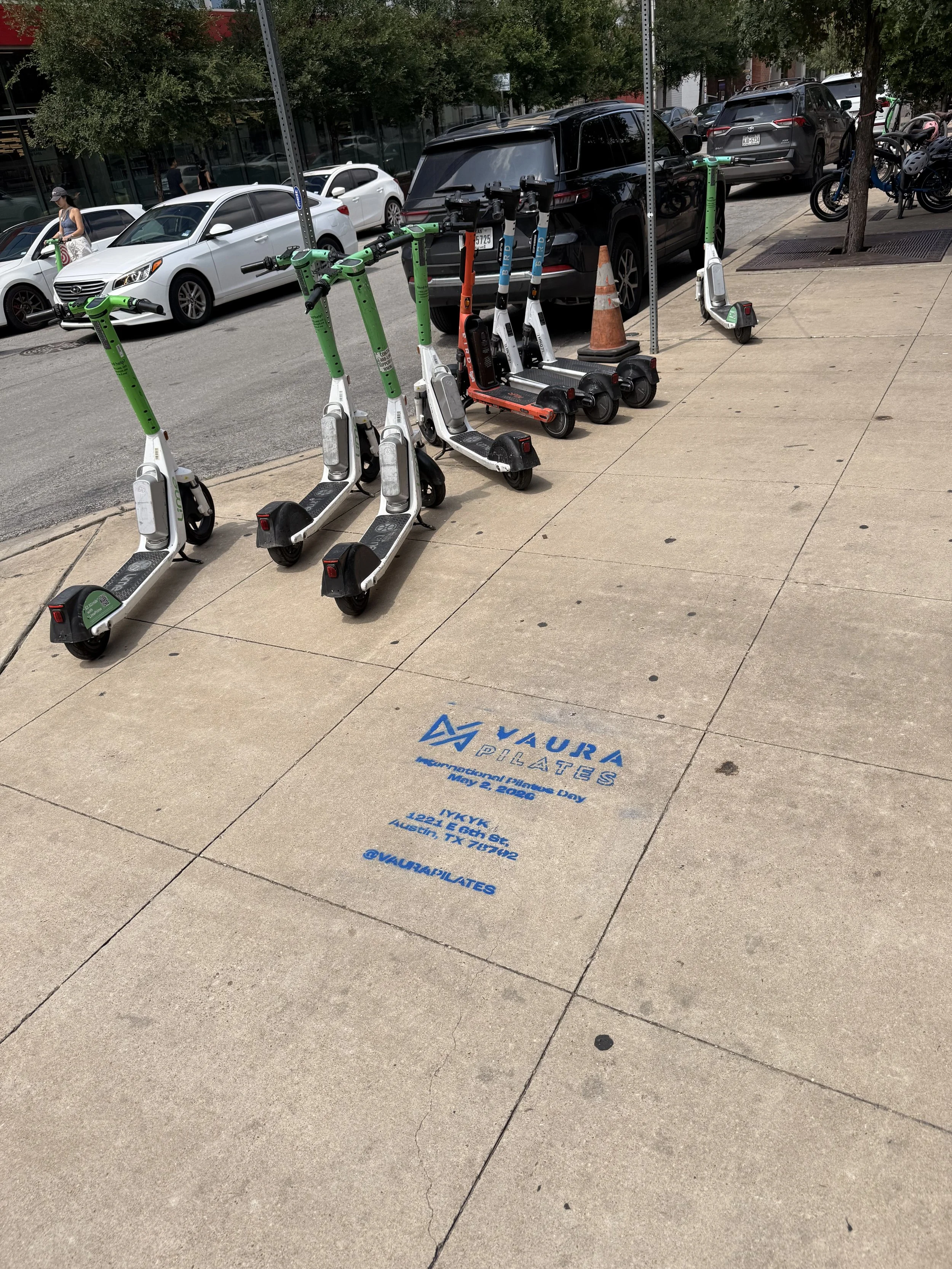
Clean sidewalk stencil placement on a busy Austin, Texas corridor for Vaura Pilates.
New York pedestrians are hard to impress, but they are still deeply responsive to what interrupts routine. That is why sidewalk stencils can be so effective. They do not wait at eye level for attention. They meet people mid-stride, inside the natural rhythm of walking, scanning, and deciding where to go next.
That simple shift matters. A sidewalk stencil asks for a downward glance in a city where most ads compete above the crowd. When the placement is smart and the message is short, the reaction can be immediate: a pause, a second look, a laugh, a photo, a text to a friend, or a change in direction.
Street-level campaigns in New York live or die on that first half-second.
Why Sidewalk Stencils Get Attention in New York
The sidewalk is one of the few places where nearly every pedestrian shares the same path. In Manhattan, Brooklyn, and busy commercial corridors across the boroughs, people move fast, but they also make constant micro-decisions. They watch for traffic, puddles, curbs, bikes, subway stairs, delivery carts, and crowds. A well-placed stencil sits inside that field of attention rather than outside it.
That helps explain why underfoot messaging can stop people more effectively than many assume. A stencil does not need a long read. It needs a sharp trigger. If the design is bold and the copy is lean, the message lands during a moment when the pedestrian is already checking the ground plane.
New York itself has shown that pavement messages can alter behavior. The city’s Department of Transportation rolled out its LOOK safety campaign at 110 intersections, then expanded it to nearly 200 intersections and more than 300 buses. The goal was safety, not advertising, but the lesson is still useful: people do respond to text placed on the walking surface when the placement matches the moment.
Common Pedestrian Reactions to Sidewalk Stencils in NYC
Most reactions fall into a small set of recognizable patterns. The first is interruption. Even a brief glance tells you the stencil broke through ambient noise. The second is evaluation. People decide almost instantly whether the mark feels relevant, intriguing, useful, playful, or ignorable. The third is amplification. If the message feels socially shareable, the phone comes out.
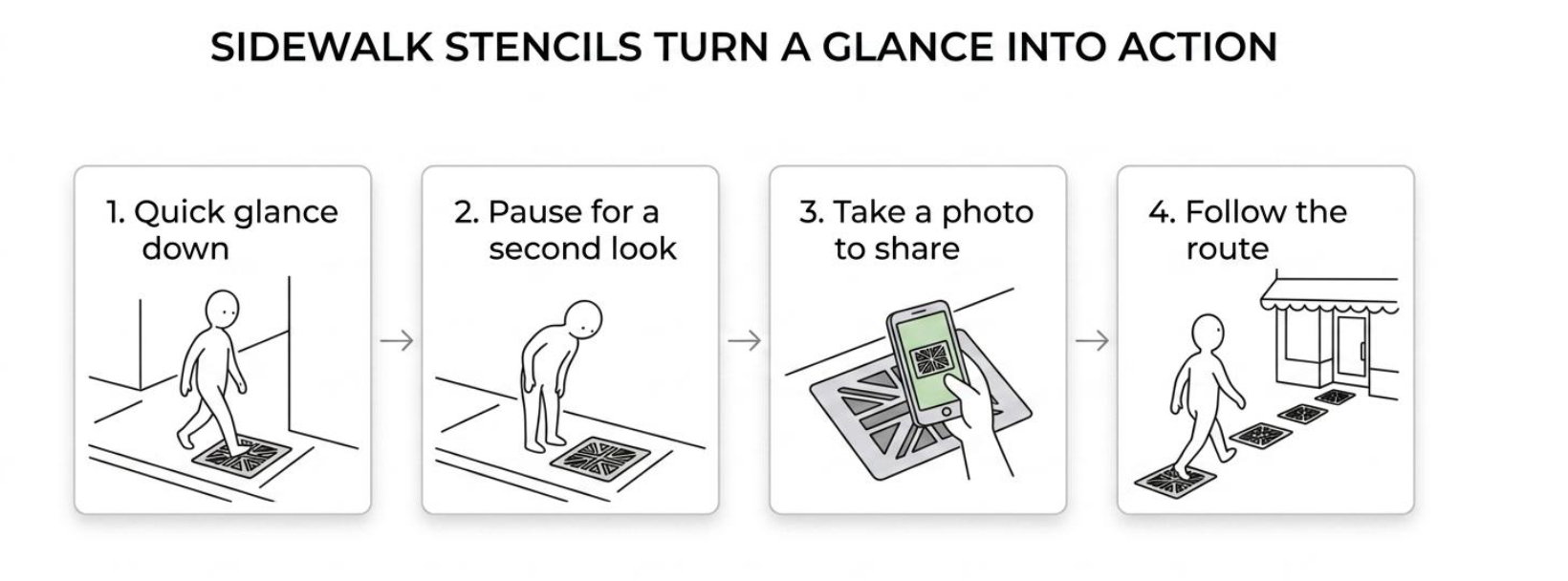
step-by-step process of a pedestrian noticing a street stencil, taking a photo, and following the path to a business
A recent Sidewalk Tattoos SoHo case example in SoHo points to that amplification effect. In a Yonex campaign, 100 sidewalk stencil hits paired with 600 jumbo posters created repeated exposure across the neighborhood. The reported response was not just awareness. Locals, shoppers, and tourists stopped to photograph the placements, which turned the campaign into organic social media content.
That is the reaction most brands want, but it is not the only meaningful one.
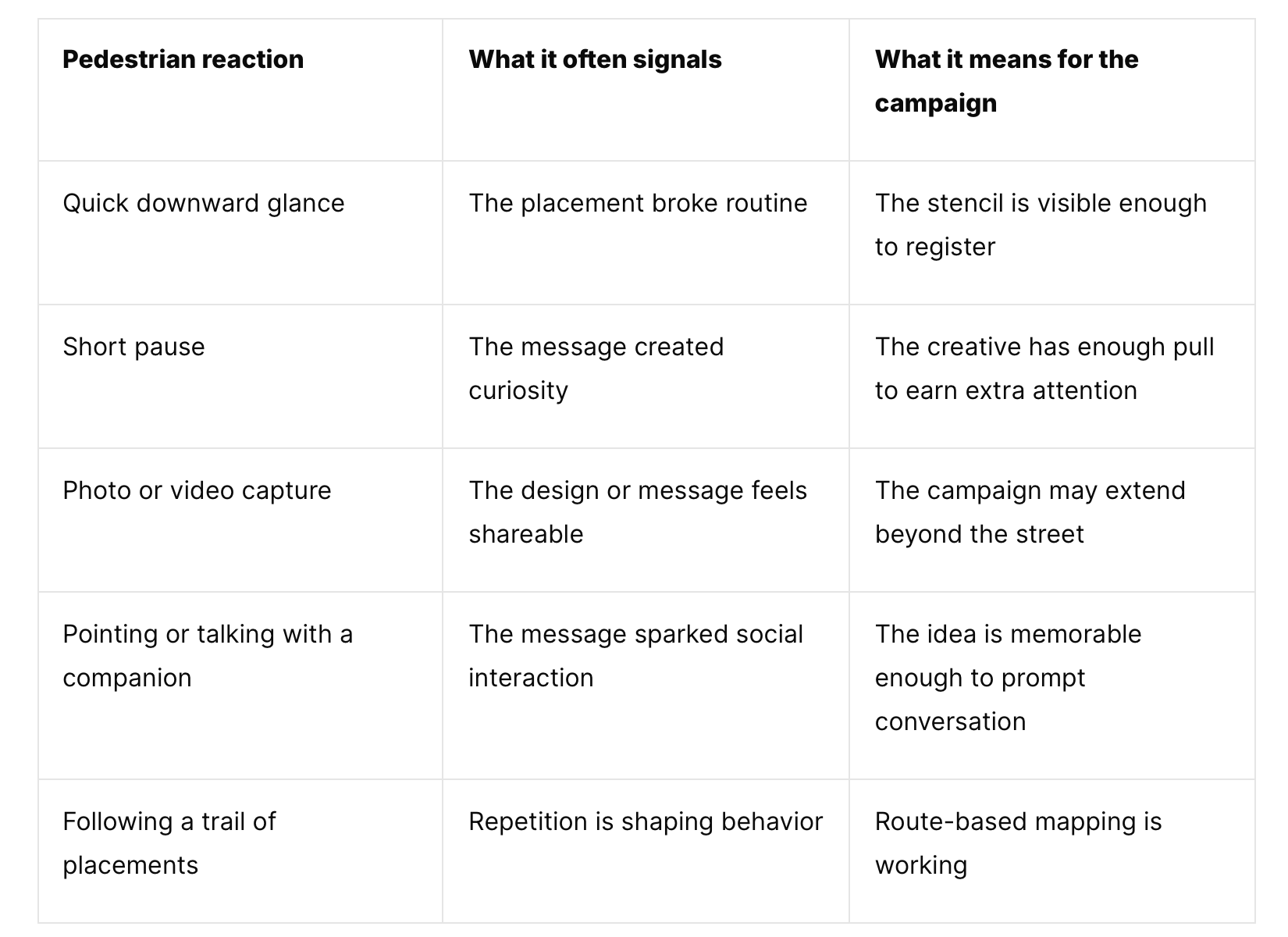
Pedestrian reaction marketing table by Side walk tattoos
In New York, that shareable moment is especially valuable because it combines public visibility with private endorsement. A person who photographs a stencil is not just noticing it. They are choosing to carry it into their own network.
A fast city still makes room for curiosity.
What Drives Strong Sidewalk Stencil Response
Reaction is rarely random. It tends to come from a tight match between placement, message, and context. A stencil outside a venue, near a launch, along a retail corridor, or on the approach to an event can feel like part of the street’s energy rather than an interruption with no purpose.
When campaigns work, a few ingredients usually show up together:
clear typography
short copy
high contrast
route repetition
proximity to a destination
The creative also needs discipline. If the message asks too much, most pedestrians will pass. If it says too little, the glance may not convert into memory. The sweet spot is usually a compact idea with a direct cue: a brand name, a date, a location, or a line that invites a closer look.
Pairing stencils with wheat-pasted posters often strengthens response because the same message appears at two different visual heights. The poster handles distance and scale. The stencil handles immediacy. Together, they can turn a block into a sequence rather than a single hit.
Why Neighborhood Context Changes Sidewalk Stencil Reactions
A stencil in SoHo does not behave the same way as a stencil near a concert venue in Brooklyn or a nightlife corridor on the Lower East Side. New York pedestrians are not one audience. They are many audiences moving through different moods.
In shopping zones, reactions often include browsing behavior. People slow down, compare visual cues, and are more open to novelty. In commuter-heavy corridors, the bar is higher. The message must be grasped almost instantly. Near events, launches, and pop-ups, pedestrians are already primed for signals about where to go and what is happening.
Tourist density changes things too. Visitors are often more likely to photograph street visuals because the city itself feels document-worthy. Locals may be more selective, but they can still respond strongly when the stencil feels culturally tuned in rather than generic.
Weather, foot traffic, and time of day all matter, but repetition remains the constant. A single stencil can spark curiosity. A mapped sequence across a neighborhood can create anticipation.
New York Sidewalk Rules for Stencil Advertising
Attention is valuable in New York, and public space is tightly regulated. That reality shapes every serious conversation about sidewalk stencils.
City guidance makes clear that sidewalks, curbs, and roadways are city-owned. New York City Department of Transportation materials define defacement to include painting, printing, writing, or attaching an advertisement or printed material to the sidewalk, curb, or roadway. The same materials state that if defacement is not corrected after 30 days, DOT may issue a civil penalty of $250.
There are also rules around sidewalk obstructions. New York City Department of Sanitation guidance says businesses are responsible for keeping public sidewalks outside their buildings free from obstructions, including advertising signs. It also notes special restrictions on zero sidewalk display streets.
That means brands should treat compliance as part of strategy, not an afterthought.
Property status: Public sidewalks are city property, not open canvases for permanent brand marks.
Defacement risk: Painted or printed advertising on sidewalks may be treated as prohibited marking.
Obstruction rules: Sidewalk displays and signs face separate limits tied to pedestrian clearance.
Campaign planning:Street activations work best when legal review and production planning happen together.
This does not reduce the value of street-level marketing. It sharpens it. The strongest operators think about location, materials, timing, and documentation from the start. Temporary methods, mapped execution, and disciplined installation standards are part of doing the work responsibly.
What Official NYC Programs Reveal About Pavement Messages
New York’s own public-space programs show a useful contrast. The city is not indifferent to visual interventions in shared space. It simply distinguishes between sanctioned public use and unsanctioned advertising.
Take City Canvas, administered through the Department of Cultural Affairs. The program allows temporary visual art on eligible construction fences and sidewalk sheds to improve the pedestrian experience. That matters because New York reports more than 300 miles of these temporary protective structures across neighborhoods. The city even made the program permanent through Local Law 163, effective September 1, 2023.
The lesson is clear: the city sees visual culture in public space as worthwhile when it is structured, temporary, and publicly beneficial.
That same logic applies to why street marketers need to be precise. Sidewalk messages can be attention-getting and culturally resonant while still requiring strict care around where and how they appear.
What Adjacent OOH Research Says About Attention and Memory
Street reactions are visible, but memory is the deeper prize. A glance is useful. Recall is better.
Recent out-of-home research from JCDecaux New Zealand suggests that format has a major effect on memory encoding and emotional intensity. In that study, premium large-format placements performed above an effectiveness benchmark for memory encoding, while other formats showed different emotional profiles. The broad takeaway is not that every out-of-home impression works equally well. Many do not. The format, environment, and creative all shape whether the exposure sticks.
That is a healthy reminder for stencil campaigns. Attention at foot level is powerful, but it is not automatic brand recognition. A stencil that earns a second look without a clear brand cue may become a memorable street moment without becoming a memorable brand moment.
This is where combined media can be especially effective. When sidewalk stencils are supported by posters, installations, or other repeated street placements, recognition tends to improve because the message appears in multiple forms across the same walk path.
Measuring Sidewalk Stencil Impact Beyond Impressions
The easiest mistake is to treat a stencil campaign as successful just because it appeared in a busy area. Foot traffic alone does not tell you how people reacted.
Better measurement starts with behavior at the site. Did pedestrians glance and keep moving, or did they stop? Did they take photos? Did they follow the campaign toward a store, event, or popup? Did the same message show up in social posts from the neighborhood? These are more useful signals than raw exposure estimates by themselves.
A disciplined reporting model often focuses on a short list of reaction markers:
Pause rate: How often pedestrians visibly break stride near the stencil
Phone lift behavior: Whether people pull out a phone to capture or inspect the message
Route continuation: Whether repeated placements guide people toward the target destination
Context fit: How well the stencil performs relative to the block, audience, and time of day
Creative recall: Whether people can connect the message back to the brand later
This is one reason mapped street campaigns remain attractive to brands, agencies, event promoters, and artists. With the right field documentation, they can do more than claim presence. They can show how a neighborhood responded.
In New York, that matters. The city gives you very little passive attention. If a sidewalk stencil earns a pause, a conversation, or a photo, it has already done something rare.
And if it does that while respecting the rules of the streetscape, it becomes more than a clever placement. It becomes a disciplined form of ground-level media with real human response at its center.
Reach out for more information :
929.678.0235
