
How Guerrilla Marketing Gives Your Brand Real Energy
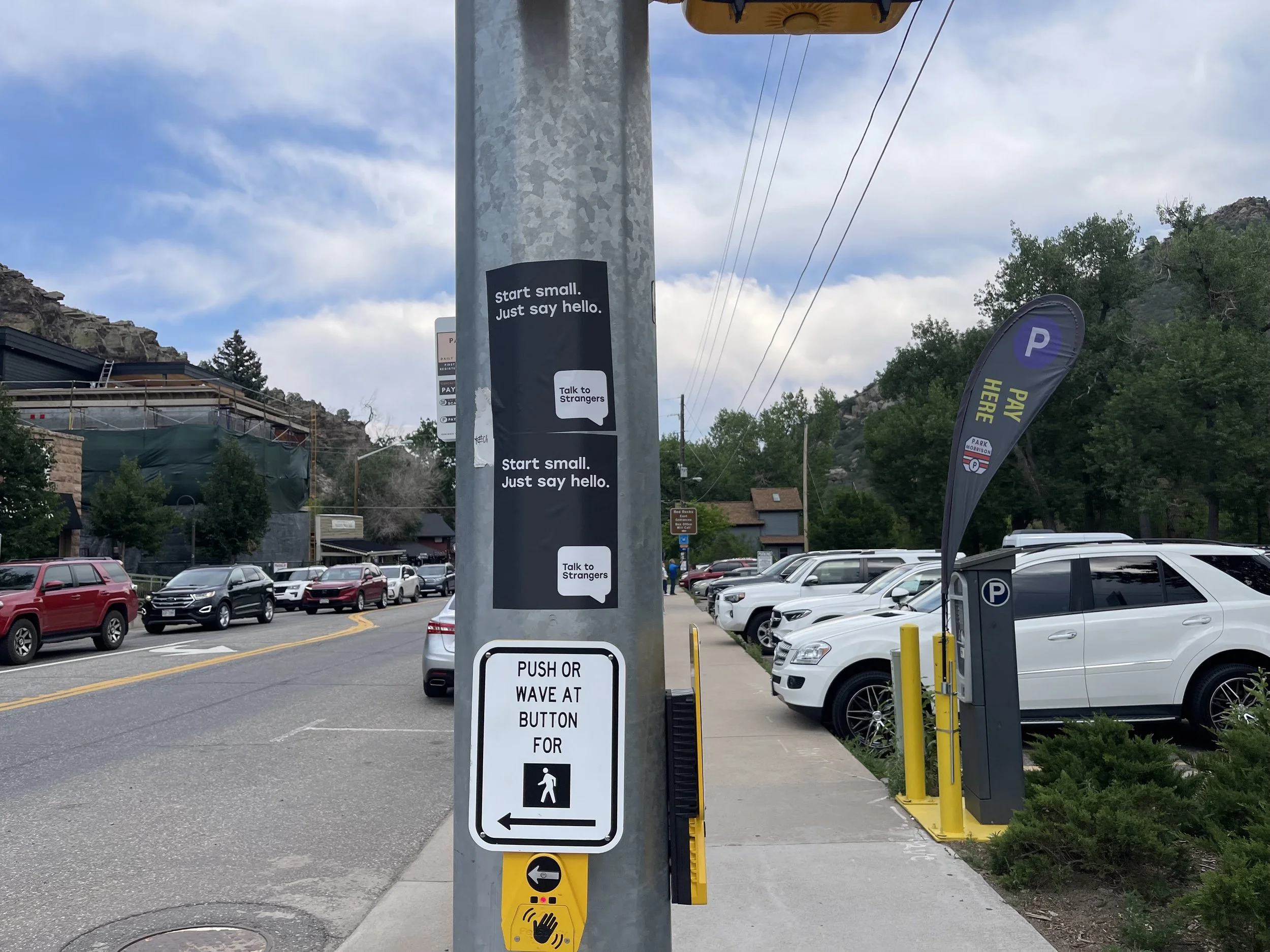
Guerrilla marketing sticker & urban street-level brand activation on a public pole
Guerrilla marketing gives a brand something that polished screens often cannot: presence you can feel.
When a message shows up on a wall, underfoot on a sidewalk, or across a run of high-traffic blocks, it enters daily life instead of waiting to be scrolled past. That shift changes the emotional temperature of a campaign. People do not just see it. They run into it on the way to work, on the way to dinner, outside a venue, near a shop, next to the crowd that already reflects the brand’s audience.
That is where real brand energy starts.
Why guerrilla marketing creates brand energy in public space
A strong street-level campaign feels active because it meets people in motion. It shows up where attention is naturally divided, where repetition happens block by block, and where a brand can become part of the visual rhythm of a neighborhood. A postered corridor or a stencil path does more than announce a message. It makes the brand look current, culturally present, and willing to occupy space with confidence.
That confidence matters. Audiences read media choices as signals. A brand that appears in the street can feel bolder than one that stays only in paid social or standard display. Street placements suggest momentum. They suggest urgency. They suggest that something is happening right now.
Quote by sidewalk tattoo client
This is one reason street activations often creates buzz far beyond the footprint of the actual placement.
After a brand shows up in public space, people tend to extend the campaign themselves through photos, conversation, social posts, and word of mouth. The city becomes both media channel and amplifier.
A few things make that energy feel immediate:
Physical presence
Repetition on real routes
Cultural relevance by neighborhood
Visual surprise
Shareable street texture
Out-of-home research behind guerrilla marketing performance
The case for street activations is no longer based on atmosphere alone. Out-of-home data points increasingly support the idea that public-facing media can drive action, recall, and commerce outcomes.
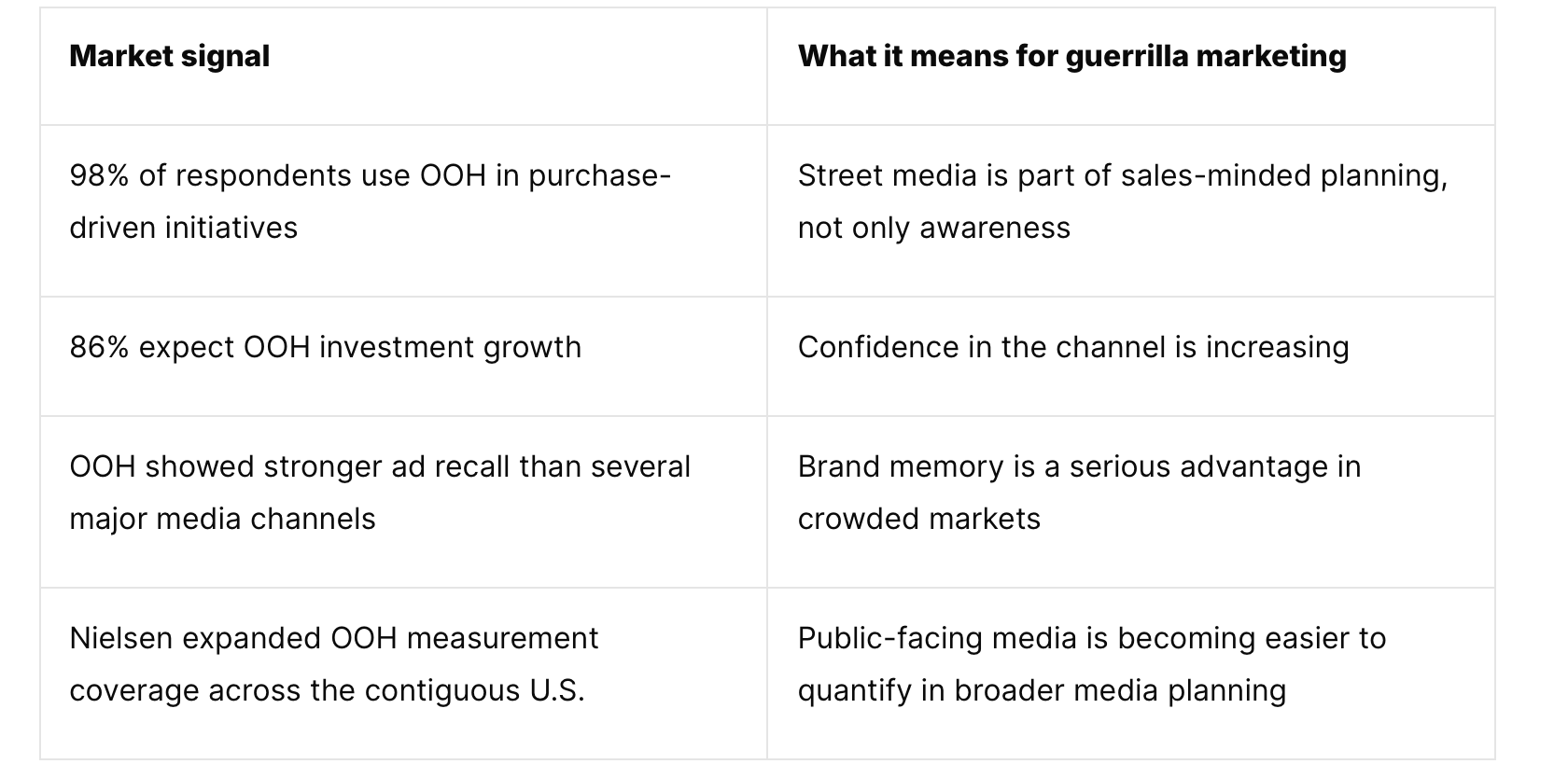
A March 2026 OAAA and Winterberry Group study reported that 98% of respondents incorporate out-of-home into purchase-driven initiatives. That is a striking number because it places OOH inside performance thinking, not just awareness planning. The same study found 86% expect their out-of-home investment to rise over the next two years, with 37% projecting growth of 15% or more.
Those figures reflect a wider shift in how marketers view street presence. Public media is being treated as a channel that helps move people, not just impress them.
Another OAAA analysis, published in 2023 using studies from 2017 through 2022, reported that out-of-home advertising produced significantly higher consumer ad recall than live TV, streaming TV, podcasts, radio, print, and online executions. That detail matters for guerrilla campaigns because recall is one of the clearest signs of brand energy. If people remember the work, talk about it later, and recognize it again on the next block, the campaign is doing more than filling space.
Nielsen’s measurement expansion adds another useful signal. In February 2025, Nielsen said its out-of-home measurement covered 100% of the contiguous U.S. TV population, allowing reach and frequency metrics to include OOH in national TV measurement intervals. For brands that want street work to sit closer to measured media, that change strengthens the business case.
OOH marketing data table by side walk tattoos
Street-level guerrilla marketing formats that spark attention
Not every street activation creates the same kind of energy. Some formats dominate a block visually. Others reward close attention. The most effective choice depends on the audience, the location, and the speed of the campaign.
Guerrilla marketing custom installs by sidewalk tattoos
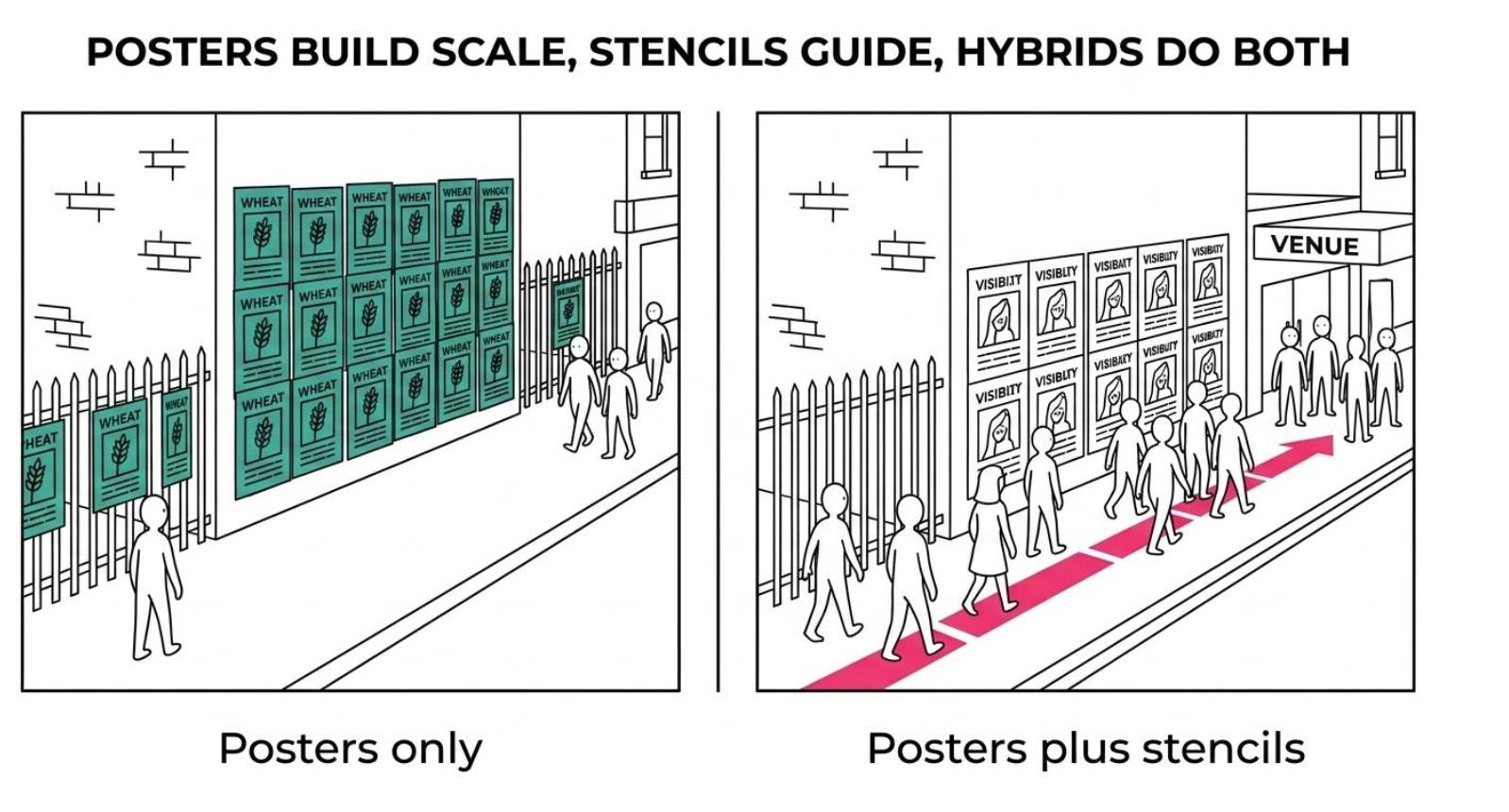
Wheat pasting is one of the strongest options for visual saturation. A single poster can be compelling, but a mapped series of posters across strategic routes creates a much bigger effect. Repeated sightings matter. They turn a message into a pattern, and patterns feel important. When commuters, shoppers, concertgoers, or nightlife crowds keep seeing the same creative, the brand begins to look larger than the media buy itself.
Sidewalk stencils work differently. They sit lower in the field of vision, closer to the body and the pace of walking. That gives them a surprising intimacy. A stencil can point traffic toward a venue, build anticipation for a drop, or create a playful interruption on a familiar route. It feels less like a distant ad and more like the city is briefly speaking in the brand’s voice.
A combined takeover often creates the strongest overall effect.
When posters handle scale and stencils handle immediacy, the campaign can feel layered instead of repetitive. One format establishes the brand visually. The other catches people mid-step and turns passing attention into active notice.
After choosing the format, the campaign goal usually becomes clearer:
Wheat pasting: best for visual dominance across key corridors and repeated exposure over several blocks
Sidewalk stencils: ideal for event traffic, launch countdowns, and directional street messaging
Hybrid installs: effective when a brand wants both scale and tactile street presence
Fast guerrilla marketing execution for launches and cultural moments
Brand energy drops when timing is off. Street campaigns work best when they appear close to the moment that matters: a launch, tour date, collection drop, product release, premiere, or city-specific event. A great concept loses force if it lands a week late.
That is why speed is one of the most valuable parts of a guerrilla marketing operation. Quick printing, field coordination, compliance review, route mapping, and installation all shape whether a campaign feels urgent or stale. The street rewards immediacy.
Published material from Sidewalk Tattoos describes a True Religion wheat-paste campaign installed in Houston within 24 hours of receiving final artwork, with an 18-city U.S. rollout coordinated city by city through local print partners, installation teams, and compliance teams. That kind of pace shows what brands increasingly expect from street-level execution: not just creativity, but readiness.
Fast deployment changes the strategic value of the medium. It allows brands to react to culture instead of planning only months ahead. It also gives agencies and in-house teams more room to support moments that are earned, emerging, or time-sensitive.
A campaign can feel alive because it is alive to the moment.
Guerrilla marketing measurement for recall, action, and commerce
Some marketers still treat guerrilla work as hard to measure, yet the street is becoming easier to document and track with discipline. The key is to define success before installation starts.
Street-level campaigns can be mapped block by block. Placements can be documented with photos and geo tags. Timing can be verified. Routes can be chosen based on neighborhoods, venues, traffic patterns, and relevance to the audience. When those elements are planned carefully, the campaign becomes easier to assess in a way that goes beyond vague “buzz.”
Measurement should also reflect what the street does best. Guerrilla marketing often drives a cluster of outcomes instead of one isolated metric. A brand may see stronger recall, an increase in branded search, a jump in social mentions, more event attendance, or increased site traffic from a city where the activation ran. Street work often operates as a catalyst.
The smartest read of performance combines physical proof with digital response.
Useful indicators usually include:
Recall: the campaign sticks in memory after a commute, errand run, or night out
Search lift: more branded queries or product searches after the activation window
Photo documentation: geo-tagged proof of placement, density, and timing
Commerce signals: store visits, landing-page traffic, code redemption, or ticket movement
This is where guerrilla marketing starts to look less like a side tactic and more like a serious media layer. It can support awareness, yes, but it can also contribute to connected commerce behavior when it is built around the right routes, timing, and creative message.
Best brand scenarios for guerrilla marketing campaigns
Guerrilla marketing is especially effective when a brand needs more than exposure. It works when the objective is to feel present, talked about, and culturally in motion.
That makes it a strong fit for fashion labels, artists, event promoters, tech launches, entertainment campaigns, startups entering a city, and established brands that want a sharper street edge. It also performs well when the target audience is concentrated in a few neighborhoods, venue districts, shopping corridors, or nightlife areas.
The strongest scenarios often share the same traits:
A message that can land quickly
A visual identity with street impact
A launch window that rewards speed
A city or neighborhood that already reflects the audience
Brands also get more from guerrilla work when they resist the urge to overcomplicate the creative. In the street, clarity wins. One strong image. One pointed line. One release date. One call to action. Public space moves fast, and the best campaigns respect that pace without losing personality.
There is also a deeper brand effect that matters. Street activations signal conviction. They show a willingness to step into shared space and be seen without the safety of a skip button. That can make a brand feel more confident, more current, and more culturally fluent than media that stays locked inside screens.
When people say a brand has energy, this is often what they mean: it shows up where life is actually happening.
