
Wheatpasting vs Billboards: Why the Street Beats the Sky
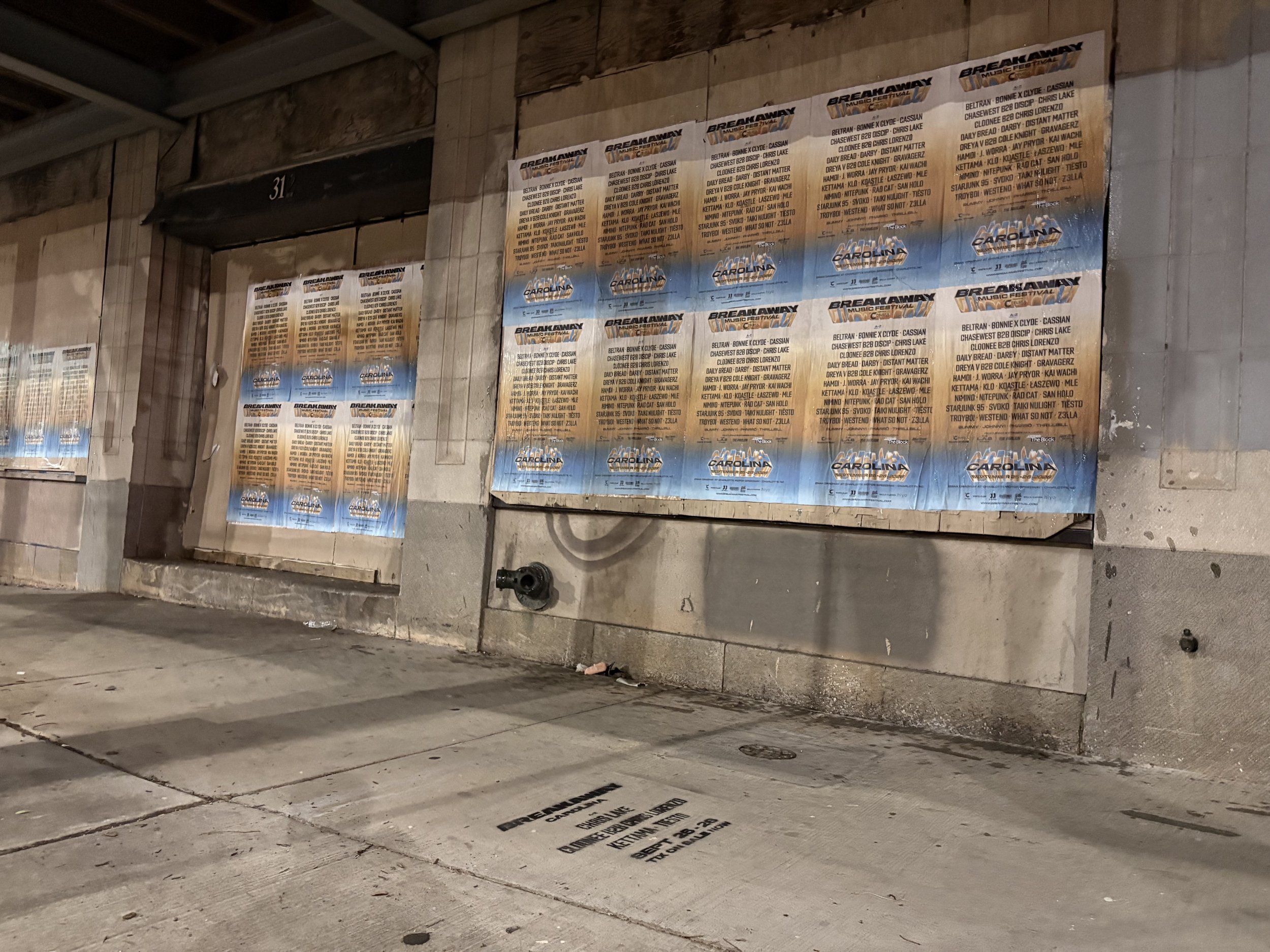
Guerrilla marketing wheatpasting campaign for Breakaway Music Festival Carolina
When marketers compare out-of-home options, the conversation often starts with scale. Billboards sit high, cover major traffic corridors, and deliver familiar brand presence. Wheatpasting works differently. It turns walls, corridors, retail blocks, and nightlife districts into a dense network of repeated visual encounters at eye level.
That difference matters more than it first appears.
If the choice is one billboard or 100 wheatpaste posters, the better answer for many launches is not the biggest format. It is the format that puts a message where people actually walk, wait, shop, film content, and make decisions. Billboards remain powerful for broad OOH reach. Yet for cost efficiency, neighborhood saturation, speed, and real-world impact, wheatpasting often gives brands a stronger return.
Wheatpasting vs Billboards on Visibility and Attention
A billboard can dominate a skyline or highway approach. That kind of visibility still has value. OOH industry data continues to show strong audience attention. OAAA has cited that 91% of U.S. residents age 16 or older who traveled in a vehicle in the past month noticed some form of OOH, and 82% of billboard viewers make a point to look at the advertising message at least some of the time.
Those numbers confirm that billboards are not fading into the background.
Still, noticing an ad and feeling surrounded by a campaign are two different experiences. Wheatpasting creates what billboards usually cannot: local media density. Instead of one high-positioned unit, brands can place a coordinated run of posters across a neighborhood. The result is repetition that feels immediate. Someone sees a poster outside a subway exit, another on the next block, a third near a coffee shop, and a fourth beside the venue or store itself.
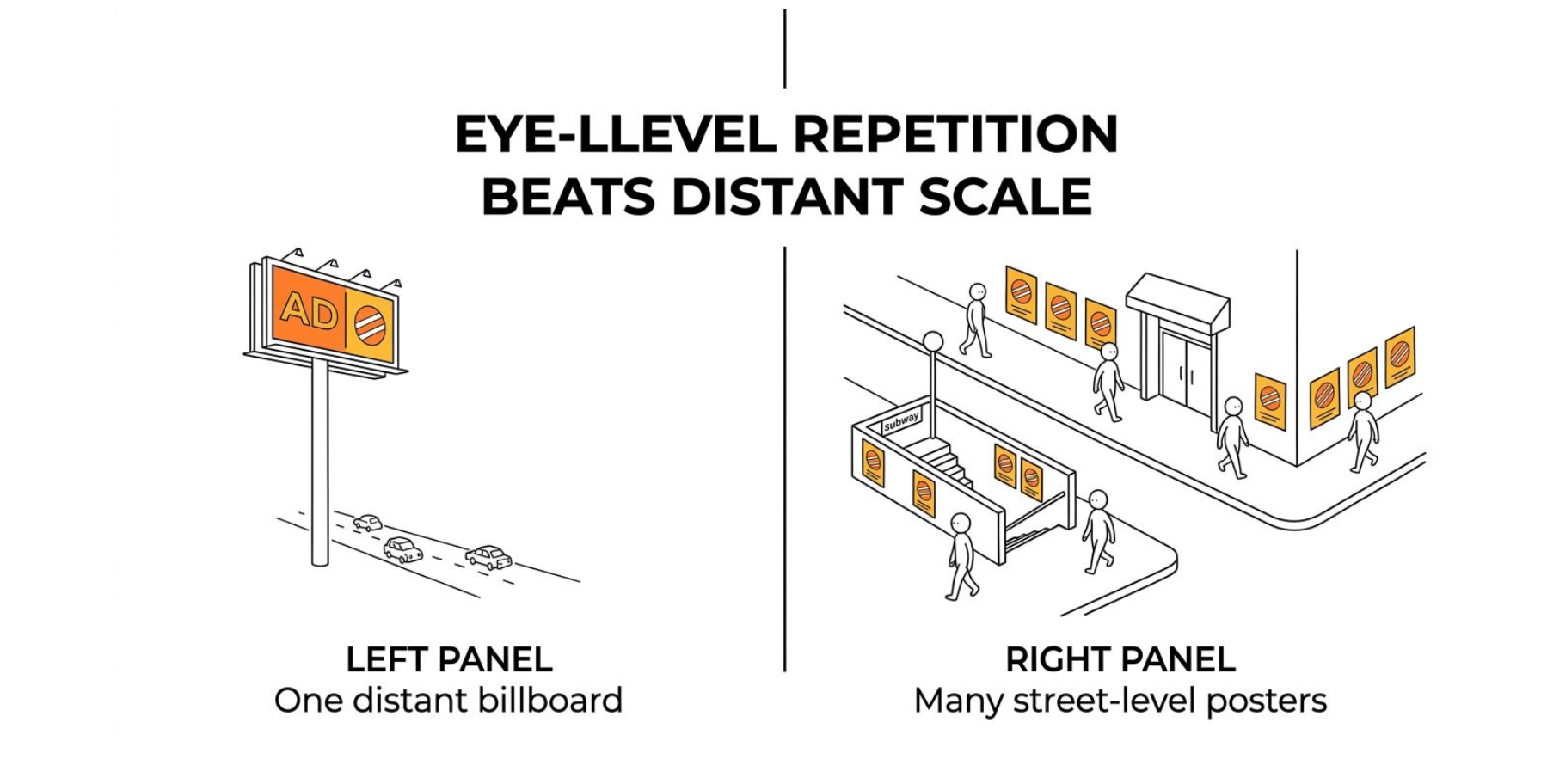
poster vs billboard illustration by sidewalk tattos
That is where street-level print advertising starts to outperform sky-high media. It meets people in the spaces where culture moves.
A strong wheatpaste rollout often concentrates exposure in high-footfall decision zones like these:
Transit exits
Retail corridors
Event perimeters
Campus areas
Nightlife streets
Why Wheatpasting Wins on Cost Efficiency and Media Density
The most direct argument for wheatpasting is simple: one billboard usually buys one location, while a wheatpaste budget can buy many moments of contact.
That changes the economics of attention. A single billboard may generate a large impression count, especially on a major road. Yet the audience relationship is thin. The message is seen once, maybe twice, from a distance and often while moving. A wheatpaste campaign can spread the same budget across dozens or hundreds of placements, turning a neighborhood into a repeated brand encounter rather than a single glimpse.
For brands launching a product, promoting a pop-up, supporting a tour, or driving store traffic, that density is often more useful than sheer height. The campaign feels bigger because it appears everywhere the target audience is already spending time.
That is where street-level print advertising starts to outperform sky-high media. It meets people in the spaces where culture moves.
A strong wheatpaste rollout often concentrates exposure in high-footfall decision zones like these:
Transit exits
Retail corridors
Event perimeters
Campus areas
Nightlife streets
Why Wheatpasting Wins on Cost Efficiency and Media Density
The most direct argument for wheatpasting is simple: one billboard usually buys one location, while a wheatpaste budget can buy many moments of contact.
That changes the economics of attention. A single billboard may generate a large impression count, especially on a major road. Yet the audience relationship is thin. The message is seen once, maybe twice, from a distance and often while moving. A wheatpaste campaign can spread the same budget across dozens or hundreds of placements, turning a neighborhood into a repeated brand encounter rather than a single glimpse.
For brands launching a product, promoting a pop-up, supporting a tour, or driving store traffic, that density is often more useful than sheer height. The campaign feels bigger because it appears everywhere the target audience is already spending time.
Fast Activation Timelines Make Wheatpasting a Stronger Campaign Tool
Speed changes campaign strategy.
Traditional billboard campaigns often depend on inventory availability, booking cycles, printing schedules, and installation windows. That can work well for long-planned awareness efforts. It is less ideal when a brand needs to move around a launch date, a pop-up, a drop, a surprise artist release, or a short promotional window.
Wheatpasting is built for faster deployment. A documented campaign rollout by this agency installed a True Religion in Houstonwithin 24 hours of receiving final artwork, with a broader 18-city rollout executed on the same rapid timeline using local print partners, mapped locations, and compliance checks. That kind of pace is difficult to match with conventional large-format buys.
Fast activation gives marketers room to act with confidence instead of over-planning every moment weeks in advance.
Street campaigns are especially useful when timing is tight:
Product drops: Match limited release windows and short hype cycles.
Event promotion: Build city visibility just before doors open.
Retail openings: Push awareness around the store when foot traffic matters most.
Culture moments: Respond quickly to trends, tours, festivals, and collaborations.
Localized Reach Makes Wheatpasting More Relevant Than a Billboard
Billboards are excellent at broad reach. Nielsen expanded OOH measurement to cover 100% of the contiguous U.S. television population in 2025, a sign of how mature and measurable traditional OOH has become. That matters for national brands and large media plans built around reach and frequency.
Yet many campaigns do not need the whole market. They need the right few blocks.
This is where wheatpasting becomes more than a media buy. It becomes placement strategy. Instead of aiming at everyone passing a freeway, brands can saturate the streets around a flagship store, music venue, fashion district, college campus, or nightlife hub. That kind of localized precision is hard to replicate with classic billboard inventory, especially in dense urban cores where the street itself is the audience environment.
A recent Soho activation illustrates the model well. The campaign used 100 sidewalk stencil hits and 600 jumbo 48x72 posters placed around busy intersections, subway exits, and shopping streets. That mix matters. Posters create scale and wall presence, while stencils extended the message onto the pedestrian path. The street became a coordinated media surface rather than a single rented panel.
The effect is both practical and cultural. People do not just pass the work. They photograph it, share it, mention it, and fold it into the visual language of the neighborhood.
Wheatpasting Builds Repetition That Can Drive Action
OOH research has become increasingly action-oriented, not just awareness-oriented. The 2026 OAAA and Kochava study, based on device-level data across hundreds of campaigns, reported that OOH drove measurable in-person outcomes like store visits as well as digital actions like website visits and app downloads. It also reported a 5.3x conversion rate increase from 1 to 10 ad exposures.
That finding supports an idea street marketers have understood for years: repetition matters.
A billboard can contribute to repeated exposure over time, especially on a commute route. Wheatpasting can create repeated exposure within a much tighter physical zone. In a walkable district, seeing five posters in twenty minutes can have more immediate behavioral force than seeing the same billboard once a day from a car.
This is especially valuable when the call to action is nearby. Visit the pop-up. Scan the QR code. Show up tonight. Walk two blocks and enter the store.
Wheatpasting Measurement and Documentation for Modern OOH Campaigns
One historical advantage of billboard media has been standardization. It sits inside a mature buying ecosystem, with recognized audience models, reach and frequency metrics, and broad reporting structures. That is a genuine strength, especially for enterprise media planning.
Wheatpasting answers measurement differently. It is less about panel-level audience estimates and more about verified execution in the exact streets and zones that matter. For many marketers, that is not a weakness. It is operational clarity.
A strong street campaign can be tracked and reported through practical field documentation:
Geo-tagged photo logs
Mapped installation routes
Placement counts by format
Time-stamped proof of posting
Neighborhood coverage summaries
That reporting style is highly useful when a campaign is tied to retail, experiential, PR, or event marketing. The brand can see where the work went, how broadly the neighborhood was covered, and how the visual system came together on the ground.
Sidewalk Stencils Make Wheatpasting Even Stronger
Wheatpasting is already effective on its own. It becomes even more powerful when paired with sidewalk stencils.
Posters create scale and wall presence. Stencils pull the campaign onto the pedestrian path itself. This combination increases contact points without needing a larger traditional media buy. A person might see the stencil first, then the poster at the next corner, then another poster near the venue. The message accumulates.
That is one reason integrated street takeovers often outperform isolated placements. The same principle appears in experiential marketing, where Midtvest Festudlejning argues that multi-sensory cues at messer function as stronger blikfang than a single standalone element, reinforcing why layered street formats tend to feel bigger than any one unit on its own.
The campaign does not feel like a lone ad. It feels like a city moment.
When Billboards Still Belong in the Media Mix
Billboards still make sense when the brief demands broad market reach, prestige positioning, long-duration presence, or corridor-based commuter exposure. They are also a strong fit when a national brand wants standardized OOH reporting across many markets.
A smart street-first argument does not require pretending billboards are ineffective. They are effective. The question is whether they are the best strategic use of budget for the objective at hand.
If a brand is launching in a specific neighborhood, trying to own the conversation around a pop-up, building excitement for an event, or chasing social spillover from a visually striking campaign, wheatpasting usually offers a better fit. It is faster, more concentrated, and closer to the audience.
In many cases, the strongest answer is a layered one: billboard reach for macro awareness, wheatpasting and stencils for local dominance.
Choosing Wheatpasting for Real-World Impact
Street-level media works because it behaves like the city behaves. It is distributed, fast-moving, social, repeated, and grounded in place. People do not experience neighborhoods from 40 feet in the air. They experience them at eye level, block by block.
That is why wheatpasting so often outperforms a billboard when brands need energy, proximity, and visible saturation rather than distant scale. A single board can announce a campaign. A hundred posters can make it feel unavoidable.
For marketers who want cost-efficient OOH, quick deployment, neighborhood precision, and a format that people actually stop to photograph, the street remains one of the most compelling media environments available.
