
Wheatpasting in San Francisco vs LA
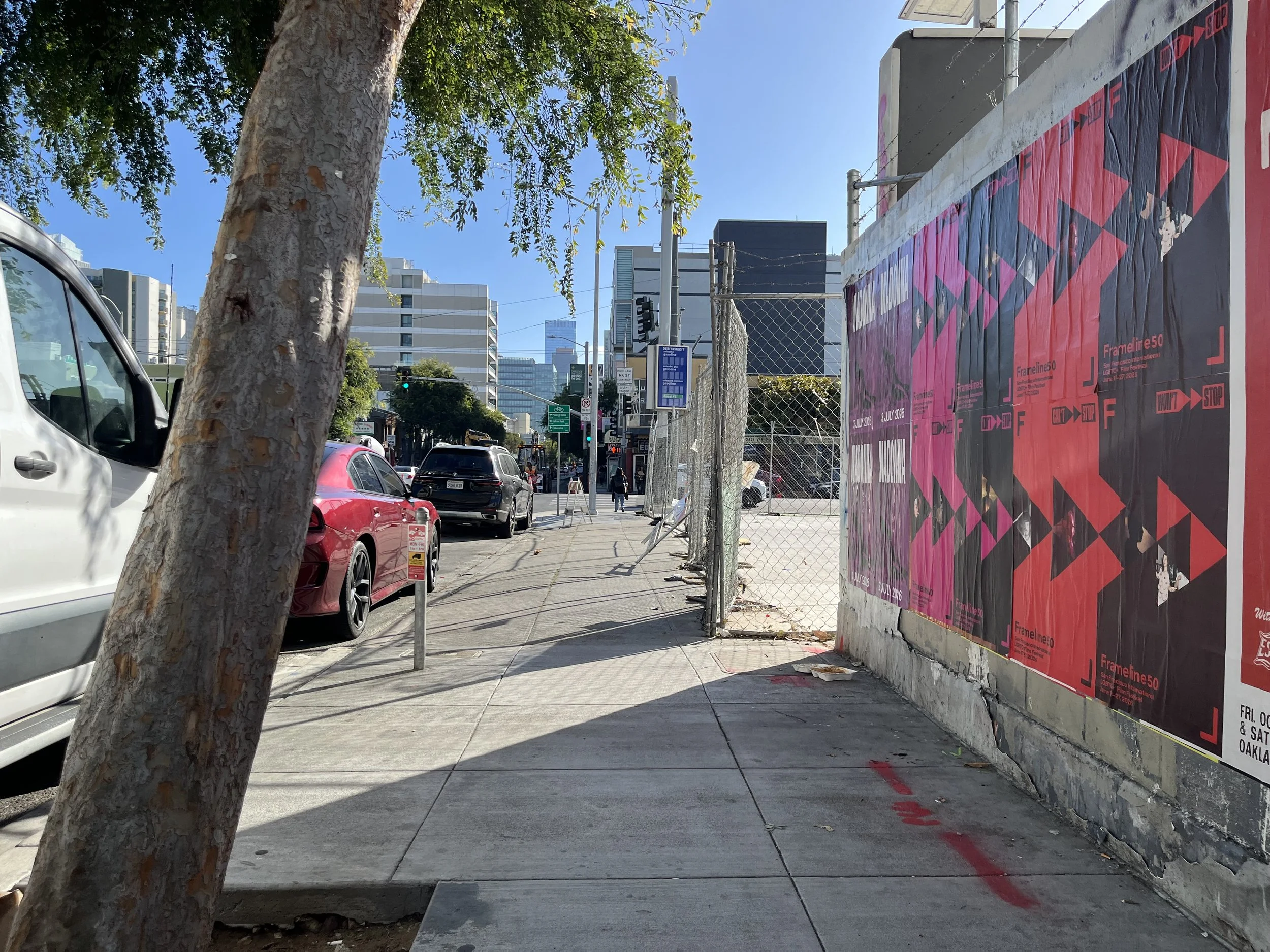
A sunlit city sidewalk runs alongside a wall plastered showcasing the vibrant street-level advertising
Choosing between San Francisco and Los Angeles for a wheatpaste campaign is not just a question of audience size. It is a question of street form, moisture, traffic patterns, enforcement risk, and how fast a message needs to travel.
One city is compact, layered, and highly walkable. The other is broad, fast-moving, and neighborhood-driven. Both can produce strong street-level visibility, yet they reward different tactics.
For brands, artists, event promoters, and agencies, that difference matters from the first route map to the final photo report.
San Francisco vs Los Angeles wheatpasting at a glance
San Francisco tends to compress attention. Foot traffic is dense, corridors are tighter, and a smaller footprint can still create a feeling of saturation in the right districts. Los Angeles works differently. Reach often comes from stitching together multiple neighborhoods that each have their own tone, pace, and audience mix.
The result is simple: San Francisco often delivers concentration, while Los Angeles often delivers spread.
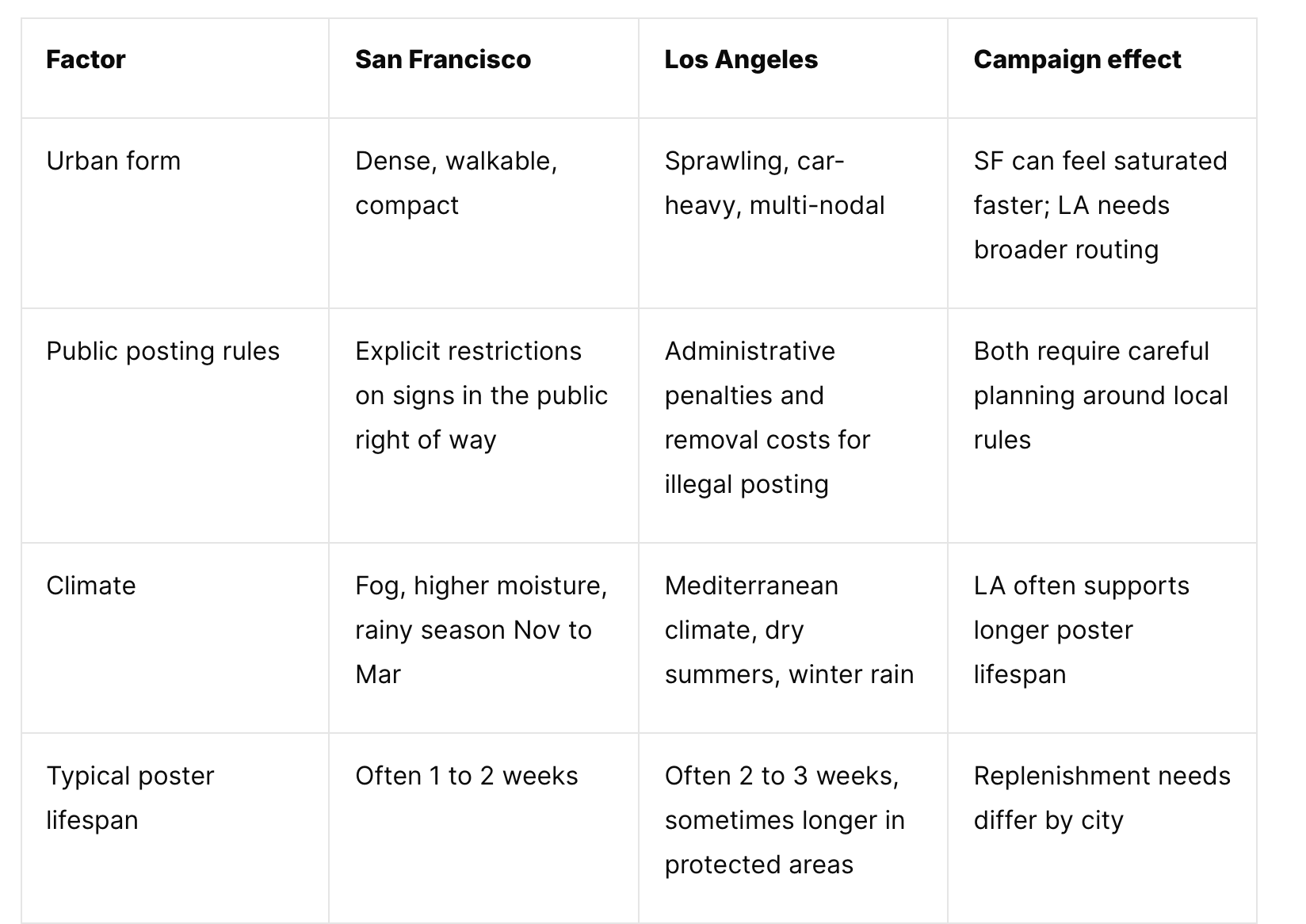
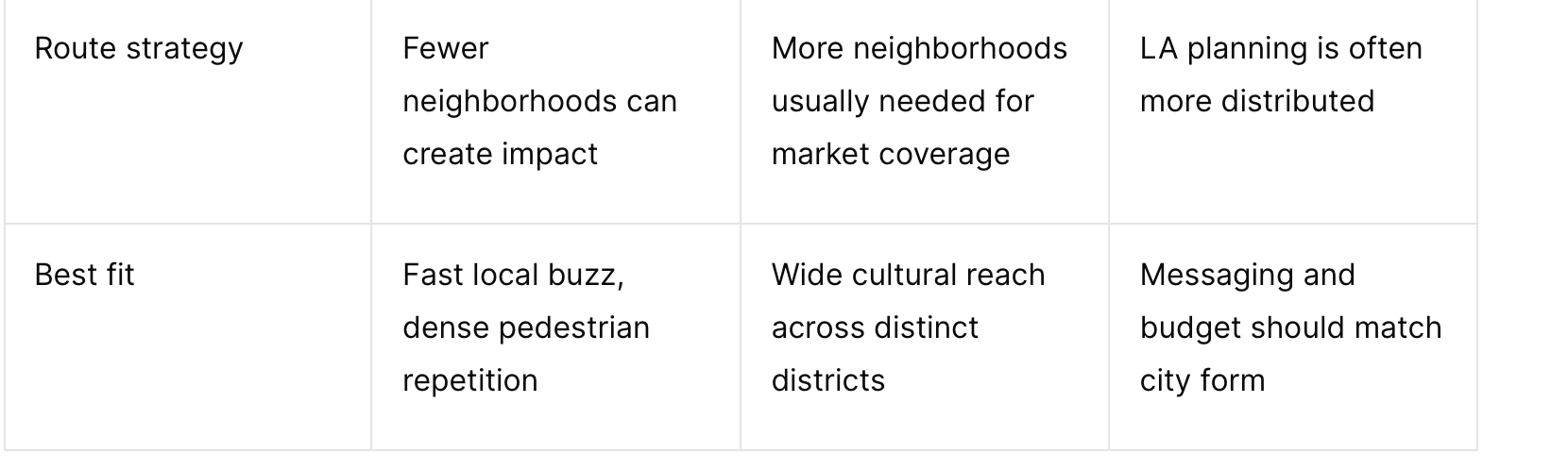
San Francisco vs Los Angeles campaign effect by sidewalktattos
Street layout and pedestrian flow in San Francisco and Los Angeles
San Francisco rewards repetition. A campaign in downtown corridors or the Mission can be seen multiple times by the same audience in a short span, which is valuable when the goal is memory, local conversation, or event urgency. A smaller route can still carry weight because the city’s walkability increases dwell time and repeat exposure.
Los Angeles rewards targeted distribution. Instead of one continuous pedestrian grid, it offers clusters. Hollywood speaks differently than Venice. Silver Lake does not move like Downtown LA. A campaign here often succeeds by matching neighborhood identity to audience intent, then spreading installs across several nodes to build cumulative reach.
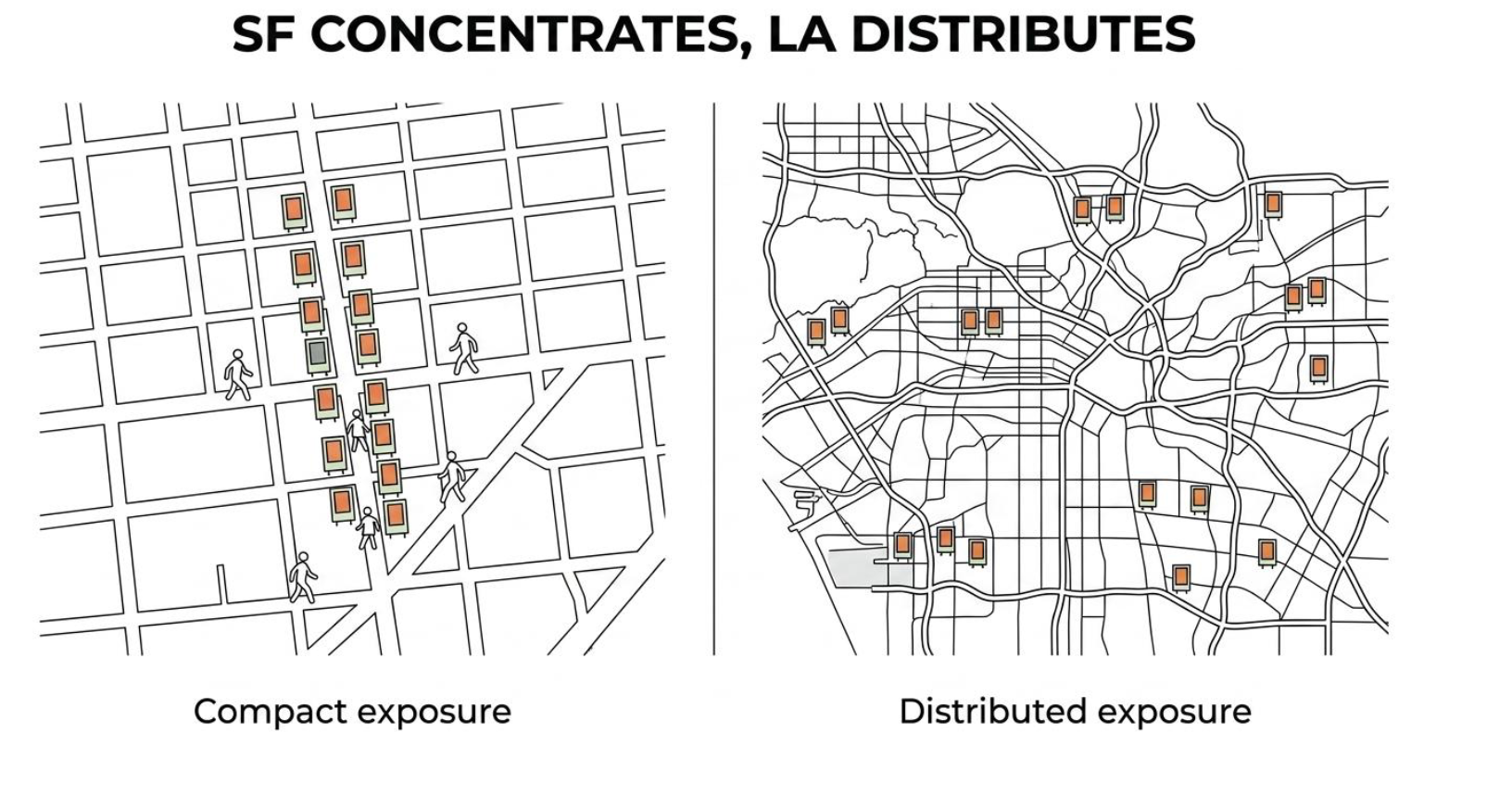
Compact vs Distributed illustration by sidewalktattos
That structural difference changes how creative is read.
In San Francisco, viewers are more likely to encounter a poster at close range, often while walking or waiting. That means typography, layering, texture, and message density can all do more work. In Los Angeles, many impressions are quicker, whether from foot traffic, rideshare movement, or roadside visibility near active retail streets. Clear hierarchy becomes even more valuable.
A smart city plan usually accounts for:
pedestrian repetition
distance between clusters
neighborhood identity
time of day patterns
replacement access
Wheatpasting legality in San Francisco and Los Angeles
Street marketing works best when planning is grounded in local rules, not guesswork. San Francisco and Los Angeles both regulate illegal postings, though the language and enforcement structure differ.
According to San Francisco Public Works, illegal postings in the public right of way can be removed by the Bureau of Street Environmental Services and may be subject to fines from $100 to $500. San Francisco also defines signs broadly. The definition can include cards, decorations, posters, or campaign signs affixed to utility or light poles that are permanently attached to the street or sidewalk.
Los Angeles takes a related but distinct approach. The Los Angeles Municipal Code assigns liability for illegal posting to the responsible party, including an administrative monetary penalty and the city’s removal costs. The first violation in a calendar year may carry a penalty of up to $100.
That means neither market should be treated casually. Good execution starts with location vetting, approved placements where needed, and route planning that respects enforcement realities.
A practical comparison looks like this:
San Francisco public property: explicit limits in the public right of way, with fines that can reach $500
San Francisco sign definition: broad enough to cover posters and other materials attached to utility or light poles
Los Angeles penalty structure: administrative monetary penalty tied to the person responsible
Los Angeles cleanup exposure: removal costs can be added to the penalty
For brands, the takeaway is not fear. It is discipline. Strong campaigns are built with city-specific planning, surface selection, and documentation from day one.
Weather, moisture, and poster lifespan in San Francisco and Los Angeles
Weather changes how long wheatpaste stays sharp on the wall. It also changes the kind of maintenance a campaign may need.
San Francisco’s climate brings more moisture risk. The National Park Service describes a rainy season from November to March, with rain unlikely from April to October, yet fog can persist through summer months. That fog matters. Even when rainfall is light, moisture in the air can soften paper, lift edges, and shorten the crisp visual life of a poster.
Los Angeles, as classified by NOAA, also has a Mediterranean climate, yet the rhythm is more favorable for poster durability across much of the year. Most rain arrives from November through March, while summers are practically rainless. Conditions vary by distance from the ocean, and coastal areas can still see more fog and cloudiness, but the broader pattern is drier.
This is where the practical difference becomes visible on the street. Campaign experience suggests San Francisco wheatpaste posters often last around one to two weeks, while Los Angeles installations often hold for two to three weeks and sometimes longer in shaded or protected locations. Those numbers still depend on traffic, wall condition, cleaning activity, and season, though they are useful for planning.
If durability is a top priority, Los Angeles usually has the edge.
If immediacy is the goal, San Francisco can still be an excellent market because density can compensate for shorter poster life.
Neighborhood routing for San Francisco and Los Angeles wheatpasting
City choice is only half the decision. Neighborhood selection often determines whether a campaign feels local and relevant or scattered and forgettable.
In San Francisco, route density is a major advantage. Downtown and the Mission are often central to wheatpasting plans because they combine visibility, cultural energy, and pedestrian circulation. A focused route can feel bigger than it is because the city stacks attention into compact corridors.
Los Angeles benefits from a portfolio mindset. Hollywood, Venice Beach, Downtown LA, Silver Lake, and Highland Park each attract different audiences and moods. Rather than expecting one district to speak to the entire city, strong LA campaigns often combine neighborhoods that reflect the brand’s exact audience mix.
San Francisco neighborhood routing patterns
San Francisco works well when the message needs fast repetition inside a concentrated footprint. Product drops, gallery openings, nightlife promotions, and local launch moments can all benefit from the city’s close-range viewing behavior.
That compactness can also help budgets stretch. Fewer route miles can still create a noticeable street presence, especially when installs are tightly clustered.
Los Angeles neighborhood routing patterns
Los Angeles shines when a campaign needs breadth without losing cultural precision. A fashion label may want Hollywood and Silver Lake. A music or event push may add Downtown LA. A lifestyle or consumer brand may want Venice in the mix.
The city is larger, so planning often needs more coordination.
A strong LA route often prioritizes:
Audience fit: each neighborhood should reflect the people the campaign wants to reach
Route efficiency: installer travel time can shape budget and timing
Visual rhythm: posters should build repetition across clusters, not appear random
Documentation value: multi-neighborhood coverage benefits from clear mapped reporting
Budget, replenishment, and reporting for city-specific wheatpasting
Budget planning changes when one city wears faster and the other spreads wider. In San Francisco, the budget conversation often includes replenishment sooner because fog, moisture, and dense interaction can age installs faster. In Los Angeles, the conversation often shifts toward route scale and neighborhood count.
Neither city is automatically cheaper. They simply spend differently.
A compact San Francisco campaign may need less geographic coverage but more frequent touch-ups. A Los Angeles campaign may hold longer once installed, yet travel, crew coordination, and distributed routing can increase the operational side of the plan. That is why clear scope matters from the start.
Documentation also becomes more important as campaigns scale. Mapped placements, geo-tagged photos, timestamps, and rollout tracking help teams see what is live, what needs replacement, and which corridors are producing the strongest street presence.
Planning a wheatpasting market launch in San Francisco or Los Angeles
If the goal is concentrated buzz in a walkable city, San Francisco has a strong case. If the goal is longer poster life and broader neighborhood reach, Los Angeles often comes out ahead. The better market depends on what the campaign needs most: repetition, spread, durability, urgency, or a blend of all four.
The most effective approach is rarely generic. It is matched to the city, the season, the audience, and the pace of the message.
Sidewalk Tattoos plans wheatpaste campaigns around those exact variables, with mapped routes, photo documentation, and street-level execution built for each market. If you are deciding between San Francisco and Los Angeles, or you want both cities working together, contact us to plan your market.
Reach out for more information :
929.678.0235
