
Wheatpasting in LA vs NYC
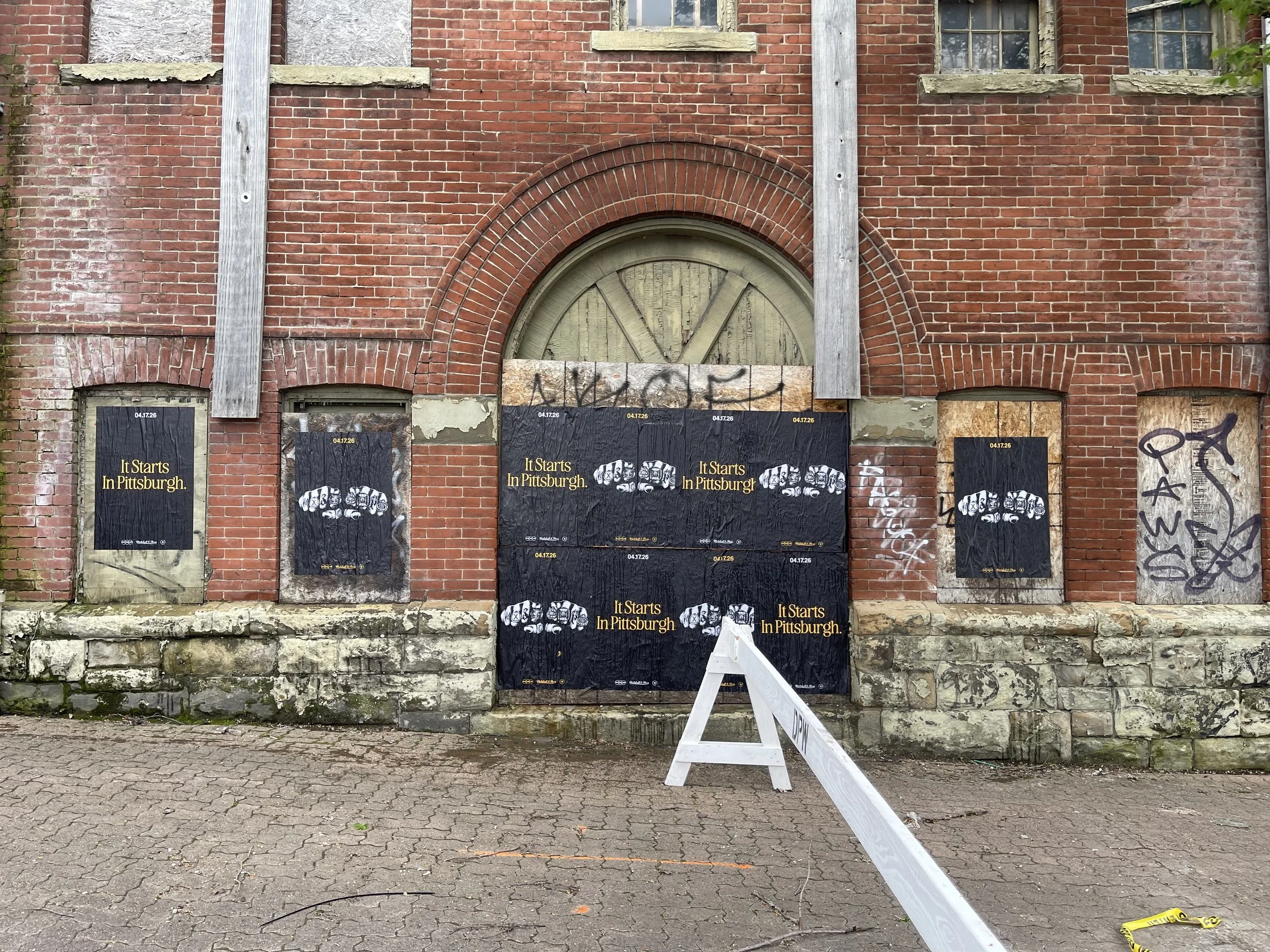
Wheatpasting installation by sidewalktattos
A wheatpasting campaign can carry the same brand message on both coasts and still require two very different operating plans. Los Angeles and New York City ask different questions of placement, pacing, documentation, and audience flow. One market rewards corridor thinking and repeated sightings across a wider footprint. The other rewards density, foot traffic, and stacked impressions within a few blocks.
That difference matters long before the first poster goes up.
Wheatpasting strategy changes when LA and NYC move differently
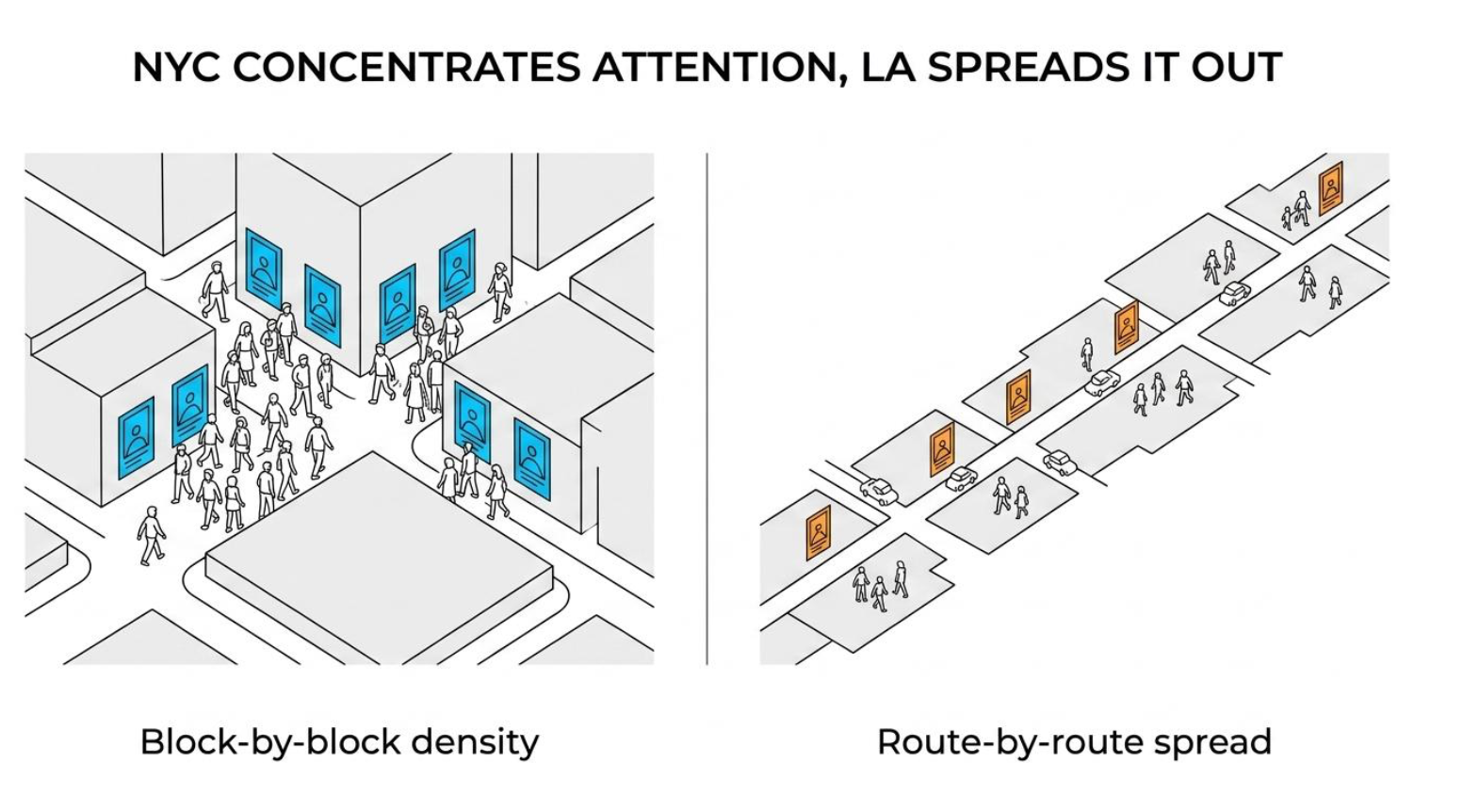
The simplest way to frame the contrast is this: New York City compresses attention, while Los Angeles distributes it.
Concentrates vs Spreads out installs by sidewalktattos
In NYC, a campaign often benefits from proximity. People move block to block on foot, pass the same streets at different times of day, and generate dense pedestrian exposure in compact zones. In a submarket like Times Square, public reporting shows daily pedestrian counts regularly landing between 200,000 and 250,000, with roughly 220,000 entering each day in 2024 and peak days reaching about 330,000. That scale changes how repetition works. A smaller mapped area can still create a strong sense of market saturation.
Los Angeles works differently. The city is not short on attention, but it spreads that attention across neighborhoods, corridors, and routines built around driving, rideshare, walking pockets, nightlife nodes, and destination retail. A LA wheatpaste rollout often needs a broader geographic lens. Instead of asking, "How do we dominate this cluster of blocks?" the better question may be, "Which routes, districts, and cultural touchpoints build repeated exposure across the week?"
That shift affects nearly every campaign decision.
tighter radius in Manhattan
broader corridor coverage in Los Angeles
pedestrian clustering versus distributed visibility
repetition by block versus repetition by route
Legal rules for wheatpasting in Los Angeles and New York City
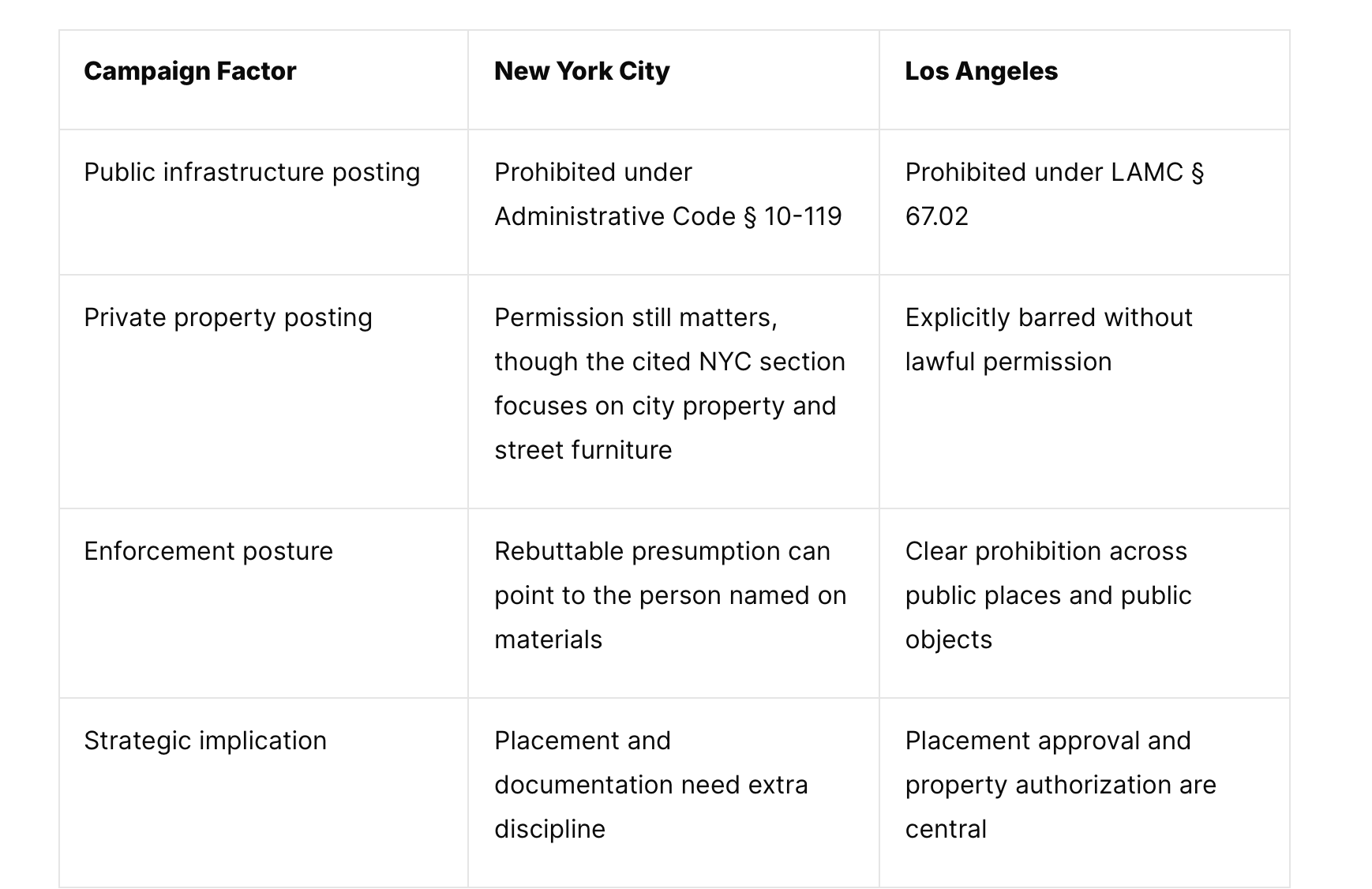
The first operational reality is legal, and both cities are restrictive.
New York City Administrative Code § 10-119 makes it unlawful to paste, post, paint, print, nail, attach, or affix posters, advertisements, stickers, handbills, and similar printed material on listed city property and street furniture. The code also creates a rebuttable presumption that the person named on the posted material violated the posting ban. That matters because liability in NYC is not limited to the installer standing on the sidewalk. The message on the poster itself can become part of enforcement logic.
Los Angeles Municipal Code § 67.02 is also restrictive, and in some ways even more explicit for campaign planners. It bars placing posters or advertisements on sidewalks, streets, alleys, and other public places, and on public objects like lampposts, poles, hydrants, curbstones, bridge walls, and trees. It also bars posting on private property without the lawful permission of the property owner or authorized agent.
So the coast-to-coast takeaway is not that one city is permissive and the other is not. It is that both require care, and LA adds very clear language around private property permission.
That is why professional wheatpaste execution is not just a design or installation question. It is a planning question tied to approved placements, property relationships, mapped deployment, and documentation.
New York City vs Los Angeles campaign factors by sidewalktattos
Street-level visibility in NYC favors density and repetition
NYC rewards campaigns that think in layers. A poster is not just seen once. It is passed on the morning commute, caught again during lunch, photographed at golden hour, and revisited at night by a different crowd. That kind of layering is what makes dense neighborhoods powerful for street media. The key is not only raw pedestrian volume. It is concentration of attention. In Manhattan and parts of Brooklyn, the right cluster can produce repeated exposure within a compressed area. A person may encounter the campaign on one block, then again two blocks later, then once more outside a venue or retail destination. The city turns proximity into momentum.
That density also shapes creative choices. In walkable areas, people have time to notice detail. Typography, texture, call-to-action placement, and visual sequencing matter more because the audience is often close to the wall and moving at human speed. A poster can reward a second look.
In practical terms, NYC campaigns often perform best when the map feels intentional rather than sprawling.
Focus area: A few connected blocks can create heavy frequency when foot traffic is strong.
Creative detail: Small design decisions matter because viewers often approach on foot.
Documentation value: Photo and geo-tagged proof become vital when density makes placement precision part of the campaign story.
Wheatpasting in Los Angeles favors route logic and neighborhood spread
Los Angeles asks for a different kind of discipline. The city has strong pedestrian zones, but it rarely behaves like a single walking market. Instead, visibility builds through route-based presence across districts where culture, retail, nightlife, dining, and event traffic intersect.
A smart LA wheatpaste rollout often treats neighborhoods as chapters, not duplicates. Silver Lake does not function like Downtown. Melrose does not function like the Arts District. Venice does not function like Hollywood. A campaign may need multiple visual footholds to feel citywide, even if the total number of posters is similar to a New York buy.
This is where mapping becomes especially valuable. In LA, spread can either look strategic or random. The difference comes from placement logic. Campaigns are stronger when each zone serves a purpose, whether that means reaching trend-sensitive retail audiences, event-driven nightlife crowds, or commuters moving through major urban corridors.
The result is a style of wheatpasting that often feels more distributed but no less forceful.
One poster in LA may not depend on the same immediate pedestrian pileup that a Manhattan install might expect. Its power can come from recall, cultural fit, and repeated sightings across several days in different parts of the city.
Weather and poster durability differ between Los Angeles and New York City
Climate is not the only factor in poster longevity, but it matters.
Downtown Los Angeles rainfall normals, based on 1991 through 2020 data, are notably low during much of the year. The normal rainfall is 0.69 inches in April and only 0.02 inches in July. That dry pattern can support longer poster durability, especially during drier months when installations face less weather disruption and less moisture stress.
NYC does not offer the same advantage. Street conditions are more variable, and weather can shorten the life of a campaign through rain, grime, slush, humidity, or simple street wear. Even when creative looks sharp at install, a New York plan often benefits from a tighter activation window and a realistic view of how quickly conditions can change.
That does not make LA "easy" or NYC "hard." It means each city rewards different timing choices. In LA, a brand may push for longer hold where conditions support it. In NYC, the same brand may care more about sharp launch timing, fast coverage, and high-frequency exposure while the creative is freshest.
Production and creative choices should reflect each city
The coast changes the job, and the job changes the poster.
In New York City, dense walk-by conditions can support a more text-forward composition, bolder information hierarchy, or layered creative series that reveal different messages block by block. The audience is often close enough to engage with nuance.
In Los Angeles, legibility from a bit farther away can matter more depending on the placement context and traffic pattern. Simpler composition, stronger color fields, and an immediate visual hook often travel better across a more dispersed field of attention. When the city itself stretches the viewing pattern, the creative has to close the gap fast.
That does not mean LA posters should be blunt or NYC posters should be busy. It means the viewing environment should guide the design brief.
A strong coast-specific production plan usually answers these questions:
What is the likely viewing distance?
How many repeat sightings matter before recall sets in?
Is the campaign building neighborhood dominance or citywide familiarity?
How quickly does the message need to register?
Campaign mapping and documentation matter more than ever
Wheatpasting has always had a raw, street-level quality, but serious brand work still needs structure. In both markets, mapped planning and proof of performance are part of the value.
In NYC, documentation helps show how the campaign concentrated around priority corridors and high-footfall districts. In LA, it helps prove that a wider footprint was not random but designed around strategic neighborhoods and routes. Photo evidence and geo-tagged reporting turn street media from a loose activation into a measurable one.
That matters for internal marketing teams, agencies, and clients trying to connect installation activity to launch timing, retail goals, event support, or social amplification.
A well-run campaign should be easy to audit after it is live.
Mapped deployment: Planned zones tied to audience behavior and launch goals.
Geo documentation: Verifiable proof that placements hit the intended footprint.
Fast rollout: Tight activation windows help brands match release dates and events.
Street authenticity: The work should still feel native to the city, not forced into it.
Choosing wheatpasting tactics for LA vs NYC campaigns
If the goal is dense urban repetition, NYC is hard to match. Few places can compress pedestrian volume, visual frequency, and cultural immediacy into such a small physical area. For brands launching something time-sensitive, that density can create fast market presence.
If the goal is broad cultural visibility across a city of distinct scenes, LA offers a different kind of strength. Its drier climate can support poster durability, and its neighborhood structure gives campaign planners a chance to build resonance across multiple subcultures and routes rather than relying on one central cluster.
The strongest brands do not ask which city is better for wheatpasting in the abstract. They ask which city structure fits the message, timing, and audience behavior they want to reach.
For some launches, the right answer is Manhattan density. For others, it is Los Angeles spread. And for many national campaigns, it is both, with different playbooks on each coast.
Sidewalk Tattoos plans and executes wheatpasting campaigns with that difference in mind, from strategic mapping and custom poster installations to photo-documented street activations across major U.S. cities and international markets. If your brand needs a coast-specific rollout in NYC, LA, or both, it helps to build the install plan around how each city actually moves.
