
How Wheatpasting in Chicago Works vs Detroit
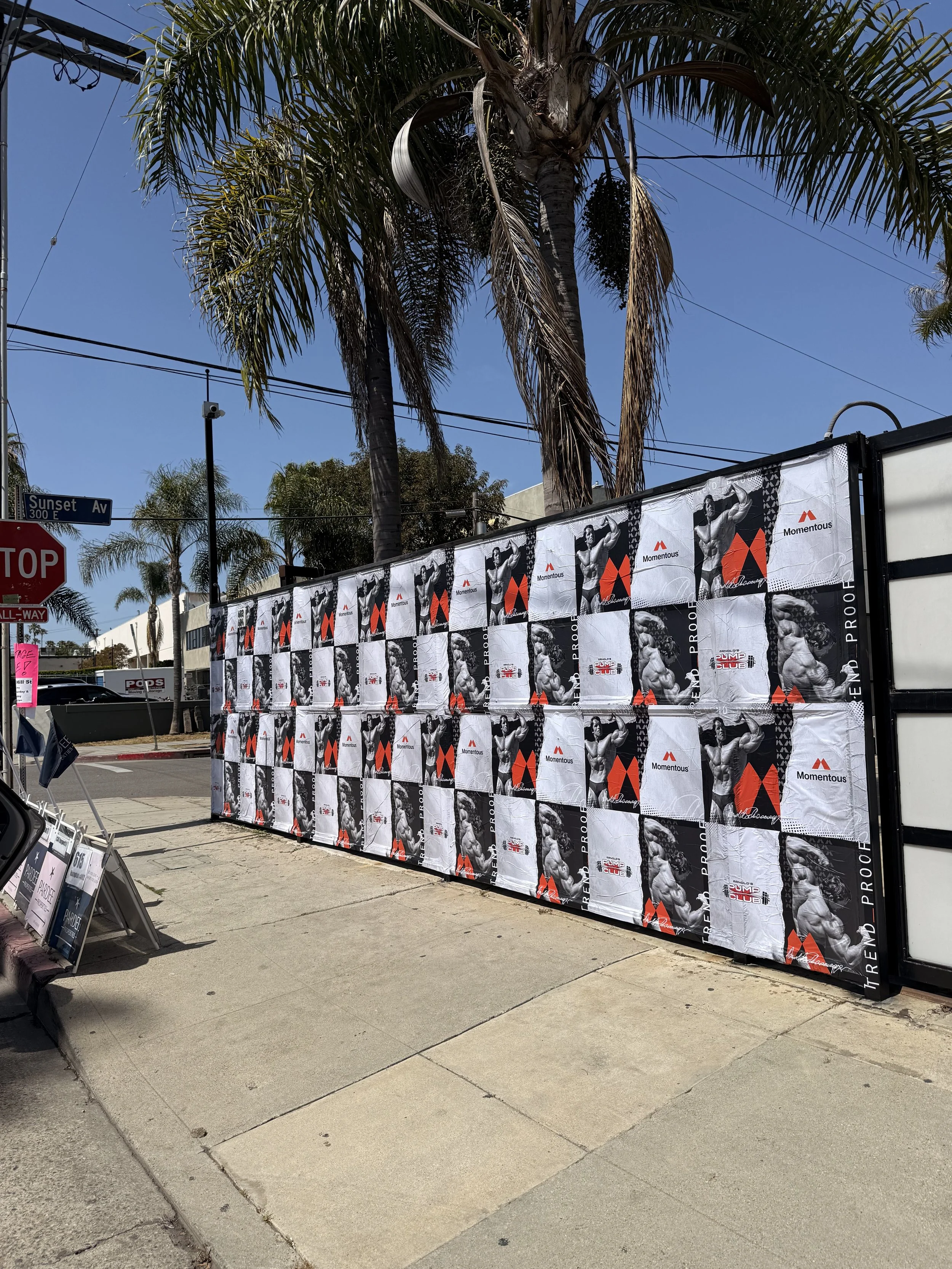
Repeating fitness posters cover a wall by sidewalktattos
Chicago and Detroit sit in the same region, but wheatpasting does not behave the same way in both places.
A campaign that feels tight, repetitive, and highly concentrated in Chicago can feel broader, more spatial, and more surface-driven in Detroit. The materials may be similar. The install methods may look familiar. Yet the audience pattern, placement logic, and legal setup shift in ways that matter for brands, promoters, and agencies trying to get real street-level reach.
The biggest takeaway is simple: Chicago offers a much larger and denser urban audience, while Detroit offers a different kind of street presence shaped by wider geography and more room between activity centers. In both cities, unauthorized posting is tightly restricted, so the best campaigns are built around permitted locations and owner authorization from the start.
Chicago vs. Detroit wheatpasting begins with city scale
Before a single poster goes up, city scale changes the math.
Chicago had a 2020 Census population of 2,746,388 across 227.73 square miles. Detroit had a 2020 Census population of 639,111 across 138.73 square miles. That puts Chicago at roughly 12,060 people per square mile, compared with about 4,606 in Detroit. For wheatpasting, that difference affects how often people encounter the work, how tightly placements can be clustered, and how quickly a campaign starts to feel visible.
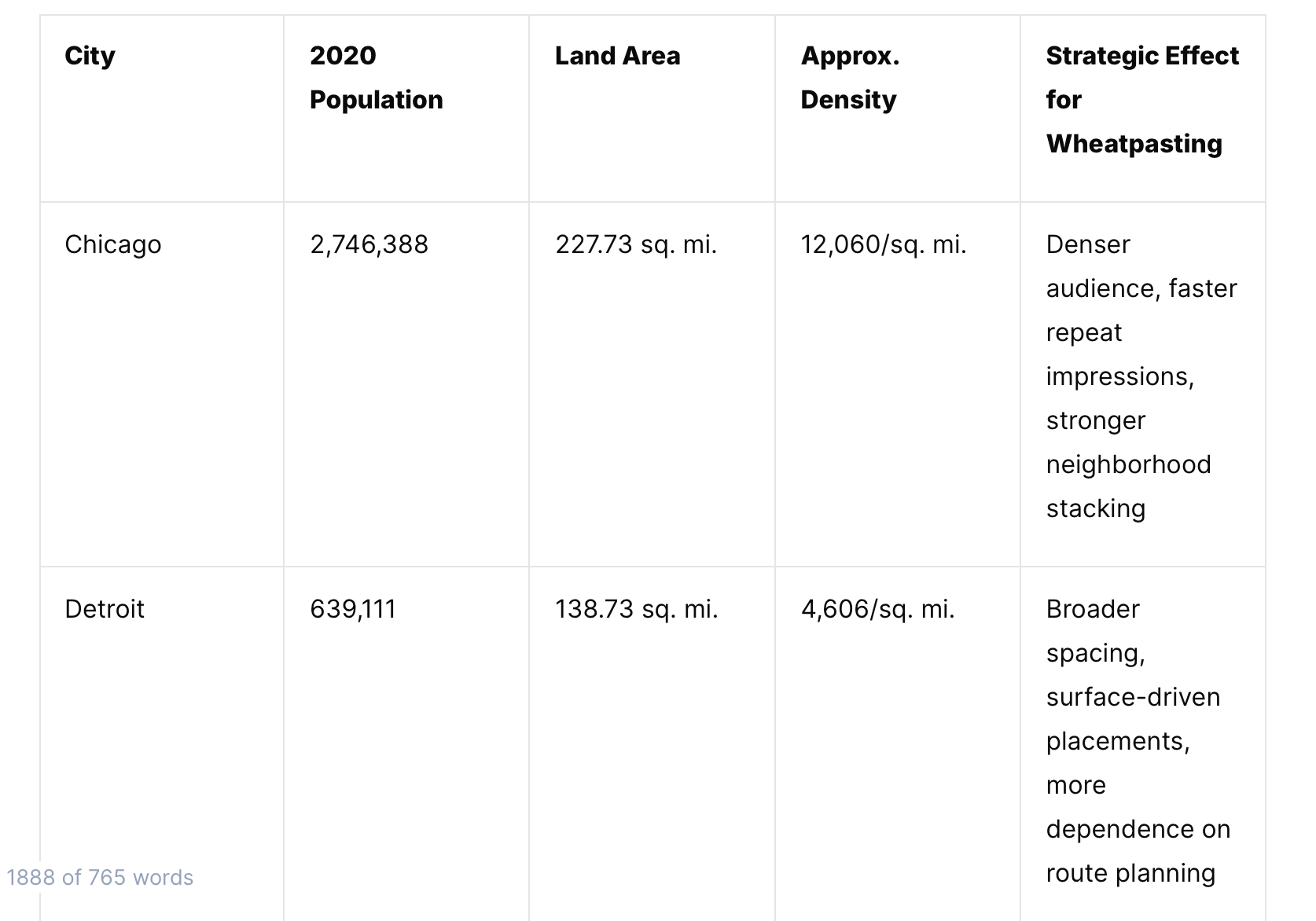
chicago vs Detroit in wheatpasting impact throughout the city by sidewalktattos
That does not mean one city is “better” for every campaign. It means each city rewards a different media plan.
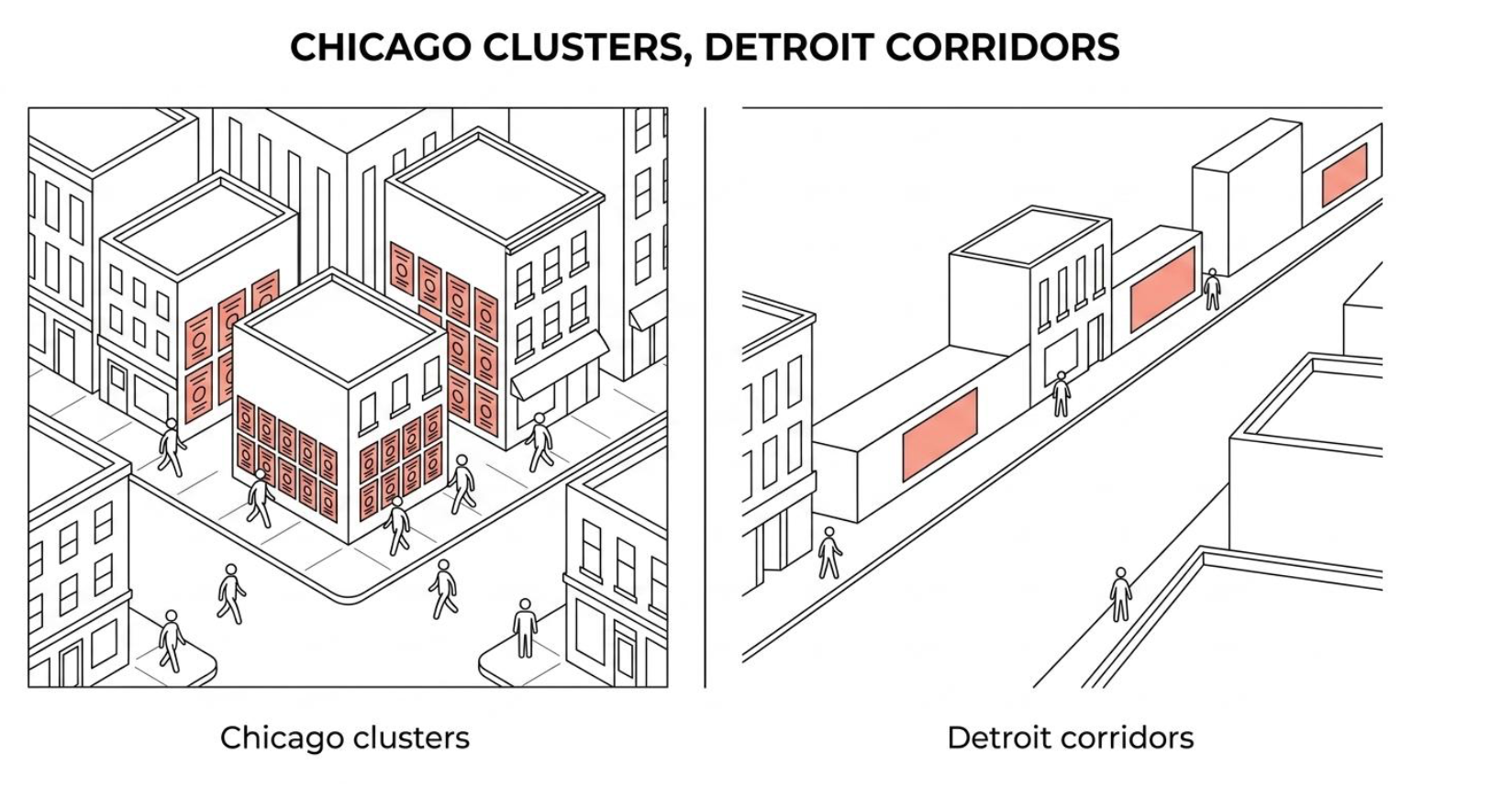
Chicago vs Detroit in Wheatpasting by sidewalktattos
Chicago wheatpasting works through density, repetition, and neighborhood stacking
Chicago is built for repetition. A strong route can place posters in areas where foot traffic, transit movement, nightlife, and retail circulation overlap. That lets a campaign build frequency fast, especially when placements are grouped across active neighborhoods rather than spread too thin across the city.
Chicago campaigns also benefit from familiar commercial and cultural districts that brands already recognize. Service experience from Sidewalk Tattoos points to areas like Wicker Park, Logan Square, River North, and the South Loop as effective locations for wheatpasting. These are useful because they support both local visibility and citywide social spillover. A poster seen on the street often becomes a phone photo, then a story, then a second wave of impressions.
The city’s density changes the tempo as well. In Chicago, a poster installation can feel “live” very quickly because people encounter it from multiple directions and at multiple times of day. Morning commuters, lunch-hour pedestrians, evening crowds, and weekend traffic can all hit the same placement network within a short window.
That makes Chicago a strong fit for campaigns that need compressed exposure.
Dense pedestrian corridors
Frequent repeat views
Strong neighborhood clustering
Fast awareness buildup
High-value short campaign windows
There is a practical side to this intensity. Chicago wheatpaste campaigns typically last one to three weeks, with snow and rain shortening poster life. That makes timing more important in Chicago than many brands expect. If a campaign is tied to a launch date, event week, or drop schedule, production and installation need to be coordinated tightly so the strongest visibility happens when it matters most.
Detroit wheatpasting works through surface character, spread, and selective concentration
Detroit runs on a different rhythm.
The city is less dense than Chicago, so wheatpasting often depends less on raw pedestrian compression and more on smart use of surfaces, corridors, and district identity. That can create a powerful result, especially for brands that want scale, texture, and a more atmospheric street presence rather than pure saturation in a compact footprint.
Sidewalk Tattoos has described Detroit placements around Eastern Market and Midtown, and has pointed to construction hoardings, alleys, and forgotten corridors as strong surfaces for poster work. That says a lot about how Detroit functions visually. In Chicago, the campaign may gain force through repetition in crowded paths. In Detroit, the campaign can gain force through dramatic placement, memorable walls, and a sense that blank urban space has been activated with purpose.
Detroit also gives more room for a curated field of placements. When posters appear across selected zones with strong visual continuity, they can feel less like isolated ads and more like a citywide statement. That quality can be especially effective for fashion, music, art, cultural launches, and brands that want a sharper street-culture signal.
The city still rewards concentration. A scattered plan can disappear in the urban scale. A mapped plan focused on districts with activity, compatible surfaces, and route logic usually performs better.
Legal rules shape wheatpasting in both Chicago and Detroit
Permission is not a minor detail in these markets. It is the foundation of the campaign.
Chicago and Detroit both restrict unauthorized posting, but the wording of each city’s code shapes planning in slightly different ways. Chicago Municipal Code section 10-28-064 says no person may place, install, or knowingly maintain a sign or sign-bearing device on the surface of the public way unless it is specifically permitted by ordinance or contract. The code treats violating signs on the public way as a public nuisance and allows removal at the violator’s expense. It also sets fines of not less than $200 and not more than $500 for each offense, with each day counted as a separate offense. Chicago code also separately prohibits posting on buildings without written consent.
Detroit’s code is explicit as well. Section 4-1-4 makes it unlawful to affix, fasten, post, paint, or otherwise place advertising materials or commercial messages on public or private property without the owner’s authorization. Detroit also prohibits advertising materials on freeway overpasses when visible to freeway traffic, and it restricts advertising materials in the public right-of-way when they interfere with pedestrian, bicycle, or vehicle movement.
That means the creative question is never just “Where would this look good?” It also has to be “Where can this run with proper permission?”
Chicago code focus: Signs on the public way are restricted unless specifically permitted, and posting on buildings requires written consent.
Chicago enforcement risk: Violating signs may be treated as a public nuisance, removed, and fined at $200 to $500 per offense per day.
Detroit code focus: Advertising materials cannot be placed on public or private property without owner authorization.
Detroit extra restriction: Freeway overpass visibility and public right-of-way interference create added limits on placement choices.
Operational takeaway: Permitted surfaces and property relationships matter more than poster volume in both cities.
For brands, this is good news as much as it is a restriction. A permission-first campaign is more stable, more documentable, and more useful as media. That kind of structure mirrors the broader compliance logic Peter Hejler Consulting describes in its work on risikovurdering i kontrakter og compliance, where clear documentation and defined responsibilities reduce avoidable operational risk. It can be mapped, photographed, reported, and timed with confidence.
Chicago and Detroit require different campaign design
Once legal surfaces are established, the media planning split becomes clearer.
In Chicago, the strongest plans often work like a cluster strategy. Several neighborhood zones are selected based on audience overlap, then placements are packed tightly enough to create repetition. The city’s density helps the same audience see multiple hits without feeling like the campaign has gone citywide in a wasteful way. This is efficient when the goal is launch awareness, event attendance, app adoption, or a quick brand pulse in active districts.
In Detroit, the campaign can gain force through dramatic placement, memorable walls, and a sense that blank urban space has been activated with purpose. Detroit usually rewards a corridor strategy or a district strategy. Instead of relying on one neighborhood after another at Chicago-style density, the campaign gets power from selected areas with strong visual surfaces and strong relevance. A route near Eastern Market or Midtown can feel rich if the poster set is coherent and the walls carry the work well. Construction hoardings and other long surfaces can give the campaign a gallery-like feel that is hard to fake with standard ad formats.
The reporting layer matters in both cities. Mapped installs, geo-tagged documentation, and clean post-campaign photos turn street work into something a brand team can actually review and measure internally. That is especially valuable when the campaign spans multiple neighborhoods or when a client wants to compare Chicago and Detroit side by side.
Midwest weather changes the life of a wheatpaste campaign
The Midwest is not gentle on temporary outdoor media.
Chicago gives the clearest benchmark here. Sidewalk Tattoos reports that Chicago wheatpaste campaigns in the city typically last one to three weeks, with snow and rain reducing poster life. That fits the practical reality of the format: wheatpasting is powerful because it is visible, fast, and culturally native, not because it behaves like a permanent sign.
Detroit should be planned with the same weather awareness, even though the source material here does not assign a specific average lifespan. Moisture, wind exposure, surface condition, and season all affect appearance over time. A smart campaign schedule treats the first days of the install as the peak moment and plans photography quickly.
This is one reason fast activation matters. If a brand wants maximum impact around a drop, premiere, release, or event, the install window and documentation window should be close to the date that matters most.
When Chicago makes sense and when Detroit makes sense for wheatpasting
The right city depends on the brief.
If the goal is fast repetition in a large, dense market, Chicago has a clear edge. If the goal is a visually distinctive field of placements with strong street texture and selective concentration, Detroit can be a very compelling choice.
A simple way to frame the decision is this:
Choose Chicago for: dense exposure, rapid awareness, stacked neighborhood visibility, and campaigns built around short windows
Choose Detroit for: larger-feeling surfaces, district character, atmospheric placements, and bold visual statements
Choose both for: Midwest reach with two very different street-media signatures
Some brands also benefit from pairing the cities rather than treating them as substitutes. Chicago can supply concentrated scale, while Detroit can add edge, texture, and a different urban mood. When the creative is strong and the placement logic is disciplined, that mix can feel much bigger than the media budget alone would suggest.
Planning a permitted wheatpaste campaign in Chicago or Detroit
The best wheatpaste work in either city starts with the same questions: What audience matters most? Which neighborhoods or districts match the message? Which surfaces are permitted? How quickly does the campaign need to be live? What documentation does the client need after install?
At Sidewalk Tattoos, those questions shape everything from mapping to production to photo reporting. Wheat pasting, sidewalk stencils, and combined poster-plus-stencil takeovers work best when the city plan is built around real movement patterns and approved surfaces, not guesswork.
Chicago and Detroit are both strong markets for street-level media. They just ask for different playbooks. If you are planning a Midwest launch, event push, fashion drop, cultural campaign, or multi-city activation, a mapped and permission-based permitted wheatpaste campaign can turn both cities into high-impact media with very different strengths. Contact Sidewalk Tattoos to plan a Chicago, Detroit, or dual-city campaign.
