
Film Festival Street Marketing: How Festival Weeks Get Won Outside the Theater
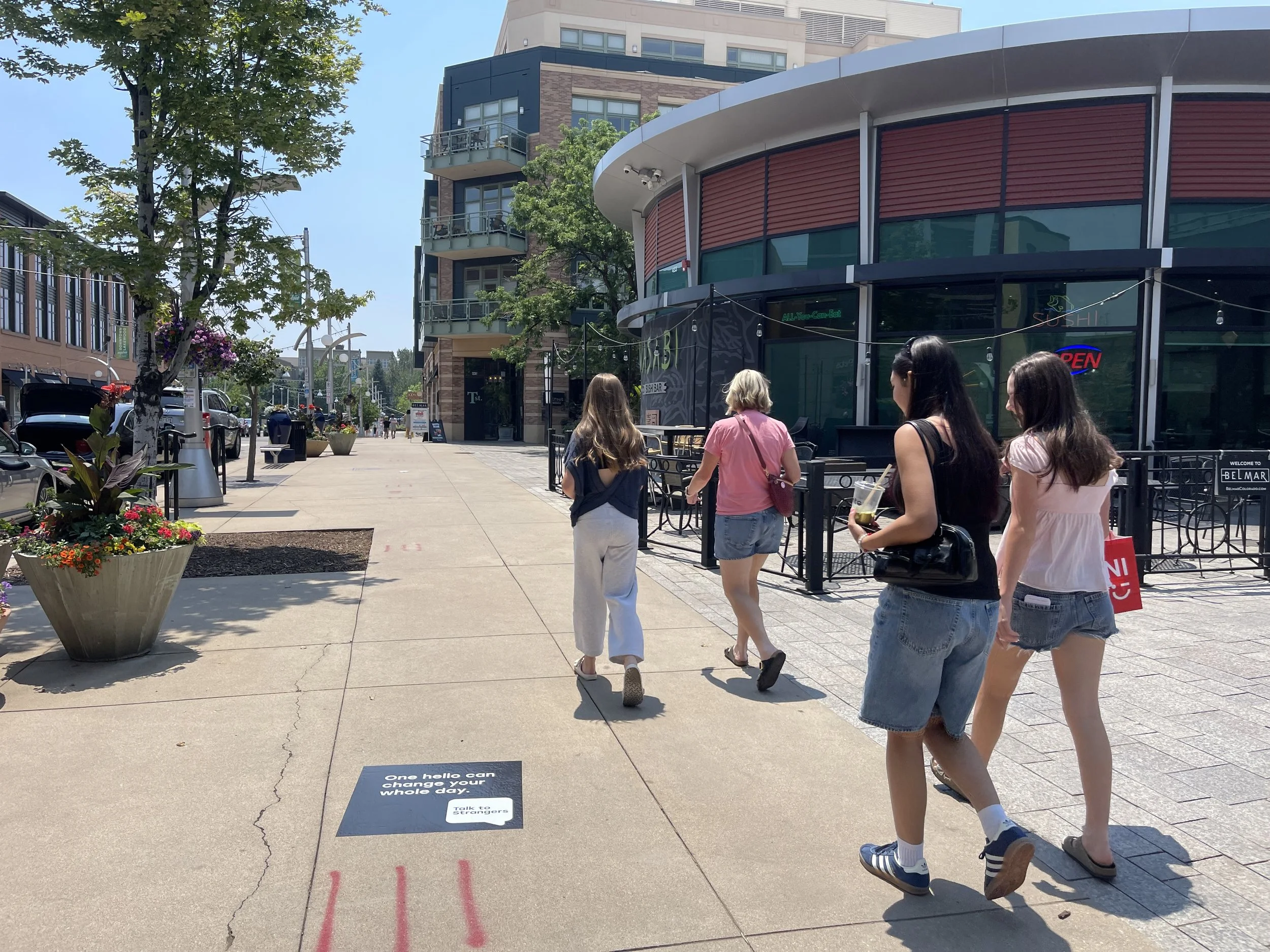
Unconventional media in high-density retail plazas by Sidewalktattoos
Film festival week rarely belongs only to the best movie. It belongs to the title people keep seeing while moving between screenings, sponsor lounges, hotel lobbies, late-night parties, and coffee lines.
That is why street campaigns matter.
A smart wheat paste run or sidewalk stencil activation keeps a film, event, or brand in front of the exact crowd that can buy tickets, post photos, tell friends, and make a title feel impossible to miss. During a festival, attention is concentrated, mobile, and highly social. The streets become part of the media plan.
Film festival audiences create a walkable media environment
Major festivals create rare conditions for local marketing. Huge attendance compresses into a defined time window and a small set of neighborhoods, which gives street-level placements unusual force. Sundance Institute reported that the 2019 Sundance Film Festival drew more than 122,000 attendees and generated $182.5 million in economic impact for Utah, with more than 43,500 out-of-state visitors. That is not just a crowd. It is a temporary city within a city.
Cannes shows the same pattern at another scale. Festival reporting for its 79th edition cited more than 52,000 accreditation requests, 35,000 festivalgoers already in town, and more than 102,000 admissions across 124 screenings at the midway point. Numbers like these tell a clear story: festival audiences are dense, active, and constantly moving between highly visible nodes.
This is exactly the setting street campaigns are built for.
Out-of-home industry materials describe pedestrian-facing placements as effective in high-density urban areas, tourist districts, downtowns, and entertainment zones. That maps closely to film festival geography. When audiences are walking, waiting, scanning blocks, and making fast choices, repeated street exposure can outperform messaging that sits somewhere else.
A festival crowd tends to move through patterns like these:
theater corridors
press and badge pickup areas
hotel entrances
coffee shops near screening venues
nightlife clusters
rideshare drop-off zones
Why film festival street marketing changes ticket and buzz outcomes
Festival decisions happen in motion. Someone hears about a screening at lunch, sees a poster on the way to a panel, notices a stencil outside a theater, and buys a last-minute ticket that afternoon. Street marketing works because it meets that compressed decision cycle.
It also makes a release feel present in the city. That matters when dozens or hundreds of titles are competing for the same attention span. A film that owns walls and sidewalks around the festival district can feel larger than its paid media budget because the message is encountered repeatedly in relevant places.
Out-of-home measurement groups often define success around a reliable opportunity to see. That standard fits festival street campaigns well. People are not glancing past your message once on a freeway. They are standing near it, walking past it, photographing it, and sharing it with friends while asking what to watch next.
Street visibility does not replace trailers, PR, social content, or industry outreach. It sharpens all of them by turning awareness into local saturation during the days when interest is highest.
Wheat paste poster campaigns build repeat visibility during festival week
Wheat paste posters are one of the fastest ways to give a film physical presence during a festival. They can scale across blocks, create repetition, and build a visual field around screening routes, nightlife areas, and media hubs. When the artwork is strong, wheat pasting gives a title instant legitimacy on the street.
That format works especially well for film because posters already belong to cinema culture. A theatrical one-sheet, a bold key image, or a stripped-back title treatment can carry real power when repeated across a district. Instead of feeling like an interruption, the poster can feel like part of the festival itself.
Placement matters as much as design: near screening venues, nightlife clusters, hotel corridors, and high-footfall intersections
Creative discipline: one strong image, readable type, and a clear call to action
Timing: installs before the crowd peaks, then refreshes during the busiest days
Documentation: photo proof and geo-tagged reporting for every block covered
Sidewalk Tattoos has documented film-release and festival-adjacent street campaigns using wheat paste and related formats. That matters because festival work moves fast, and execution only counts if it is visible where people are actually walking.
Sidewalk stencil activations turn festival foot traffic into direction
Sidewalk stencils do something posters cannot always do on their own. They direct movement.
A stencil can point people toward a premiere, a sponsored lounge, a gallery pop-up, an afterparty, or a limited screening. It can turn the city into a path instead of a backdrop. That is especially useful during festivals, where guests are already scanning sidewalks for cues, venue names, and event lines.
The medium also suits the pace of a crowded week. Quick reads win. A clean logo, date, arrow, hashtag, or screening reminder can land in a second. When repeated across a few blocks, that message starts to feel built into the environment.
There is also a social element. Sidewalk graphics often get noticed at eye-line distance, right where people stop to chat, queue, or check directions. That makes them unusually photographable. Sidewalk Tattoos has cited sidewalk stencil activations that drove hyper-local buzz and direct ticket sales for event campaigns, which is the exact kind of local response festival organizers and film teams want during a narrow release window.
Film festival street marketing formats compared
Different moments in festival week call for different formats. Posters are ideal when the goal is saturation and image recall. Stencils are ideal when the goal is wayfinding, repetition, and tactical reminders. Used together, they create both atmosphere and action.
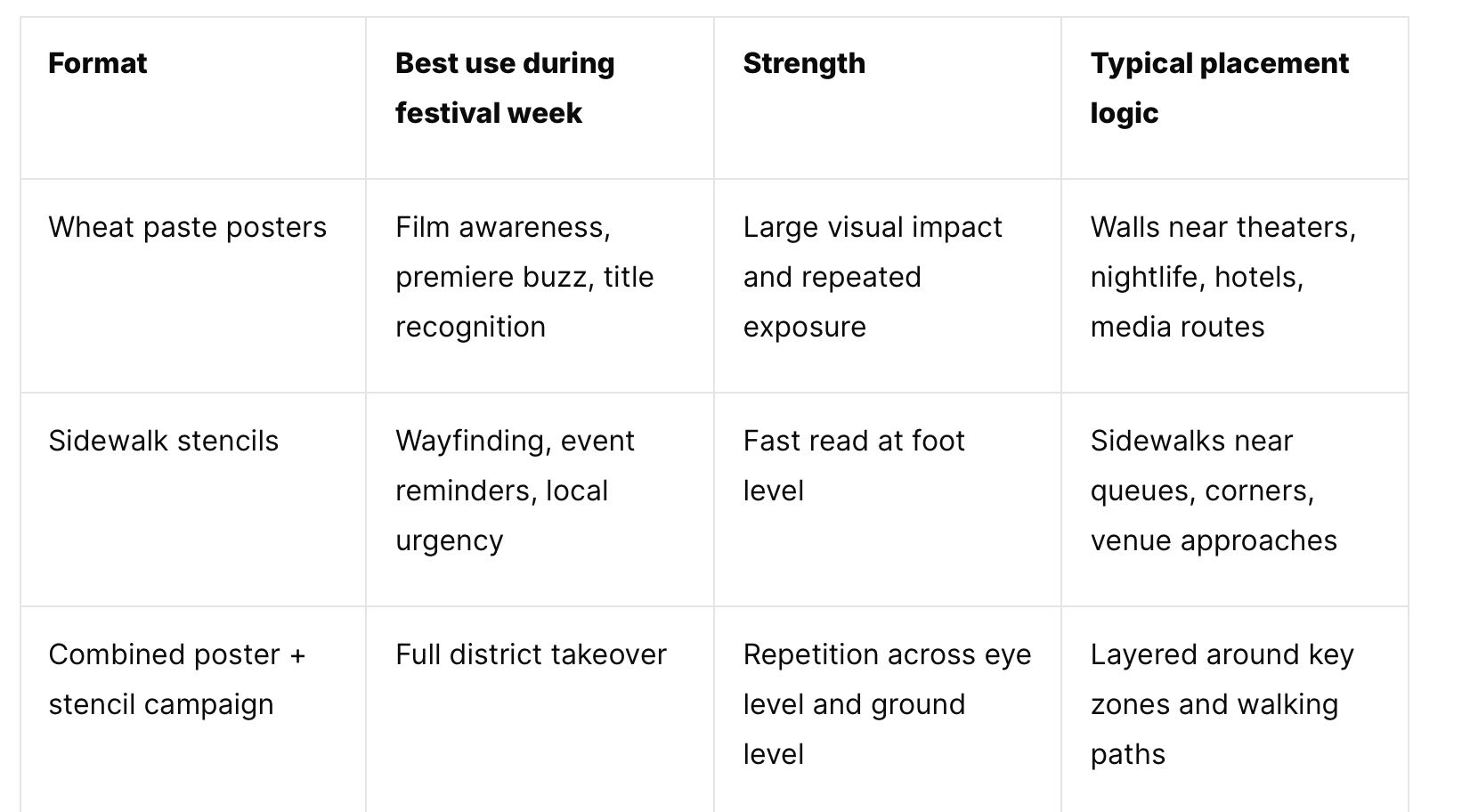
Marketing strategy and its use by Sidewalktattoos
The combined approach often wins because it mirrors how people move. They notice a poster from a distance, then encounter a stencil as they get closer to the venue. One format creates memory. The other prompts action.
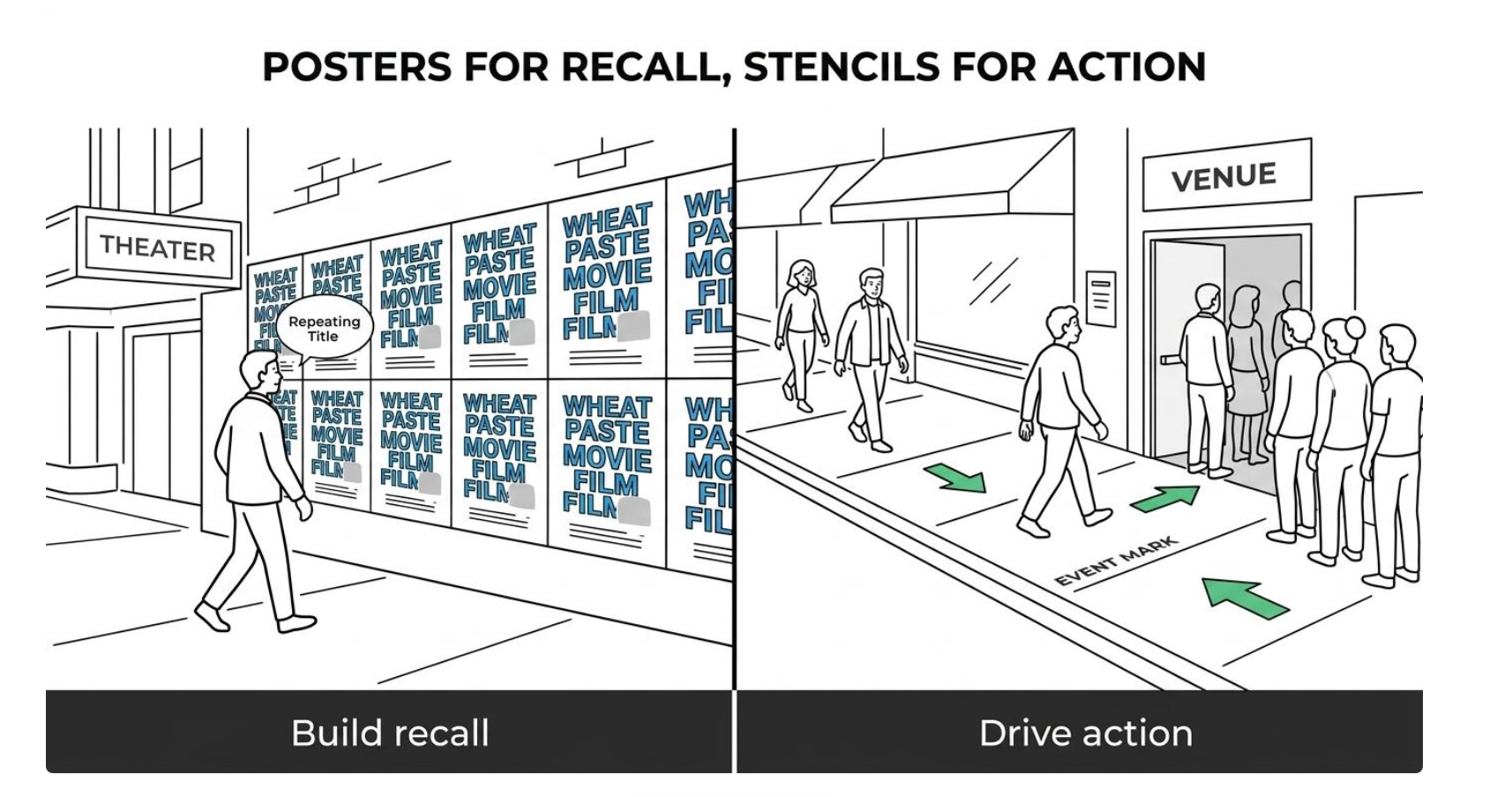
Stencil and Wheatpasting by Sidewalktattoos
Measurement and documentation make festival street campaigns accountable
Measurement and documentation make festival street campaigns accountable
Street marketing has a creative reputation, but strong execution is also operational. Festival teams need proof that installations happened where planned and when planned. They need mapped routes, timestamped photos, and location reporting that can be shared with distributors, marketers, partners, or clients.
That is where disciplined field documentation matters. A campaign should not end with “it went up.” It should produce a usable record of the activation across neighborhoods, blocks, and venue corridors. photo-documented execution make it easier to confirm coverage, assess placement quality, and compare the campaign against ticketing spikes, social chatter, or event attendance.
This also helps with follow-up decisions. If one theater district outperformed another, the next push can shift there. If a poster cluster got heavy organic posting, the creative team has evidence about which image or phrase connected most strongly.
Good reporting usually includes a few practical layers:
block-by-block photo proof
geo-tagged placement logs
launch-day and refresh-day records
notes on high-traffic zones and standout placements
Measurement does not make street work less artistic. It makes it easier to repeat what worked.
Fast execution matters for film festival street campaigns
Festival timelines are compressed. A premiere gets added, a screening sells out, a party location changes, press heats up, or a title suddenly becomes the talk of the week. Campaigns need to move at the speed of that momentum.
That is one reason wheat pasting and sidewalk stencils are so effective. They can be activated quickly, updated quickly, and deployed in targeted zones without waiting on long traditional media cycles. A street team can respond to real conditions on the ground and keep the campaign close to the audience.
Timing is not only about launch day. It is also about staying visible through the middle of the week, when fatigue sets in and attention gets harder to hold. Fresh placements, selective reposting, and tactical stencil routes can keep the campaign feeling active while other messages start to fade.
For brands, filmmakers, publicists, and event promoters, this speed opens up a useful option: own the blocks that matter while the audience is still deciding where to go next.
Film festival street marketing works best when the city becomes the screen
The strongest festival campaigns treat the host city as active media. They do not wait for audiences to find a message online after a screening. They place that message where conversations are already happening, where lines are already forming, and where people are already making choices.
When that happens, street marketing does more than advertise. It shapes atmosphere. It tells festivalgoers what matters this week.
Reach out for more information :
929.678.0235
