
Conference Week at Moscone: Why San Francisco's Biggest Weeks Are Won on the Sidewalk
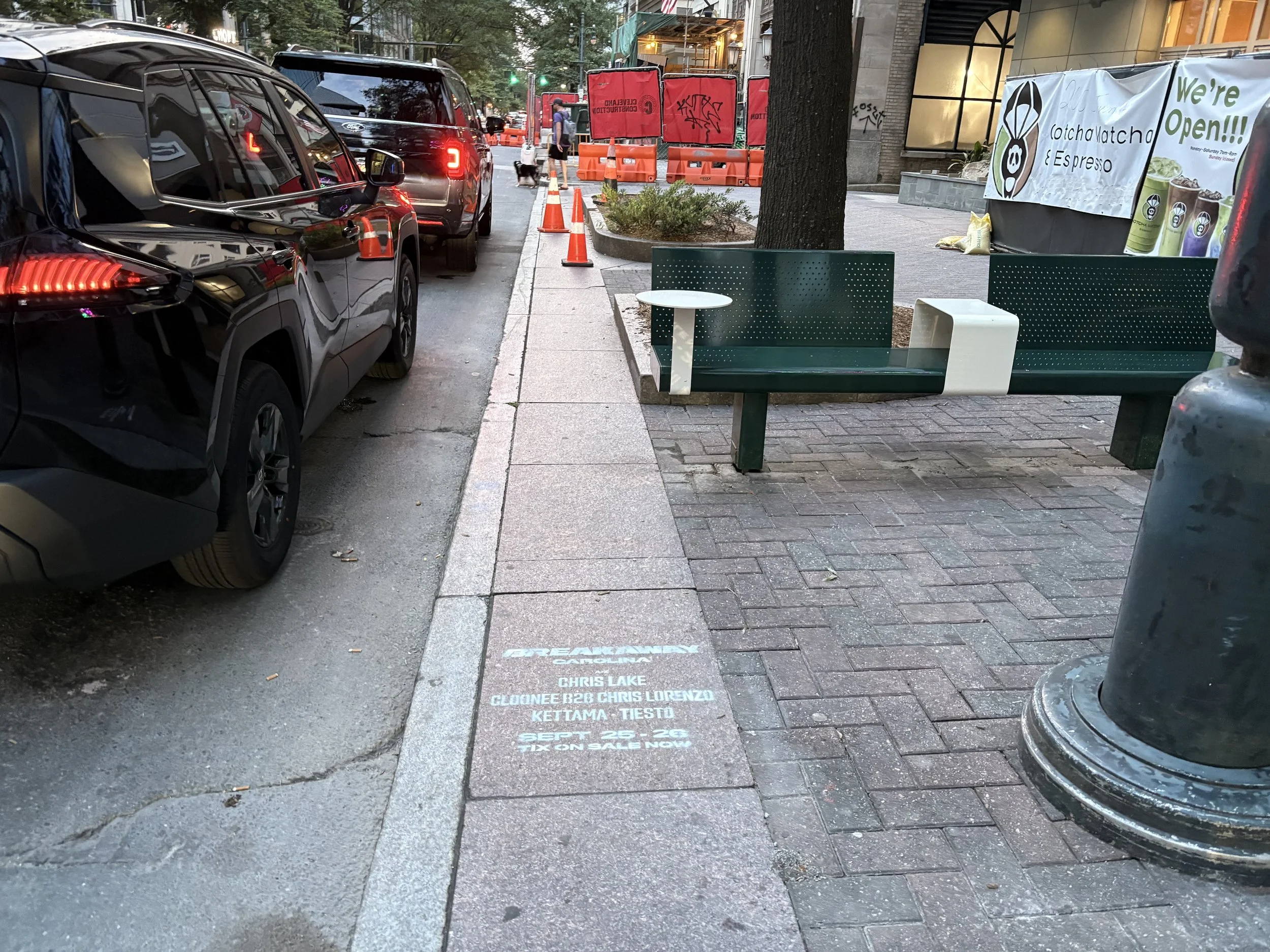
Stencil install by Sidewalktattoos
When Moscone fills up, San Francisco changes at street level first.
Thousands of attendees pour out of keynotes, cross Howard and 4th, line up for coffee, head toward hotel lobbies, drift into private dinners, and keep moving long after the convention hall closes. During those weeks, the sidewalk becomes the one channel everyone shares, whether they came for a global tech conference, a trade show, a brand summit, or a launch event.
That is why big conference weeks are often won outside the venue, not inside it. The brands that stay visible between sessions, between transit stops, and between after-hours plans are the brands people keep seeing.
Moscone Center conference weeks create concentrated sidewalk attention
Moscone is not just a major venue. It is a machine for compressing audience attention into a dense, walkable grid. According to the City and County of San Francisco, Moscone draws more than one million attendees and exhibitors per year. Its footprint includes more than 700,000 square feet of exhibit space and 106 meeting rooms. That scale matters because it pushes people into repeated pedestrian patterns, morning to night.
San Francisco Travel projects 38 Moscone Center events in 2026, generating 674,000 room nights. The same release projects 24.2 million visitors citywide and $9.9 billion in visitor spending. Those figures are useful not just as tourism data, but as media planning signals. A conference week is not a normal week. It is a temporary concentration of professional audiences, category insiders, media, partners, buyers, and creators all moving through the same blocks.
Downtown San Francisco’s own planning framework reinforces the point. The city describes downtown as compact enough that large hotels can cluster near the convention center while still connecting visitors to services north of Market. In plain terms, that means attendees walk a lot, and they often walk the same routes.
During conference week, the sidewalk does three jobs at once:
arrival path
meeting point
memory trigger
post-session overflow
nightlife handoff
Sidewalk advertising during conference week reaches people outside the badge zone
Inside Moscone, attention is expensive and crowded. Booths compete with booths. Sponsorships compete with schedules. Screens compete with each other. Many attendees are also moving too fast to give every indoor message a fair read.
Outside, the dynamic shifts.
On the sidewalk, your brand can intercept people before the keynote, remind them after lunch, and reappear when they are headed to a reception or dinner. A wheatpaste campaign or sidewalk stencil installation is not asking for forty seconds of fixed attention in a controlled space. It is building recognition through repetition in the real routes attendees already take.
That distinction is powerful.
Street placements also reach the people who matter around the event, not just inside it. Think agency teams without expo passes, local founders heading to satellite events, creators filming recaps, hospitality staff, rideshare users, press, and attendees bouncing between official and unofficial programming. Conference culture spills well beyond the venue walls, and the best campaigns meet that spill.
Downtown San Francisco foot traffic stays active after hours and on weekends
One of the strongest arguments for street media around Moscone is that downtown activity in San Francisco does not stop at 5 p.m. The Downtown San Francisco Partnership reported Saturday foot traffic in 2025 at 75% of the 2019 baseline and Sunday at 72%. The same report found that Muni weekend ridership averaged 94% of 2019 levels in 2025, nearly 20 percentage points higher than weekday recovery.
That matters because conference behavior is not purely office-hour behavior. People arrive early. They stay out late. They attend mixers, dinners, launch parties, investor gatherings, and side events. Downtown visits between 6 p.m. and midnight accounted for a larger share of activity in 2025 than in 2019, according to the same report.
So if a media plan only thinks about the keynote crowd at 9 a.m., it misses half the opportunity.
A strong conference-week street campaign follows the full rhythm of the district: morning commutes from hotels, lunch runs, afternoon breakouts, evening receptions, and weekend spillover when a major event overlaps with shopping, tourism, or nightlife.
Wheatpaste poster campaigns around Moscone work because they match pedestrian behavior
Wheatpaste works especially well during Moscone weeks because it fits how people scan the city on foot. A poster wall, a row of repeated placements, or a mapped set of installs along a corridor can create fast recognition without asking the viewer to stop.
That is the point. Conference attendees are in motion.
Sidewalk Tattoos’ San Francisco approach centers on areas where foot traffic remains active: transit stops, retail corridors, event venues, downtown commuter paths, and neighborhoods connected to conference traffic. Around Moscone, that logic is direct. Place messaging where people naturally slow down, wait, cross, queue, and regroup.
The best placements often fall into a few strategic buckets:
Transit adjacency: near Muni access points, rideshare drop zones, and key walking exits
Hotel-to-venue routes: paths between SoMa hotels, Moscone entrances, and nearby food stops
After-hours corridors: streets feeding bars, dinners, private events, and nightlife activity
Satellite event zones: blocks where conference week programming spills into galleries, rooftops, and pop-ups
Wheatpaste also has an advantage in conference week timing. It can be installed quickly, adapted to short campaign windows, and scaled across multiple blocks for repeated exposure. When the goal is to own a specific week, speed matters almost as much as creative quality.
Sidewalk stencils and wheatpaste posters create different kinds of recall
These formats work best together because they do different jobs.
A poster installation gives a campaign weight. It can hold a larger visual, a stronger brand world, a face, a product shot, or a headline that lands in one glance. It creates presence.
A stencil does something else. It feels embedded in the route itself. It can act like a directional nudge, a recurring signature, or a compact message that pops up again and again on the walk from one conference moment to the next.
Used together, they turn a district into a coordinated sequence instead of a single placement.
Here is a simple way to think about the split:
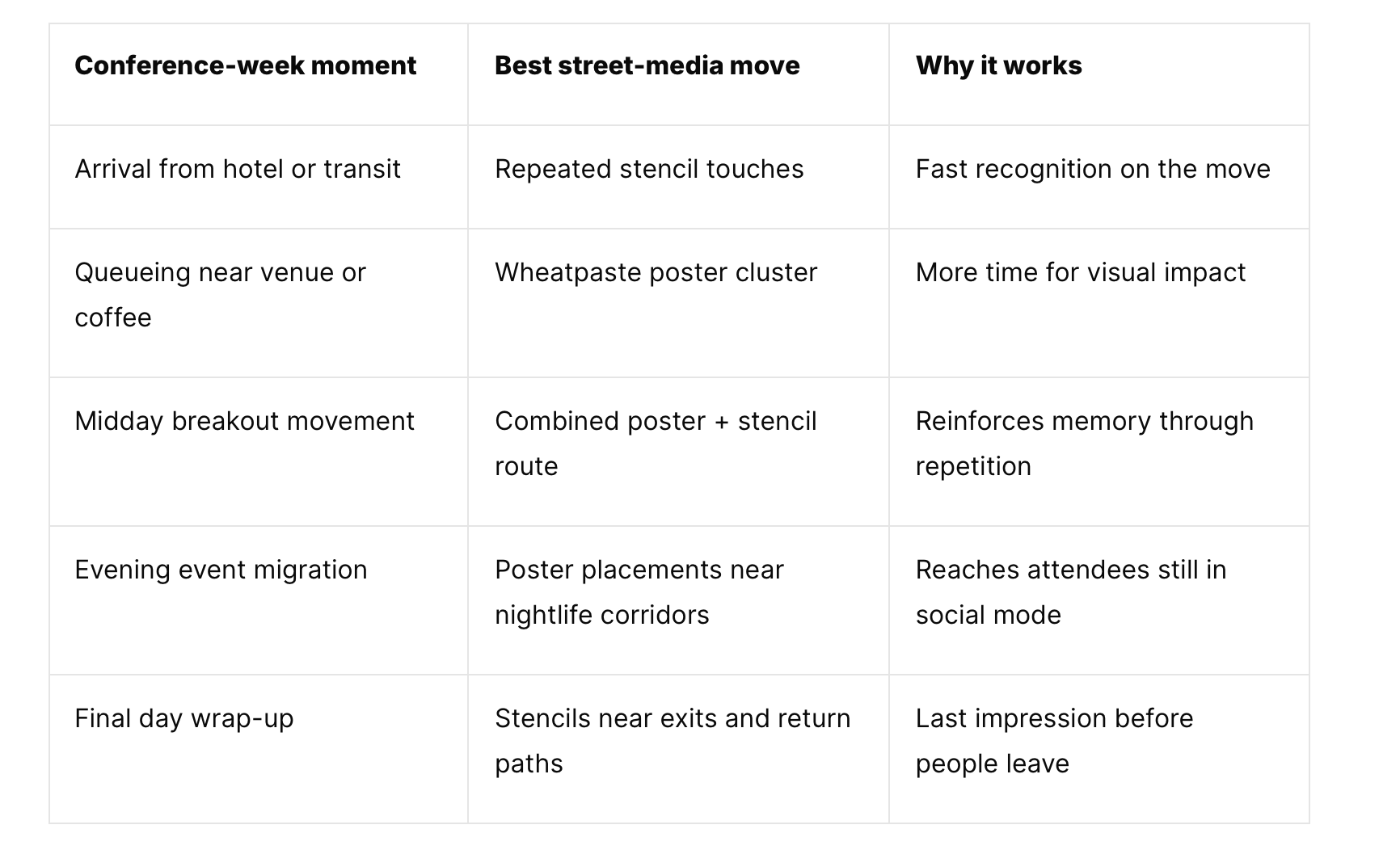
Conference week illustrations by Sidewalktattos
This pairing can be especially strong for launches, app brands, fashion labels, media properties, events, and companies that need to feel current rather than purely corporate.
Creative strategy for Moscone conference week street activations
Conference-week creative needs a different standard than always-on outdoor media. It has less time to make an impression and more competition from the city itself.
That usually means the message should be tighter, bolder, and more immediate.
Short phrases tend to travel better at street level. Strong iconography helps. Dates, booth numbers, QR codes, and product claims can work, though only if they remain legible at walking speed. If the campaign is tied to a launch party or satellite event, timing and location clarity matter more than decorative copy.
A few principles consistently make street creative stronger during a big Moscone week:
One message: keep the core idea unmistakable
One visual system: repeat colors, type, and graphic language across placements
One geographic logic: map installs to actual attendee flow, not abstract impressions
There is also a tone question. San Francisco conference audiences are highly literate in branding. They have seen polished booth graphics, overscheduled app alerts, and endless sponsored panels. Street work often performs best when it feels direct, confident, and culturally aware rather than overexplained.
Timing and execution matter during San Francisco conference weeks
A great concept can still underperform if it lands a day late or in the wrong sequence.
Conference weeks reward precise deployment. Often, the smartest timing is to activate just before peak arrival, then hold visibility through the middle of the week when side events and social circulation accelerate. For shorter bursts, a 48 to 72 hour activation window can be ideal, especially when the goal is maximum presence around a launch, keynote, or branded event.
Execution details matter because San Francisco streets move quickly. Good mapping is not optional. Neither is documentation. Geo-tagged photos, corridor coverage, and field reporting give brands a real view of what was installed and where the campaign was seen.
This is where experienced street execution stands apart from improvised flyering or generic out-of-home thinking. A mapped sidewalk campaign can be intentional, repeatable, and city-specific while still feeling organic on the street.
San Francisco sidewalk campaigns perform best when they respect local movement patterns
Moscone sits inside a part of the city built for heavy pedestrian circulation. The San Francisco Planning Department notes that downtown’s highest pedestrian volumes often require more space for movement and safe crossings where large numbers of people cross the street. That is useful context for media placement. The best activations do not fight the pedestrian flow. They work with it.
That means thinking in corridors, corners, pauses, and transitions. It means knowing where people naturally bottleneck and where they speed up. It means knowing which blocks remain lively after the expo floor empties out.
It also means accepting a simple truth: winning conference week in San Francisco is less about one premium moment and more about repeated presence across the attendee’s actual day.
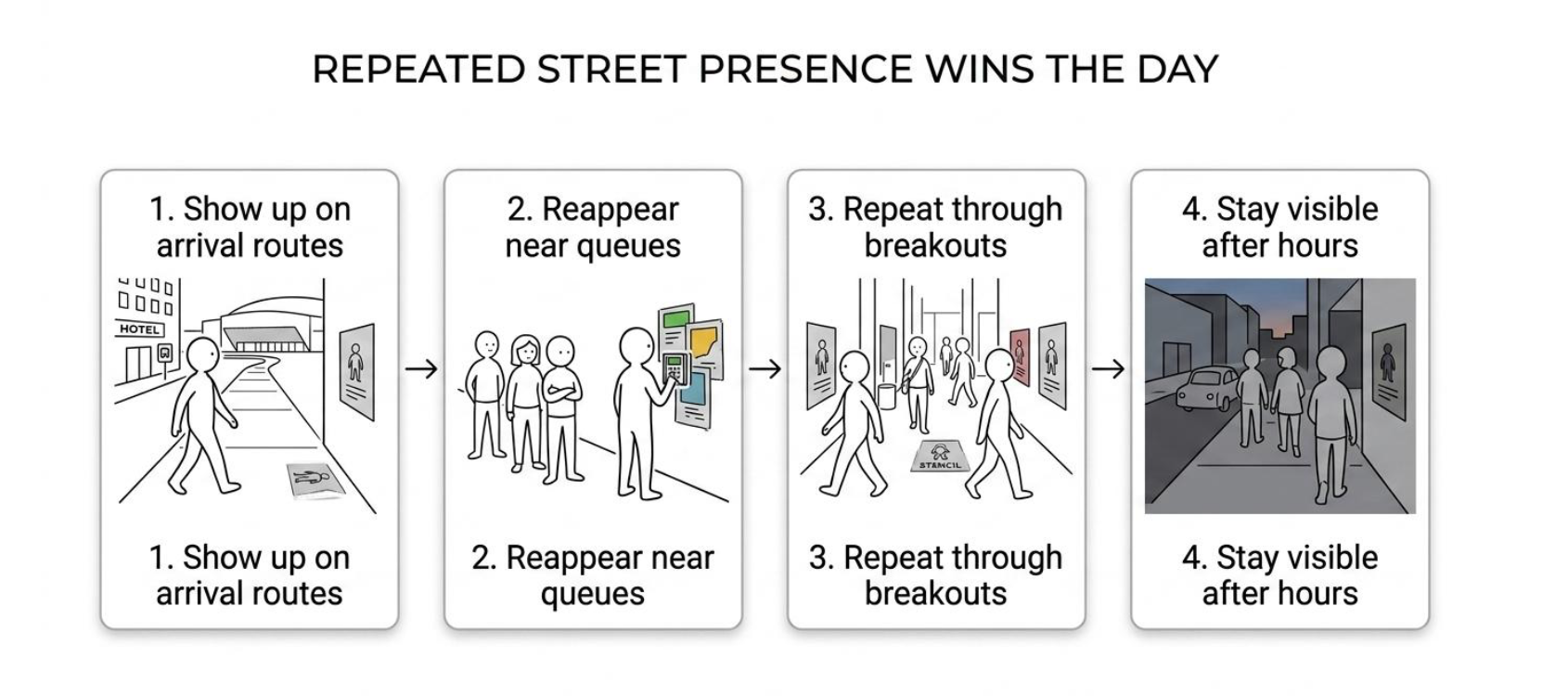
Street presence of posters by Sidewalktattoos
From breakfast to badge pickup, from breakout to bar, from keynote to curbside pickup, the sidewalk is where conference attention keeps getting reset.
Planning a Moscone conference week wheatpaste campaign
If a brand wants to show up big during San Francisco’s busiest event weeks, the planning window should start before everyone else begins buying indoor inventory. Street campaigns are strongest when the routes, creative system, and timing are set around the conference calendar rather than added at the end.
The practical brief is simple. Know who you want to reach. Know where they will walk. Know what single message should stay with them after a long day in a crowded city.
For Moscone weeks, that often means building around SoMa, downtown commuter paths, transit stops, hotel corridors, nearby retail movement, and the streets feeding after-hours venues. It also means using temporary, eco-conscious materials and a field team that can move fast without losing discipline.
If your next launch, event, or brand push is tied to a major week at Moscone, this is the moment to claim the blocks people actually remember. Contact Sidewalk Tattoos before the next conference hits, and put your message where the city is already looking.
