
Why Broadway in Nashville Rejects Stencils, and What Actually Works There
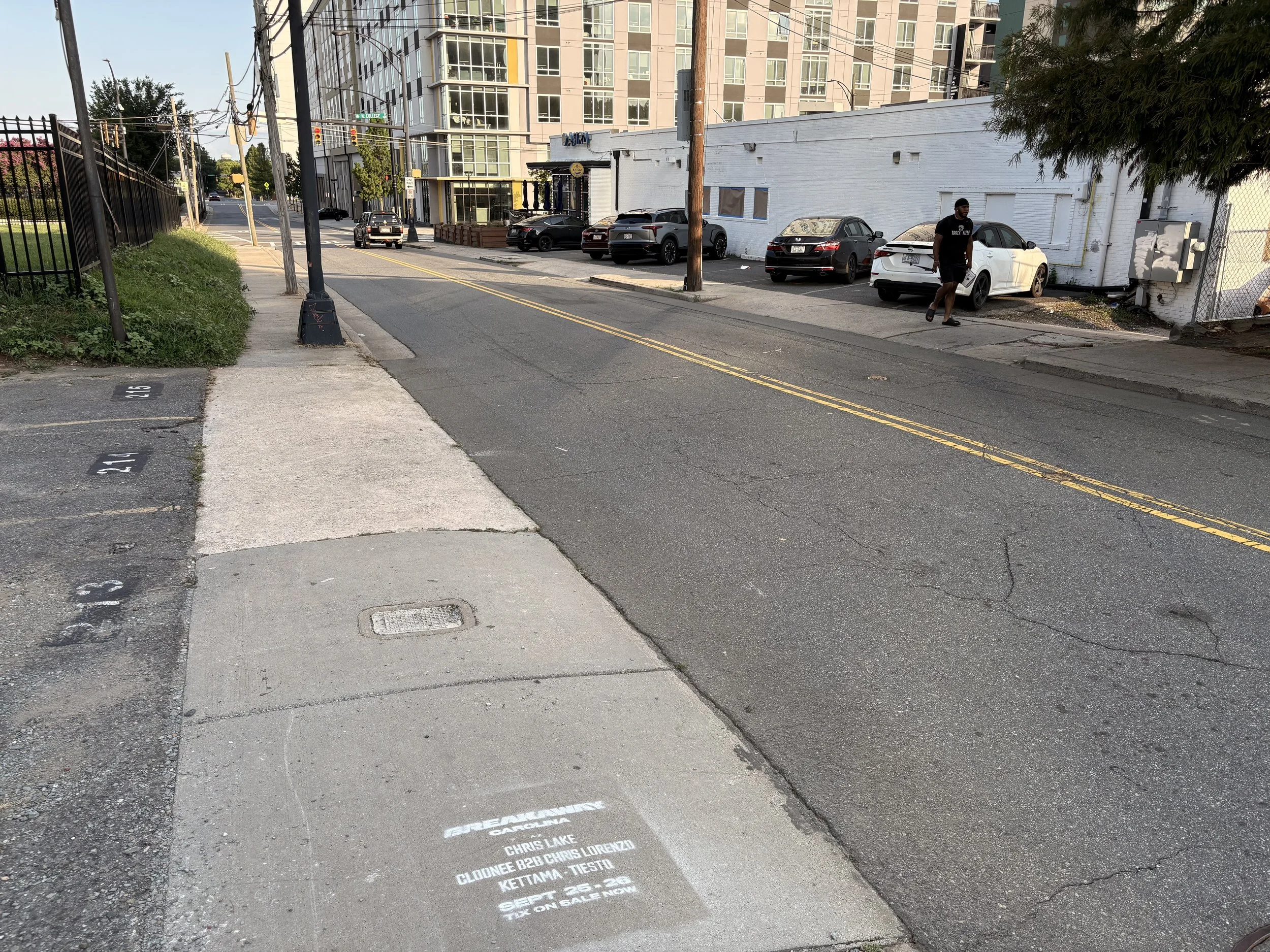
Clean, high-contrast street stenciling by Sidewalktattoos
Broadway looks like the obvious place for a street campaign in Nashville. It is loud, crowded, photographed constantly, and tied to nightlife in a way few corridors in the country can match. That visibility makes it attractive. It also makes it one of the hardest places to treat casually.
If a brand is considering sidewalk stencils on Lower Broadway, the honest answer is simple: this corridor is not stencil-friendly. Nashville’s rules, along with the way Broadway is actively managed for pedestrian flow and loading, push campaigns toward more controlled formats and more disciplined placement strategy. The result is not a dead end. It just means the plan has to fit the street.
Nashville Broadway stencil restrictions and public right-of-way rules
The first issue is legal, not creative. Nashville code does not treat streets, sidewalks, thoroughfares, and public rights-of-way as open ad surfaces. City ordinances prohibit affixing advertising matter on streets, sidewalks, and similar public areas, and the responsibility does not stop with the person physically placing the ad. The organizing or advertising party can be treated as responsible as well.
That matters because sidewalk stencil thinking often starts with a false assumption: if the mark is temporary, fast, or low-profile, it may slide by. Broadway is the wrong place to make that assumption. On a corridor with intense foot traffic and active city attention, “temporary” does not mean “acceptable.”
Nashville also has permit pathways for specific temporary uses, which reinforces the point. Public space use is regulated, reviewed, and approved case by case where appropriate. It is not an open canvas for ad hoc ground-level installs.
A practical read of the corridor looks like this:
Public right-of-way restrictions
Permit reality: Temporary occupation of sidewalk space is regulated, not informal
Liability exposure: The advertiser or organizer may be treated as the responsible party
Enforcement risk: Materials creating a safety issue can be cited and removed
This is why Broadway rejects stencil-first planning. The issue is not whether stencils are visually effective. They often are. The issue is that the corridor’s rules and operating conditions do not support casual sidewalk-based advertising.
Lower Broadway pedestrian conditions make sidewalk stencils a weak fit
The second issue is physical. Lower Broadway is officially treated as a high-pedestrian-volume area with constrained walking space. Nashville has addressed that pressure with pedestrian improvements, added walking area, a dedicated loading zone, crossing changes, and temporary fencing measures tied to movement and safety. That tells you a lot about how the street functions.
When a city is actively expanding pedestrian room and managing crossing behavior, any street-level advertising concept that depends on unstructured ground placement becomes harder to justify. Broadway is busy at almost every hour that matters to brands. Crowds bunch near entrances, spill around corners, stop for photos, queue for venues, and surge after events. Even a well-designed stencil can become a poor operational fit if the surface is constantly blocked, cleaned, trampled, or scrutinized.
There is also the attention problem. On paper, a stencil on Broadway sounds powerful because so many people pass through. In practice, eye-line competition is fierce. Signage, facades, digital screens, vehicles, musicians, line movement, and nightlife energy all compete for attention. A ground-level message has to fight through one of the most saturated visual environments in the region.
That does not mean street-level marketing fails on Broadway. It means the format has to respect the corridor’s traffic pattern and visual hierarchy.
What actually works near Broadway in Nashville
The better answer on Broadway is usually controlled poster-led execution, often with campaign density and smart positioning doing the heavy lifting. In Nashville, that often means wheat pasting posters and custom poster installations in areas where placements can be planned, documented, and repeated at meaningful scale.
Custom poster installations work better here because they can be mapped around movement patterns instead of forced directly into the most constrained sidewalk moments. They can build frequency near Broadway, connect adjacent nightlife zones, and keep the creative at eye level, where the audience is already scanning.
A brand trying to own Nashville energy does not need a literal stencil under every boot on Lower Broadway. It needs visible repetition in the right places around the Broadway ecosystem.
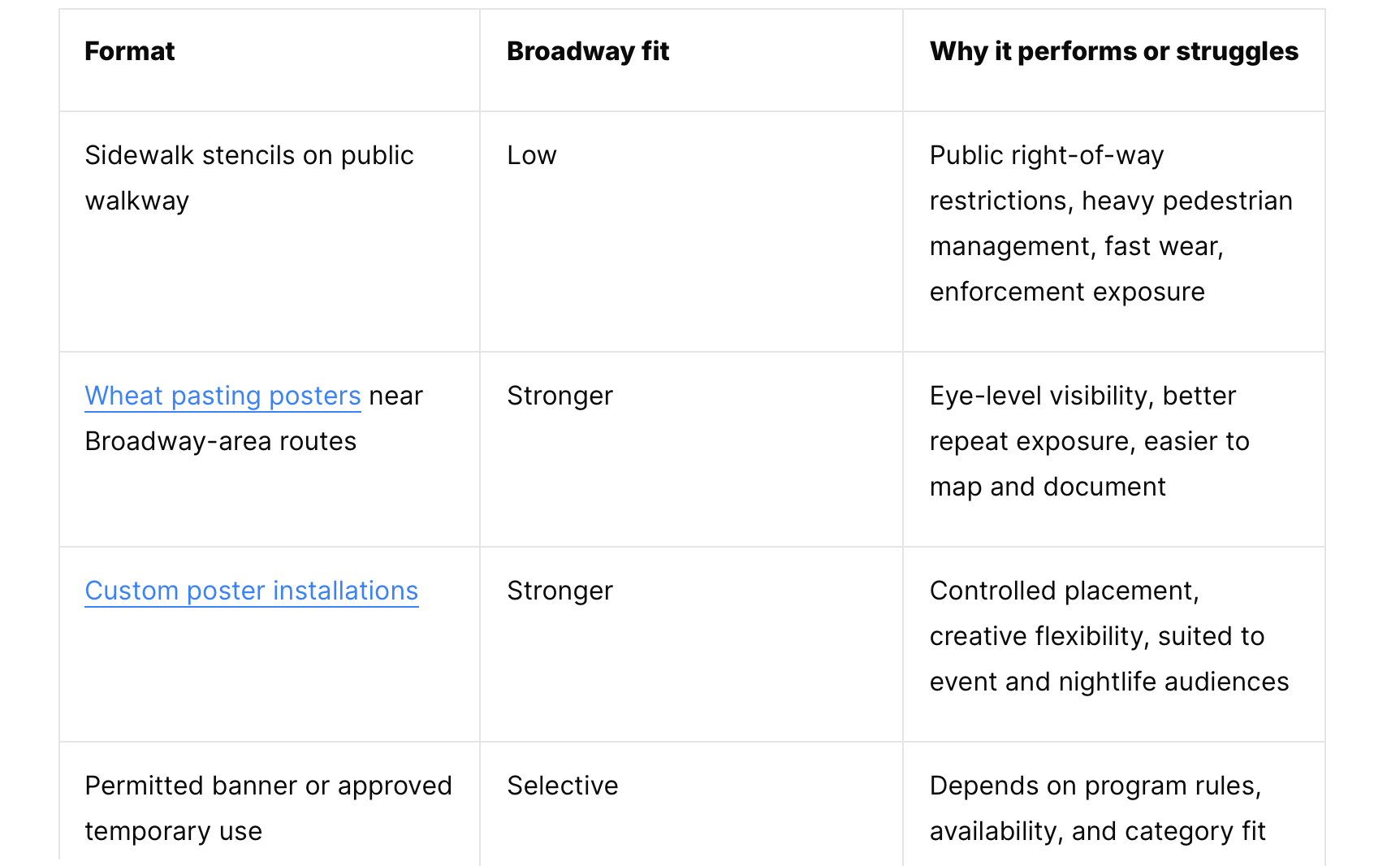
The difference between the use of stencil VS wheatpasting by sidewalktattoos
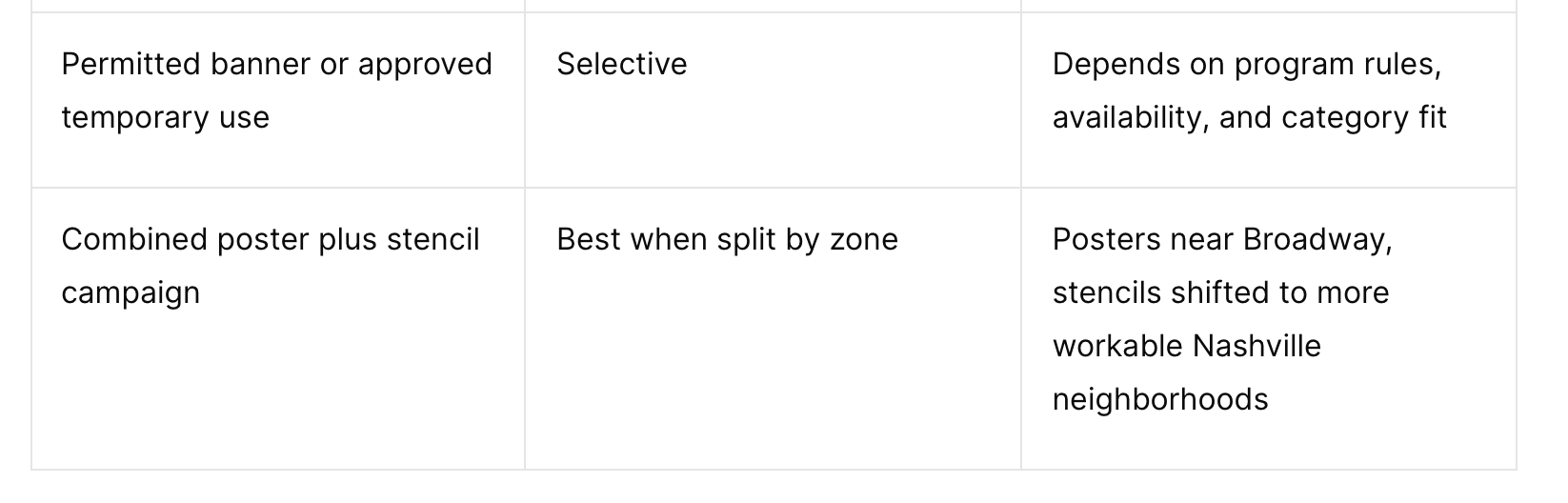
That last point is often the winning move. The most effective Nashville plans do not force one format into every street. They let each format do its job where the environment supports it.
Why controlled placements outperform ad hoc installs on Broadway
Broadway is a corridor where control matters. Control of placement. Control of sightlines. Control of compliance. Control of proof.
For brands and agencies, that changes the campaign brief. Success is not “get something on the ground in the busiest block.” Success is “build repeated, photo-documented visibility around the highest-value pedestrian stream without creating avoidable legal or operational friction.”
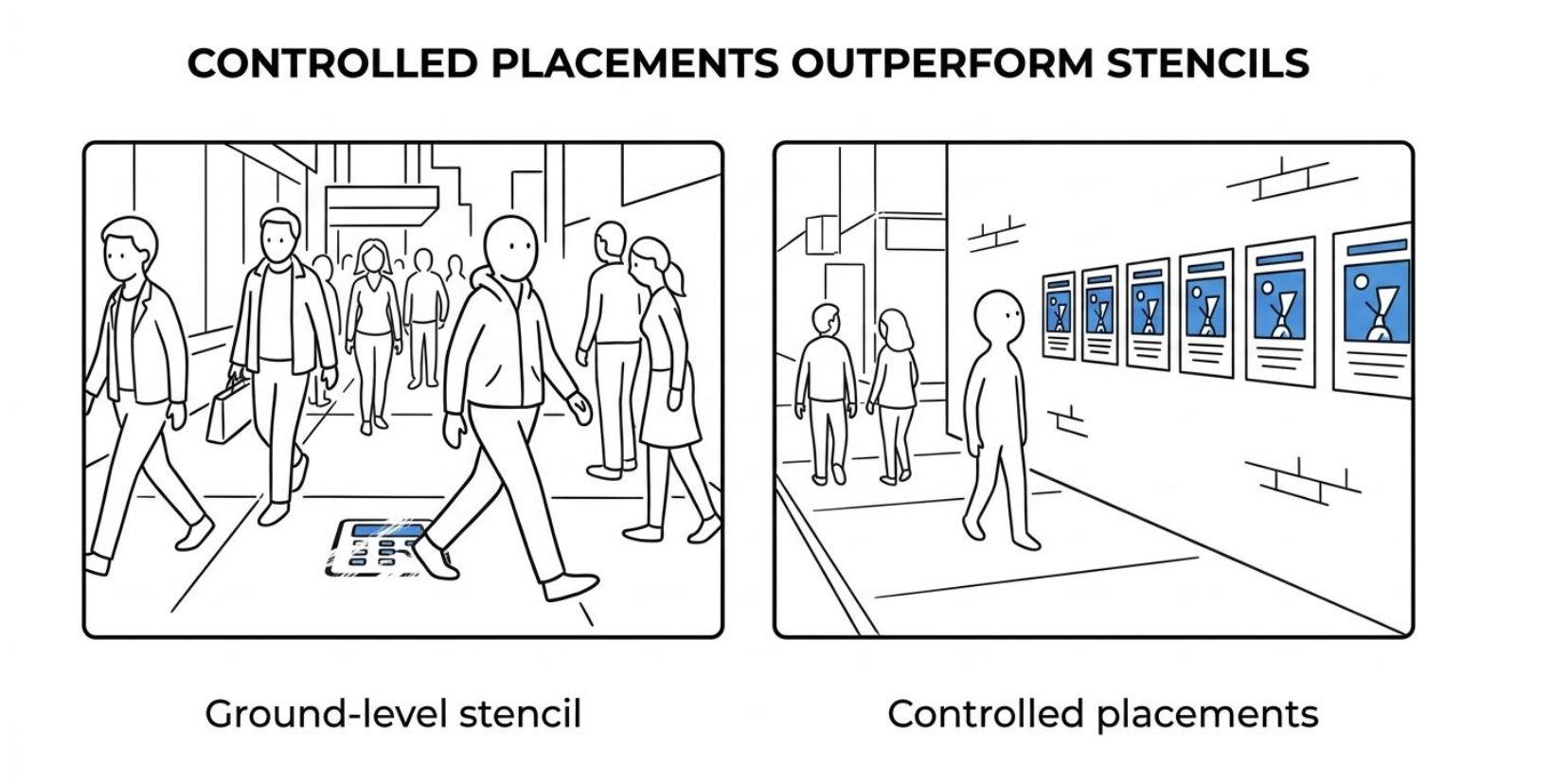
Ground level visuals vs Controlled placements by Sidewalktattoos
That is where mapped street campaigns stand out. A well-planned poster network can cluster near nightlife routes, venue traffic, hotel corridors, entertainment spillover, and adjacent districts that feed Broadway. The creative then shows up again and again as people circulate through the area, not only when they happen to look down.
A good Nashville street plan usually prioritizes:
Eye-level poster visibility
Repetition across multiple blocks
Geo-documented placements
Fast deployment windows
Corridor-specific format choices
Broadway rewards discipline. Brands that treat it like a free-form graffiti zone usually get poor longevity and unnecessary exposure. Brands that treat it like a managed urban media environment usually get much better results.
Where stencil activations fit better in Nashville
Stencils still have a place in Nashville. They just tend to work better outside the tightest Broadway conditions.
That means looking at neighborhoods and submarkets where pedestrian activity is strong but less compressed, where the visual field is not quite as overloaded, and where campaign routes can be designed with more consistency. Nashville campaigns often look beyond Lower Broadway to places like The Gulch, 12South, East Nashville, Midtown, Music Row, or other active entertainment and lifestyle zones, depending on the audience.
The value of stencils in those areas is different from the Broadway fantasy. Instead of trying to interrupt the single busiest tourist strip, stencils can create rhythm across a district. They can support a launch, push event awareness, build repeated directional cues, or extend a poster campaign into a second layer of street presence.
That works especially well when the audience is local-leaning, culturally tuned-in, or moving through neighborhood circuits rather than packed shoulder-to-shoulder in one entertainment funnel.
A practical placement split often looks like this:
Broadway-adjacent strategy: Poster-heavy visibility near the main traffic engine
Neighborhood stencil strategy: Tactical stencil density in more workable entertainment and retail districts
Event-week strategy: Use rapid deployment and concentrated placement to match venue schedules and crowd timing
Documentation strategy: Track every placement with photos and geo references for accountability
This kind of split-format planning is not a compromise. It is usually the smarter creative media decision.
Nashville permit pathways and approved alternatives matter
There is another reason Broadway resists informal stencil use: Nashville does provide structured channels for certain temporary or public-interest visual programs. The city’s sidewalk encroachment framework signals that sidewalk occupation is regulated. Its street pole banner program shows that some promotional visibility near the broader Broadway area can exist, but only inside defined rules and eligibility categories.
That distinction matters for marketers. It shows the city is not anti-visibility. It is pro-control. Broadway is one of the places where that difference becomes very clear.
A mature campaign plan should ask a few direct questions early:
Is this format appropriate for a public right-of-way?
Is there a permit pathway, property control, or approved use case?
Will the installation interfere with walking, loading, crossings, or safety?
Is the message better delivered at eye level than underfoot?
Can the same budget produce stronger frequency in adjacent placements?
Those questions save time. They also tend to produce better work.
How to build a Broadway-area campaign that actually performs
The strongest Broadway-area street campaigns usually begin with audience flow, not format preference. If the audience is moving from hotels to venues, from parking to bars, from event spaces to after-parties, the campaign should be mapped to those transitions. That opens up much more useful inventory logic than “put stencils on Broadway.”
It also gives the brand room to layer formats intelligently. Posters can anchor the main visibility push. Custom installs can sharpen creative impact in selected spots. Stencils, if used, can move into districts where they support the broader route instead of colliding with Broadway’s restrictions.
This is where execution speed matters too. Nashville can shift quickly around concerts, openings, tour stops, festivals, and media moments. Campaigns that can activate in a short window, document every placement, and adjust by zone have a clear advantage over one-note installs.
If the goal is to plan Nashville right, Broadway should be treated as the center of gravity, not the only surface that matters. That is a better media view of the city, and it tends to produce stronger street presence with fewer avoidable problems.
For brands, promoters, agencies, and artists, the useful question is not “Can we stencil Broadway?” It is “What is the highest-impact Broadway-area mix that fits Nashville’s rules and the way the corridor actually works?” When that question leads the planning process, the answer is usually sharper, more visible, and much more durable.
Reach out for more information :
929.678.0235
