
How Agencies Upcharge You Based on City Reachability, and What Fair Pricing Looks Like
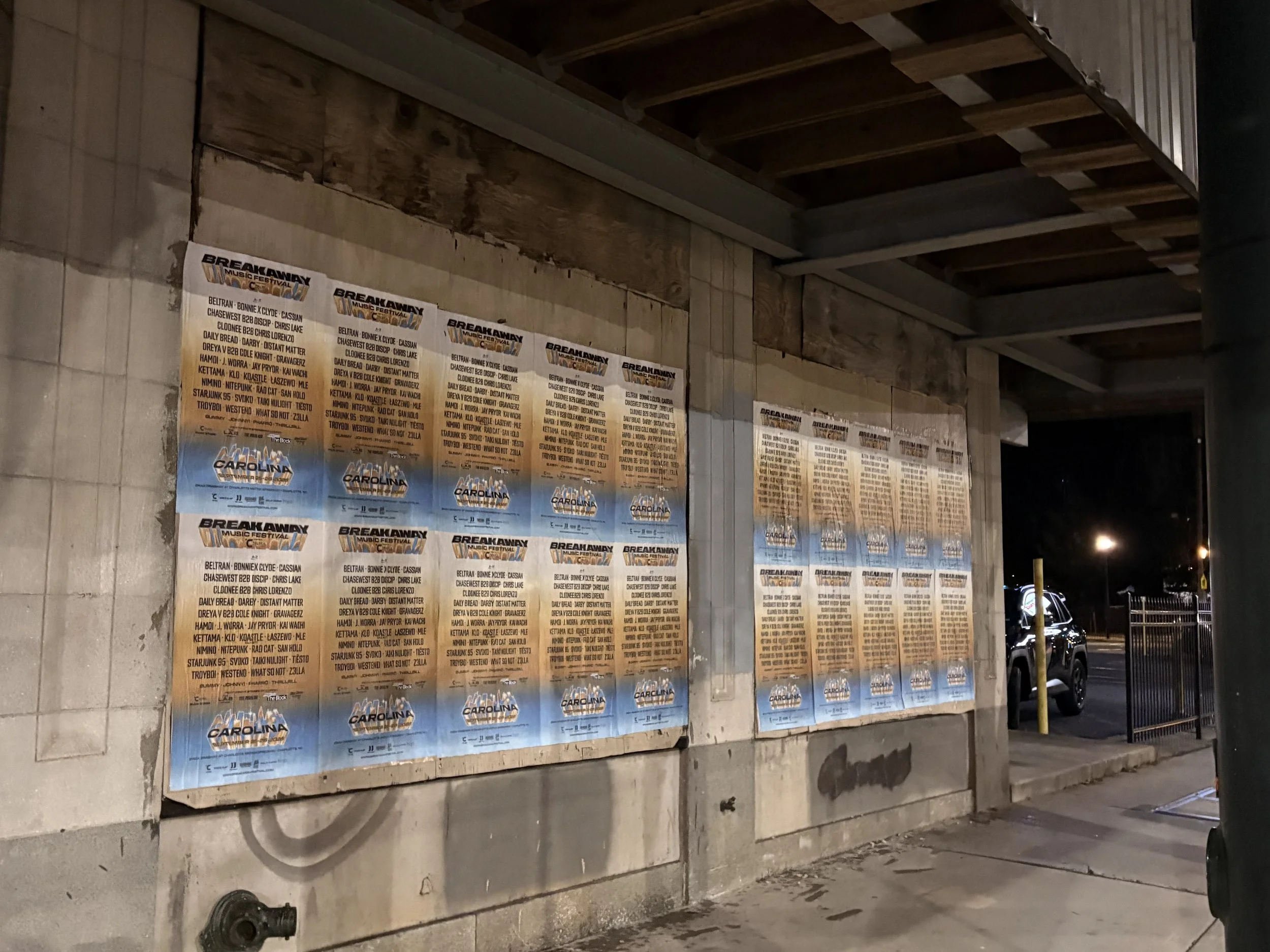
wheatpasting campaign for sidewalktattos
Street marketing is physical media, so geography is never just a line on a map. It affects crew time, transportation, local printing, scheduling windows, and how many placements can actually be completed in a shift.
The problem starts when a real cost factor becomes a vague pricing weapon.
Many agencies talk about “city reachability” as if it were a mysterious premium that only they can calculate. A brand gets quoted one number for a dense, familiar city and a much higher number for a place labeled hard to access, spread out, or operationally difficult. Sometimes that increase is justified. Sometimes it is simply margin wrapped in logistics language.
For marketers buying wheat pasting, sidewalk stencil activations, or multi-city street takeovers, the difference matters. A fair quote should separate true labor and travel costs from arbitrary upcharges, especially when rollout speed and market coverage are already pushing the budget.
Why city reachability changes street campaign costs
Not all cities are equally easy to execute.
A compact urban core with strong crew coverage, nearby print partners, and predictable routes is cheaper to activate than a metro with long driving distances, fragmented neighborhoods, parking constraints, strict local rules, or a limited bench of dependable installers. If an agency is sending teams into high-traffic areas across multiple zones in one day, the city’s layout directly affects how much work can be completed per hour.
That is not theory. It shows up in real execution. In one 18-city same-day wheat-paste campaign, each market required local print partners, installation teams, and compliance teams because of local regulations, traffic patterns, and print timelines. That kind of rollout is operationally serious. It should not be priced like a single-neighborhood flyering job.
Reachability also changes depending on the format. Wheat pasting poster installations may require more material handling, more visible placement strategy, and more coordination with local print. Sidewalk stencil activations may involve route efficiency, surface selection, timing, and cleanup standards. The city can affect each format differently.
A useful way to think about reachability is this: it is not just distance, it is friction.
How agency markups get hidden inside city pricing
The hard part for buyers is that reachability markups are rarely labeled clearly. They often get blended into broader categories, which makes an inflated quote look operationally normal.
A quote might show a single “city execution fee” without explaining how much of it covers real labor, how much covers travel, and how much is simply premium pricing because the client lacks local context. In street marketing, that is where budget discipline can slip fast.
Common hiding places for reachability markups include:
Travel charges: mileage, tolls, parking, flights, hotels, ferries
Labor multipliers: longer shifts, split routes, overtime, local crew scarcity
Rush premiums: compressed printing and install windows stacked on top of city fees
Coverage inflation: standard neighborhood spread described as unusually difficult
Management overhead: extra coordination fees with no clear scope change
None of those categories are illegitimate by themselves. The issue is opacity.
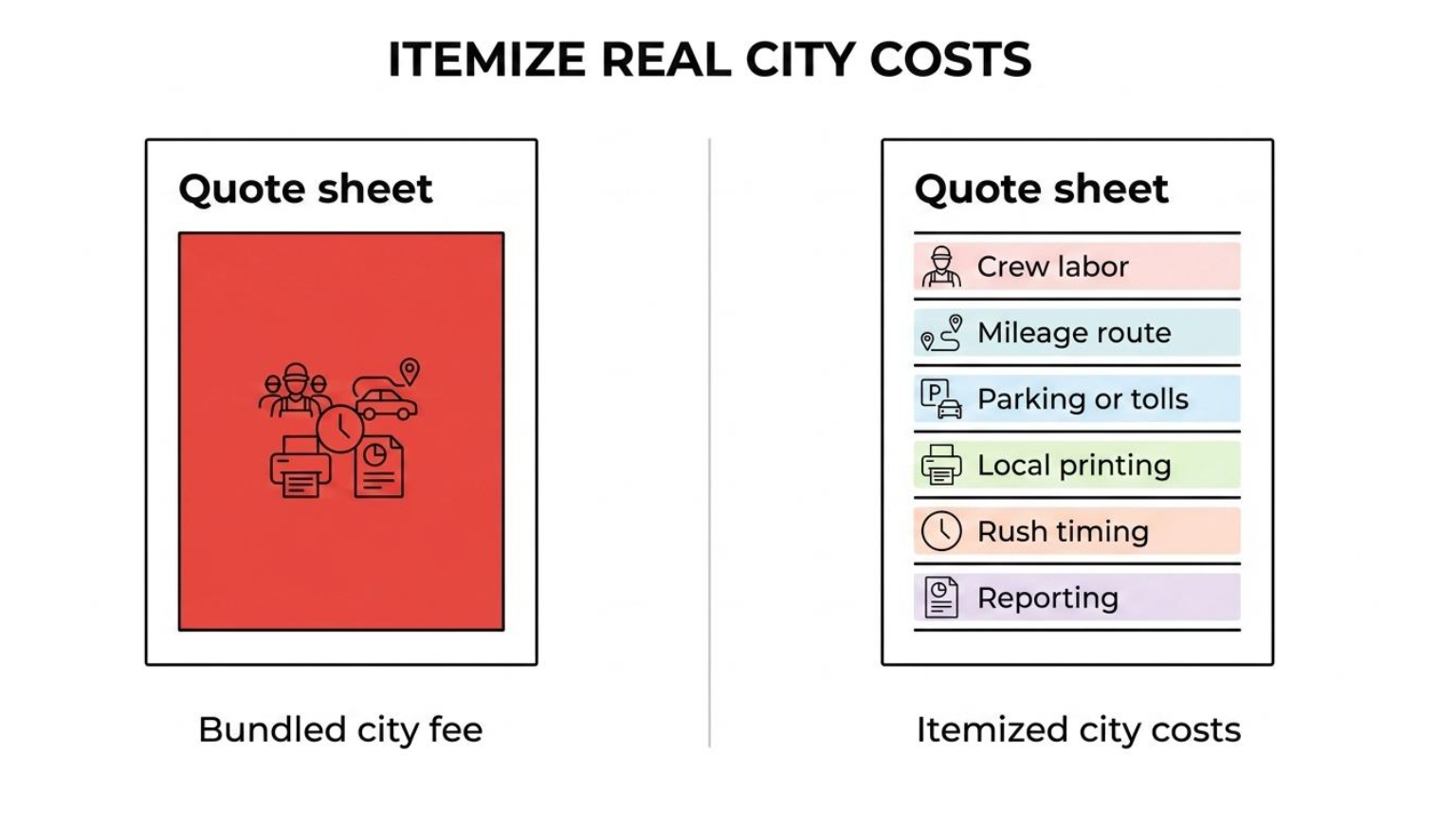
Campaign cost illustration by sidewalktattos
If an agency says a city is expensive because it is “hard to reach,” the next question should be simple: hard for whom, and based on what? A city may be expensive because local wages are higher, because a suburban spread requires significant drive time, or because a national same-week launch forces local print in every market. Those are real reasons. “That market is tricky” is not.
Fair pricing benchmarks for labor, travel, and city access
Fair pricing starts with itemization. A buyer should be able to see the structure of a quote, not just the total.
Public data helps here. The U.S. Bureau of Labor Statistics notes that wages often run higher in large metropolitan areas, with cost of living and related factors pushing pay upward. That supports a real labor difference between markets. A crew day in San Francisco should not cost the same as a crew day in a smaller, less expensive metro if local labor is being sourced properly.
Travel also has a usable benchmark. The IRS standard mileage rate for 2026 is 72.5 cents per mile for business driving. The IRS states that this rate is optional, not mandatory, yet it still gives buyers a concrete reference point for vehicle use. If a team is driving across a large market all day, mileage-based billing can be reasonable. If an agency charges a large flat travel premium with no route logic behind it, that deserves a closer look.
Labor pricing in metropolitan areas should vary, but not wildly
There is nothing suspicious about labor costing more in a large metro.
The BLS point matters because street campaigns are not abstract media buys. They depend on real people doing real work in real cities. If wages trend higher in major metropolitan areas, buyers should expect some city-by-city labor variation. That is normal and healthy.
What should raise concern is the size and logic of the jump. If one city is 12 percent to 20 percent higher than another because local crew rates, driving time, and parking all stack up, that may be easy to justify. If the quote doubles because the market is “less reachable,” something else is going on.
Fair labor pricing usually has a few traits:
local crew sourcing
rate differences tied to market conditions
route-based time estimates
clear overtime rules
documented deliverables
That kind of structure builds trust because it connects price to execution.
Travel pricing should use a recognizable benchmark
Mileage should not feel mystical.
If an installation team is covering a wide metro, vehicle use can be estimated with route planning and billed as a pass-through or near-pass-through cost. The IRS mileage rate is useful because it creates a public reference point for business driving. Again, it is optional, not a required billing method, though it gives buyers a way to test whether a quote is in the realm of reason.
A fair travel model often looks like this:
Mileage: estimated or actual business driving near a known benchmark
Tolls and parking: billed at cost
Hotels or flights: only when local execution is not available
Extra drive time: reflected in labor hours, not hidden in a mystery fee
When an agency already has local teams in place, reachability premiums should generally drop. That is one of the clearest advantages of a distributed field network. The agency is not reinventing execution every time a client adds a city.
A practical pricing framework for wheat pasting and sidewalk stencil campaigns
Street campaigns tend to price cleanly when four variables are separated: format, coverage, timing, and rollout size.
Format matters because poster installs, stencil activations, and mixed campaigns have different material and labor profiles. Coverage matters because a compact downtown blitz is not the same as a citywide mapped push across several neighborhoods. Timing matters because a 48 to 72 hour activation window can trigger local print and rush scheduling. Rollout size matters because one city, five cities, and eighteen cities create very different coordination loads.
That framework is visible in how scaled street campaigns are actually run. Teams built for national execution often scope around format, city coverage, timing, and rollout size because those are the inputs that change cost in the field.
Here is a practical model buyers can ask for:
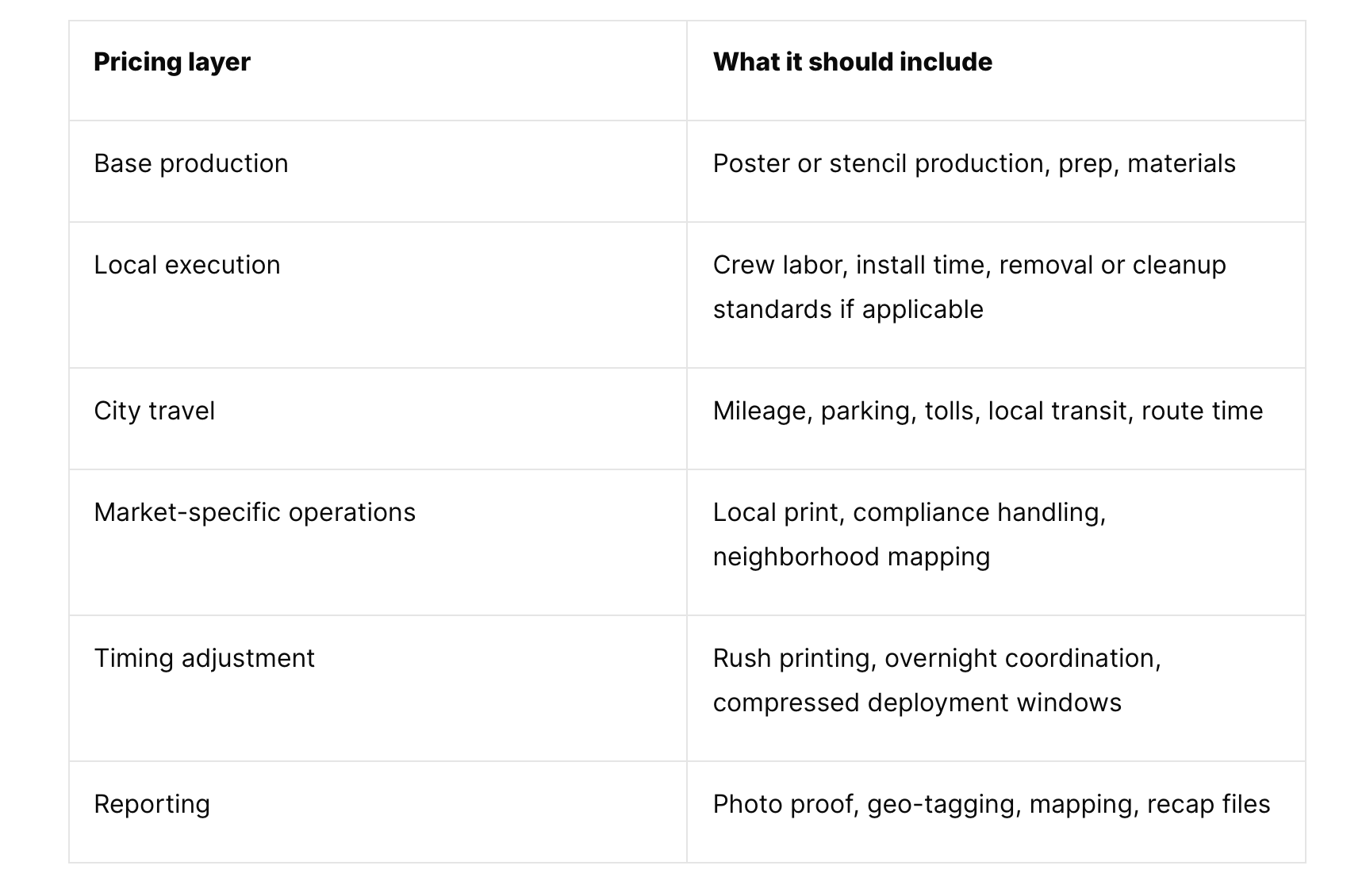
Campaigns package details by sidewalktattos
This model does something important: it forces reachability to show up where it actually lives. If a city is harder to cover, the difficulty appears in labor hours, route miles, parking, local print, or scheduling. It does not need a floating surcharge with no anchor.
Signs a city reachability fee is reasonable and signs it is not
Buyers do not need perfect field knowledge to spot a fair quote. They just need the right pattern recognition.
Reasonable signs include route logic, city-specific crew assumptions, local print necessity, and documentation commitments. Red flags include giant flat fees, repeated “complexity” charges, and unexplained premiums that appear only after a city list is shared.
A simple screen helps:
Itemized travel and labor
City-by-city assumptions
Rush fees separated from access fees
Local vendor logic for fast launches
Photo and geo documentation tied to scope
No unexplained “market premium”
Questions to ask before approving a city-based agency quote
A strong agency should welcome these questions because clear pricing makes operations easier on both sides.
What part of this quote is labor, what part is travel, and what part is production?
Are city premiums tied to local crew rates, drive time, parking, or print constraints?
If mileage is billed, what route estimate or benchmark is being used?
Is local printing necessary for timing, or is it simply being marked up?
Are rush charges separate from reachability charges?
What proof of execution is included in the price?
One more question often changes the conversation fast: if this city became part of a larger rollout, would the per-city premium go down because coordination and local sourcing improve?
That question gets to the heart of fair pricing. Reachability is real, but it should become more efficient as an agency gets better at mapped deployment, local team coverage, and repeatable execution across markets.
For brands buying street media, that is the standard worth expecting. Pricing should reflect the city, not exploit the client’s distance from it.
Reach out for more information :
929.678.0235
