
The Truth About Wheatpasting and How It Really Affects Marketing Standards
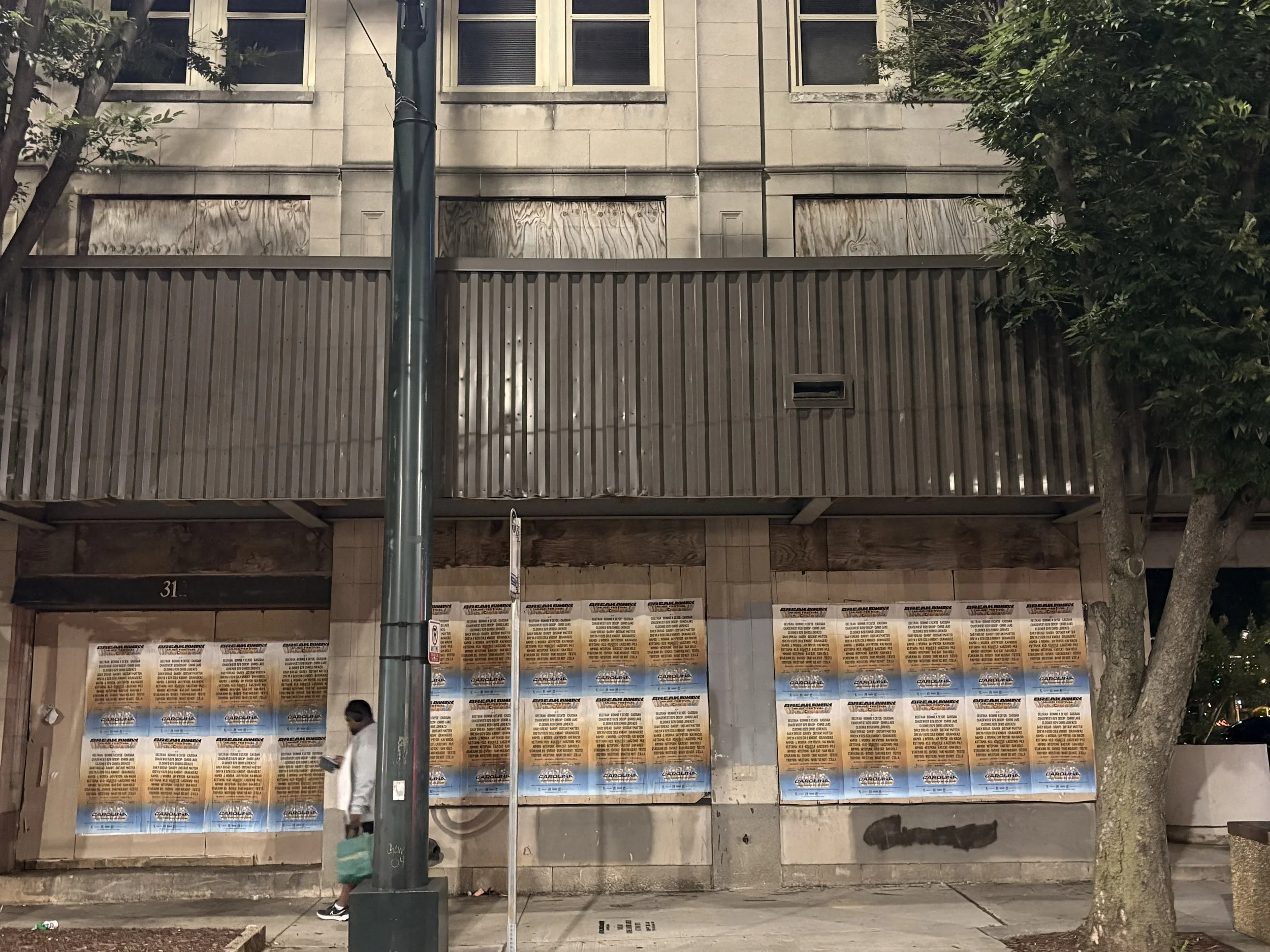
wheatpasting install by sidewalktattos
Wheatpasting has always had a reputation problem.
To some people, it still sounds like a fringe tactic, something improvised, messy, or outside the standards that govern serious advertising. Yet that view no longer matches how the strongest street campaigns are planned and judged. Today, wheatpasting often sits inside the same performance conversations as out-of-home, experiential, social content, and local market launches.
That shift matters because wheatpasting did not just give brands another place to put creative. It changed what many marketers now expect from visibility itself: speed, street credibility, neighborhood relevance, and proof that real people actually noticed.
Wheatpasting in modern street marketing
At its simplest, wheatpasting is the installation of printed posters onto approved or available urban surfaces using a paste adhesive, often as part of a concentrated street-level campaign. In practice, modern wheatpasting is far more structured than the stereotype suggests. It can involve mapped routes, coordinated installations, photo reporting, geo-tagged documentation, and synchronized timing across multiple neighborhoods or cities.
That makes it less of an outlier and more of a flexible branch of out-of-home advertising. It shares the same basic goal as a billboard or transit ad, which is to place a message in public view, but it does so with a different kind of immediacy. The work happens closer to pedestrians, storefronts, nightlife, retail corridors, music venues, and event traffic. The street becomes part of the message.
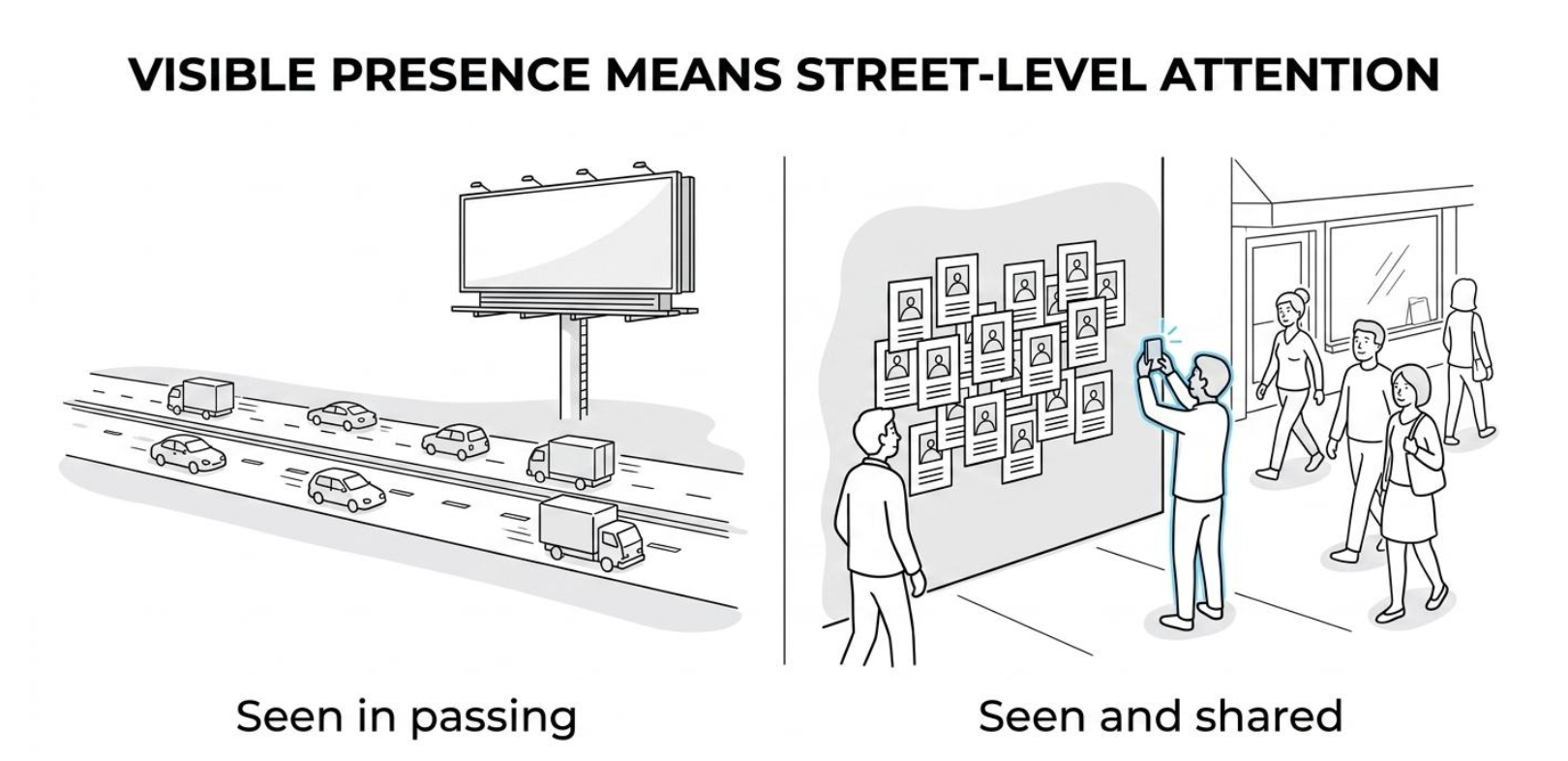
sidewalktattos campaign attraction
This is where the perception gap shows up. Wheatpasting may look raw, but high-quality execution is often highly controlled.
Wheatpasting and marketing standards for visibility
Traditional media taught brands to think in terms of polished placements, broad reach, and fixed inventory. Wheatpasting introduced another standard: visible presence in the exact places where culture moves first.
That has changed the benchmark for what “being seen” means. A brand is no longer judged only by how many people could have passed a placement. It is also judged by whether the placement feels current, whether it belongs in the environment, and whether it creates enough friction or excitement to spark a reaction.
In street marketing, presence now carries a few different expectations:
Real neighborhood context
Fast deployment
Repetition across a walkable area
Organic phone-camera moments
Creative that feels native to the street
These are not minor preferences. They have become part of the standard many launch campaigns are measured against, especially in fashion, music, tech, nightlife, and pop-up promotion. A polished ad in a controlled media buy can still perform well. But it may not create the same sense of immediacy as a takeover that suddenly appears around a district people already associate with style, nightlife, or influence.
Published campaign examples help illustrate the point. Sidewalk Tattoos has shared case material stating that a True Religion wheatpaste campaign in Houston was installed within 24 hours of receiving final artwork, with broader deployment across major U.S. cities on the same turnaround model. In another published example, the agency says it installed 600 jumbo 48x72-inch posters and 100 sidewalk stencil hits for a Yonex Soho pop-up, producing the kind of street density that people photographed and shared on their own.
That is not just a story about speed. It is a story about a new marketing standard: if a campaign can be launched quickly, dominate a local footprint, and generate proof of attention, brands start expecting all channels to move with that level of urgency.
Truth-in-advertising rules still apply to wheatpasting
There is an important truth behind the paste that does not get enough attention: wheatpasting may feel unconventional, but it is still advertising.
That means the same truth-in-advertising rules still matter. The Federal Trade Commission makes clear that advertising standards apply across media formats, including billboards and buses. The format does not create an exemption. If a street poster makes claims about a product, price, health benefit, performance level, or competitive advantage, those claims still need support.
This is one of the biggest ways wheatpasting has affected marketing standards. It has pushed brands to combine street authenticity with legal and strategic discipline. A campaign can look disruptive without being careless.
The strongest operators treat wheatpaste creative the same way they would treat paid media creative:
Claim review: product, pricing, and performance statements need substantiation
Creative consistency: street posters should match the broader campaign message
Audience sensitivity: regulated categories need extra caution
Documentation: proof of what was posted, where, and when protects the campaign record
That matters even more because street placements can feel intimate and immediate. A consumer may encounter the message at eye level, near a store, near an event line, or on a route they walk every day. When an ad is that close to real life, sloppy messaging stands out fast.
Out-of-home measurement standards and wheatpasting performance
Another misconception is that wheatpasting sits outside normal media standards because it lacks the rigid structure of classic out-of-home inventory. The reality is more nuanced.
Traditional out-of-home has formal categories, recognized sizes, and standard measurement systems. The Out of Home Advertising Association of America identifies bulletin formats as among the largest standard-sized OOH units, and notes that TAB OOH Ratings are the official measurement system for those placements. Public health and media reference materials have also long referenced poster sizes like 30-sheet and 8-sheet units, each tied to different traffic environments and use cases.
Wheatpasting does not always fit neatly into those same inventory buckets, yet it still exists in relation to them. Brands compare it against the same business questions: How visible was it? How concentrated was the market coverage? Did it reach pedestrian traffic? Did it create recall? Did it drive social content? Did it support retail or event attendance?
Here is a practical way to think about the difference:
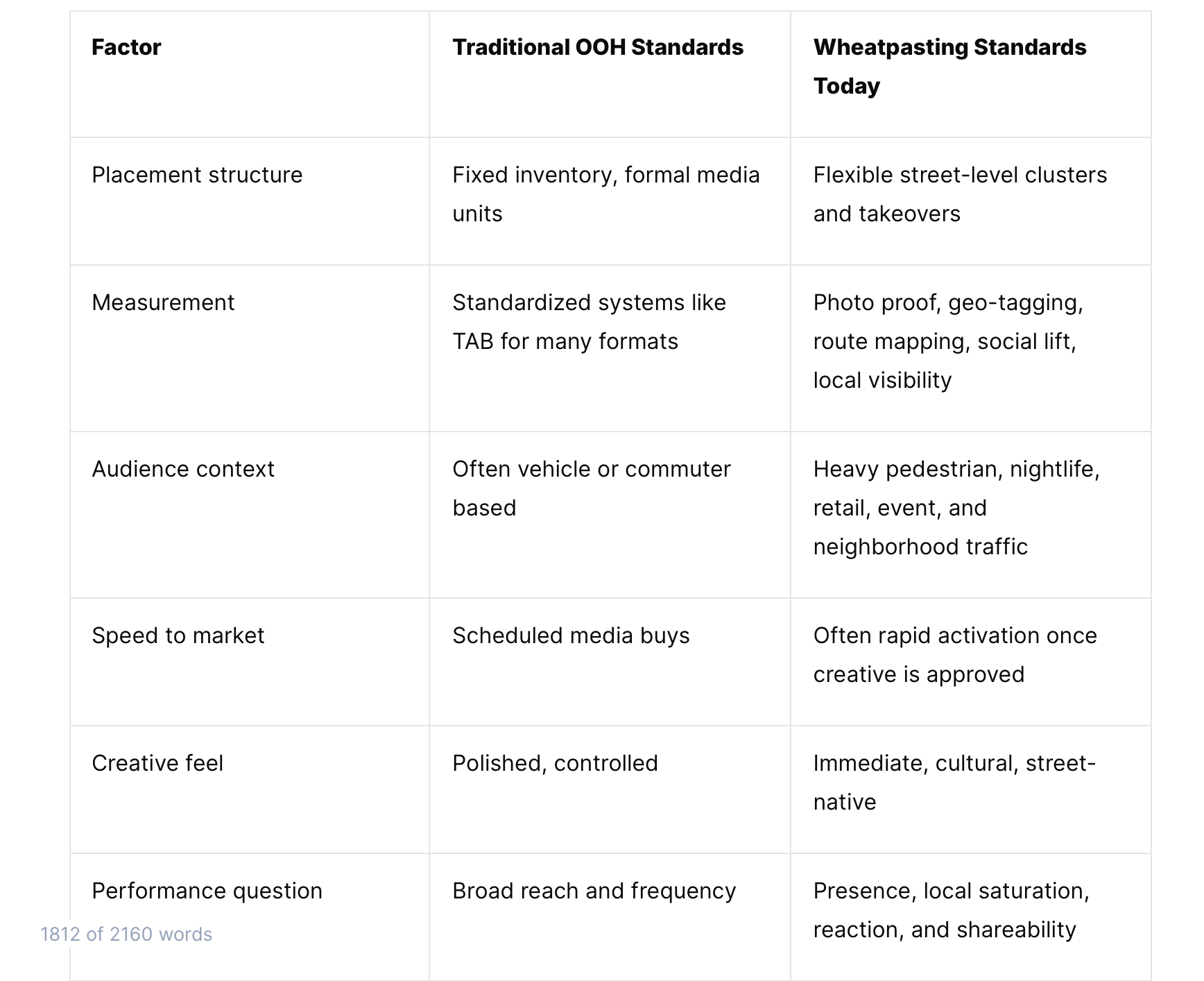
wheatpasting factors and standards by sidewalktattos
This comparison helps explain why wheatpasting has had such a strong effect on marketing standards. It did not replace measurement. It expanded the definition of what counts as meaningful exposure.
A street campaign may not always deliver the same type of audited reporting as a premium bulletin network, but it can deliver something many brands now value just as much: visible concentration, cultural placement, and proof that the work lived in the real environment rather than only on a media plan.
Local posting permission and compliance in street advertising
This is where the conversation becomes more grounded.
Wheatpasting is still subject to local rules, property rights, and posting restrictions. Municipal codes can limit or prohibit the placement of advertising materials without permission. One example appears in Baltimore’s code, where placement of advertising material on unattended property or vehicles is presumed to be without permission unless proven otherwise. The broader lesson is simple: street visibility does not cancel compliance.
That reality has raised standards in a healthy way. Serious campaign teams cannot treat every wall or surface as available just because it is visible. Professional execution starts with knowing what is approved, what is restricted, and what requires direct permission.
A higher-standard process usually includes:
Surface review and local rule checks
Permission-based posting where required
Market-specific planning
Removal expectations when relevant
Clear documentation of the install
This is one of the most useful truths to keep in mind. Wheatpasting works best when it is treated as a disciplined media operation, not as a shortcut.
What high-standard wheatpasting campaigns look like today
The old stereotype says wheatpasting is loose, improvised, and impossible to manage at scale. The stronger reality is nearly the opposite.
A high-standard campaign often begins with location strategy. The goal is not random visibility. It is concentration in blocks that match the audience, timing, and campaign intent. A product drop may need nightlife corridors and fashion districts. A pop-up may need walkable retail density near the venue. An entertainment release may need repetitive exposure near cultural anchors.
Execution quality matters just as much as location choice. Poster sizing, print durability, paste consistency, install sequencing, route efficiency, and photography all shape the outcome. If the work is meant to feel bold, it still needs to be clean. If it is meant to feel organic, it still needs structure behind the scenes.
That is why documentation has become one of the clearest modern standards in wheatpasting. Brands want proof. They want time-stamped images, mapped placements, and a visual record of market coverage. In many cases, that proof becomes part of the campaign asset library, helping sales teams, internal stakeholders, and agency partners see that the street media was actually there, not just promised.
Social proof and street-level documentation in wheatpasting campaigns
One of the biggest ways wheatpasting has reset expectations is by collapsing the distance between media placement and content creation.
A billboard may be photographed. A wheatpaste wall is often approached, examined, framed, and shared. That difference matters. When posters appear in clusters, near a pop-up, or across a recognizable district, they can create the feeling that something is happening right now. People respond to momentum.
This is where the street and the feed begin to overlap. The campaign does not stay in one lane. It becomes public media, local atmosphere, and social backdrop at the same time. In Sidewalk Tattoos’ published Yonex Soho pop-up example, the agency notes that passersby photographed the posters and stencils, generating organic social activity around the activation.
That kind of spillover has raised the bar for all kinds of campaigns. Brands now ask harder questions before launch:
Will people stop for it?
Will it look strong on camera?
Will the placement feel tied to the neighborhood?
Will the campaign leave a visible footprint beyond paid impressions?
Those questions show how wheatpasting has influenced marketing standards far beyond the street itself. It has made visibility more accountable to human reaction.
Why wheatpasting keeps pushing marketing standards forward
Wheatpasting has not changed advertising by ignoring standards. It has changed advertising by forcing standards to become more realistic.
Real streets. Real timing. Real constraints. Real reactions.
That combination has made brands sharper about what they want from public-facing media. They want speed, but not chaos. They want authenticity, but not unsupported claims. They want scale, but also neighborhood precision. They want proof, not just promises.
And that is the truth behind the paste. Wheatpasting works because it brings marketing out of abstraction and back into physical life, while still answering to the same expectations that define serious advertising: honesty, planning, relevance, execution quality, and visible results.
Reach out for more information :
929.678.0235
