
How Long Does a Street Campaign Last? The Real Lifespan of Posters, Stencils, and Snipes.
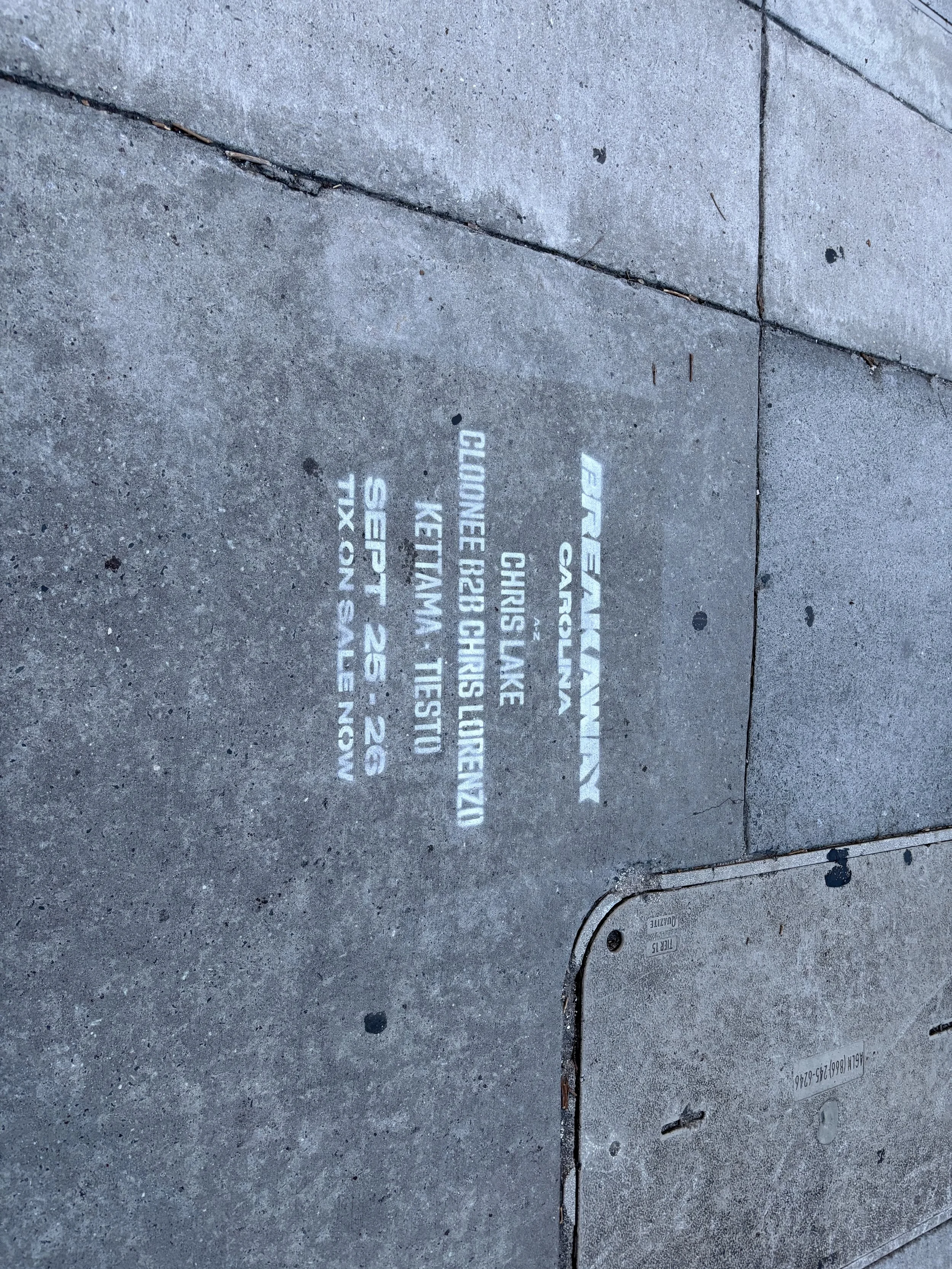
White promotional street stencil for Breakaway Music Festival Carolina by sidewalktattos
One of the first questions brands ask about street advertising is also the hardest to answer with a single number: how long will it last?
The honest answer is that street campaigns do not have a fixed shelf life. A wheatpaste poster on a protected brick wall may stay visible far longer than the same poster on a slick metal surface exposed to rain and repeated contact. A sidewalk stencil near a busy venue can look sharp on day one and noticeably lighter after a packed weekend.
That variability is not a flaw. It is part of what gives street media its energy. Posters, stencils, and snipes live inside the city, and the city pushes back. The strongest campaigns are planned around that reality from the start.
Street campaign lifespan depends on format and exposure
Street media lasts in ranges, not guarantees. The format matters. The surface matters. Weather matters. Foot traffic matters even more than many marketers expect.
There is a useful parallel in Federal Highway Administration guidance on pavement markings. FHWA treats service life as something shaped by traffic volume, environmental conditions, road surface, and location. Street campaigns are not roadway markings, of course, but the core idea carries over well: materials in public space wear at different speeds depending on where and how they are used.
That is why a good street campaign plan should focus less on a single promised duration and more on visible life, attrition rate, and refresh timing.
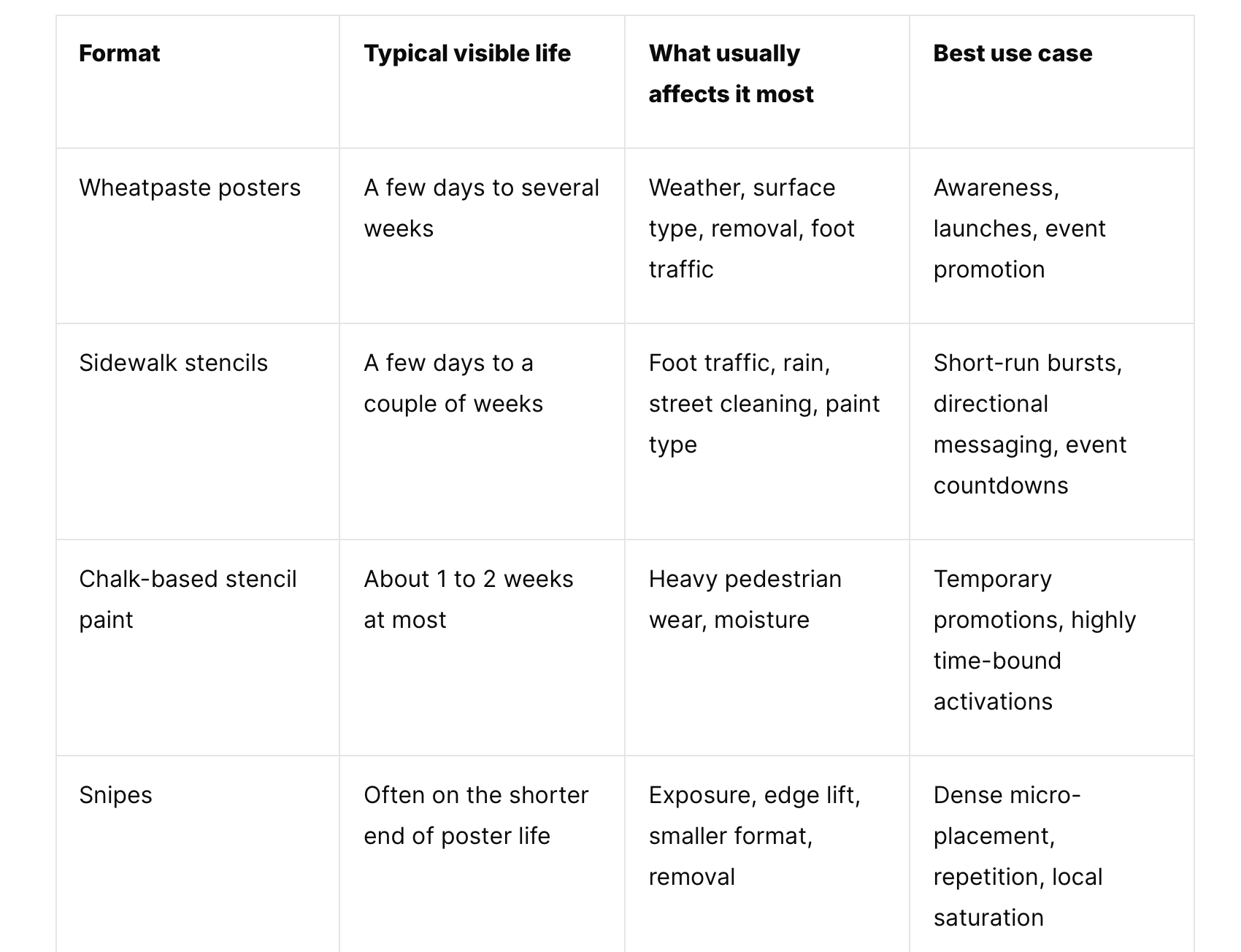
sidewalktattos marketing method table
Average lifespan of wheatpaste posters, stencils, and snipes
Wheatpaste posters usually have the widest working range. In many campaigns, they last from a few days to several weeks. In some city-specific examples, one to four weeks is a fair average. That does not mean every poster will hold for a month. It means the campaign can remain active and visible in that window, with some placements dropping off earlier and others holding longer.
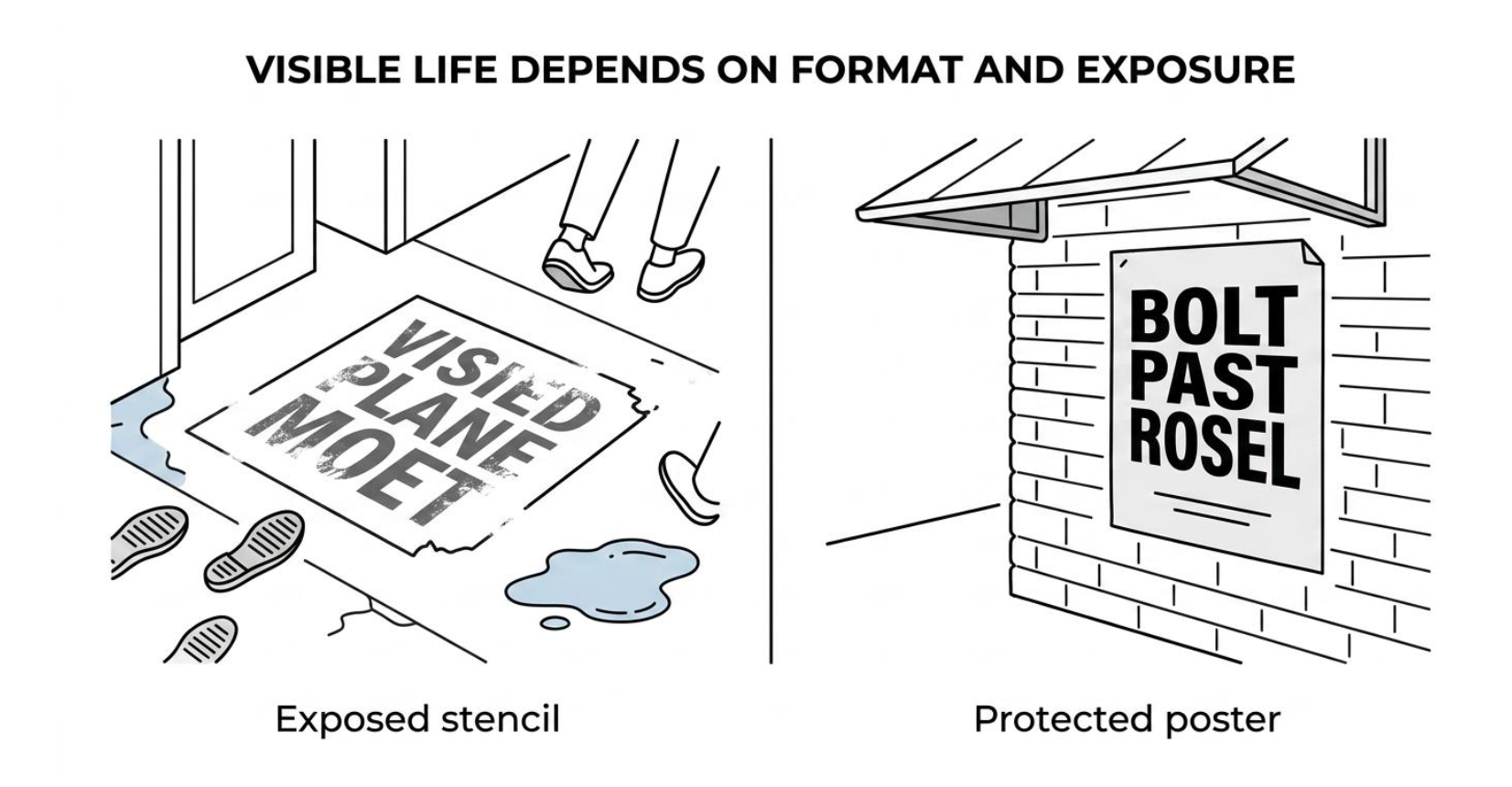
Stencil vs poster by sidewalktattos
Sidewalk stencils are naturally shorter-lived. Temporary, non-toxic paints are designed to fade rather than permanently mark the surface. A realistic expectation is a few days to a couple of weeks, with chalk-based stencil paint often landing around one to two weeks at most. If the stencil sits in a very busy pedestrian corridor, visibility can decline much faster.
Snipes sit in an interesting middle ground. They can be effective because of density and repetition, not because each unit is likely to become a long-term fixture. Since they are smaller and often placed in exposed micro-locations, they tend to perform best as fast-hit media. Their job is to multiply impressions quickly.
This is why the question should shift from “How long will it stay there?” to “How long will it stay strong enough to do the job?”
What affects wheatpaste poster longevity on city surfaces
For posters, the bond between paper, paste, and surface is everything. Porous walls often hold paste better than very smooth or painted surfaces. Texture can help. Too much texture can also create weak spots where edges lift early. Even before weather enters the picture, surface choice is already shaping the result.
Moisture is the next big variable. Rain, runoff, and freeze-thaw cycles can soften paper, stress edges, and weaken adhesion. Heat and direct sun can dry materials too quickly during install or make posters brittle later. Street cleaning schedules also matter, especially in commercial zones where surfaces get more regular maintenance.
A few common pressure points show up again and again in poster campaigns:
Rain and runoff
Porous brick versus slick metal
Direct sun and heat
Heavy pedestrian contact
Cleaning crews and maintenance routines
Intentional removal
Placement strategy can offset some of this. A poster campaign built with enough density can keep its visual presence even as individual units age at different rates. One lost panel does not kill a takeover if the surrounding placements are still holding. That is part of why mapped installations matter so much. Good coverage is a durability strategy, not just a visibility strategy.
The creative itself also plays a role. Bold contrast, large type, and simple composition tend to keep reading well even as paper wrinkles or edges roughen. A design that depends on fine detail has less room for natural wear.
Why sidewalk stencil campaigns fade faster in high-traffic areas
Stencil campaigns are usually judged by impact per day, not by maximum lifespan. They are meant to feel timely. When the message is tied to an event, drop, premiere, or opening weekend, that short runway can be a strength rather than a limitation.
Temporary stencil materials also age in a very public way. They do not simply vanish all at once. They fade, scuff, and lighten. That means the first several days are often the peak visibility period, especially in high-footfall zones.
FHWA guidance on pavement markings makes a broader point that fits here well: wear exposure changes service life. On sidewalks, “shoe traffic, moisture, surface friction, and cleaning activity” translates directly into shoe traffic, moisture, surface friction, and cleaning activity. The shortest-lived stencil placements are usually the ones under the most daily stress.
A few factors have an outsized effect on stencil fading:
High foot traffic: Constant pedestrian movement grinds pigment down quickly.
Surface texture: Rough concrete usually holds temporary paint better than polished stone.
Water exposure: Rain, puddling, and wash-down cycles shorten visibility.
Placement context: Entryways, queue lines, and curb-adjacent areas wear faster than open sidewalk sections.
Message design matters here too. A stencil with a short URL, release date, or simple icon can remain legible deeper into the fade cycle than a design packed with copy. In street work, durability is partly a material issue and partly a communication issue.
How refresh cycles keep street campaigns visible longer
The strongest multi-week street campaigns are rarely one-and-done installs. They work in waves.
A refresh is exactly what it sounds like: replacing weakened or missing posters, adding new placements, or reapplying stencil inventory in key zones so the campaign keeps its visual force. This is where honest planning beats optimistic guessing. If a brand needs two full weeks of strong presence, the install plan should probably include a refresh window rather than betting everything on day one.
A practical refresh approach usually looks like this:
Launch with enough density to create immediate citywide presence.
Review documentation early to see how exposed placements are aging.
Replace losses before the campaign feels thinned out.
Add a second wave around key dates, announcements, or event weekends.
This is also where documentation becomes more than a reporting nice-to-have. Photo proof and geo-tagged placement logs help teams see which zones are holding, which ones are fading fast, and where refresh spend will work hardest. Fast activation timelines, often in the 48 to 72 hour range with the right field partner, make mid-campaign adjustments much more realistic.
Refresh planning changes the budget conversation in a healthy way. Instead of paying for an imaginary static month, brands can pay for the actual visibility window they need.
Planning a street campaign timeline by week, not by month
Street campaigns are best planned in phases. Week one is your peak impact. Week two shows the first meaningful signs of attrition. Week three may call for replenishment if sustained presence matters. After that, the question becomes whether the campaign should continue with the same creative, shift to a second message, or taper off because the objective has already been met.
That makes format choice much easier. If the goal is a fast, high-energy push around a narrow date, stencils and snipes can be exactly right. If the goal is broader awareness over multiple weeks, wheatpaste usually gives more staying power. If the goal is both, a mixed-format plan often performs best: posters for hold time, stencils for immediacy, snipes for density.
Street media stays strongest when it is treated like a live channel, not static inventory.
The smartest campaign brief usually includes a few practical questions up front:
Peak visibility window: Do you need the campaign to hit hardest for three days, ten days, or a full month with refreshes?
Exposure profile: Are placements facing heavy foot traffic, direct weather, or regular cleaning activity?
Refresh plan: Will there be a second wave to restore density before the campaign loses momentum?
When those questions are answered early, lifespan becomes easier to manage. Not because the city gets predictable, but because the campaign is built for real-world conditions from the beginning.
Reach out for more information :
929.678.0235
