
Sidewalk Decals vs Stencils: Which Ground Game Is Right for Your Brand?
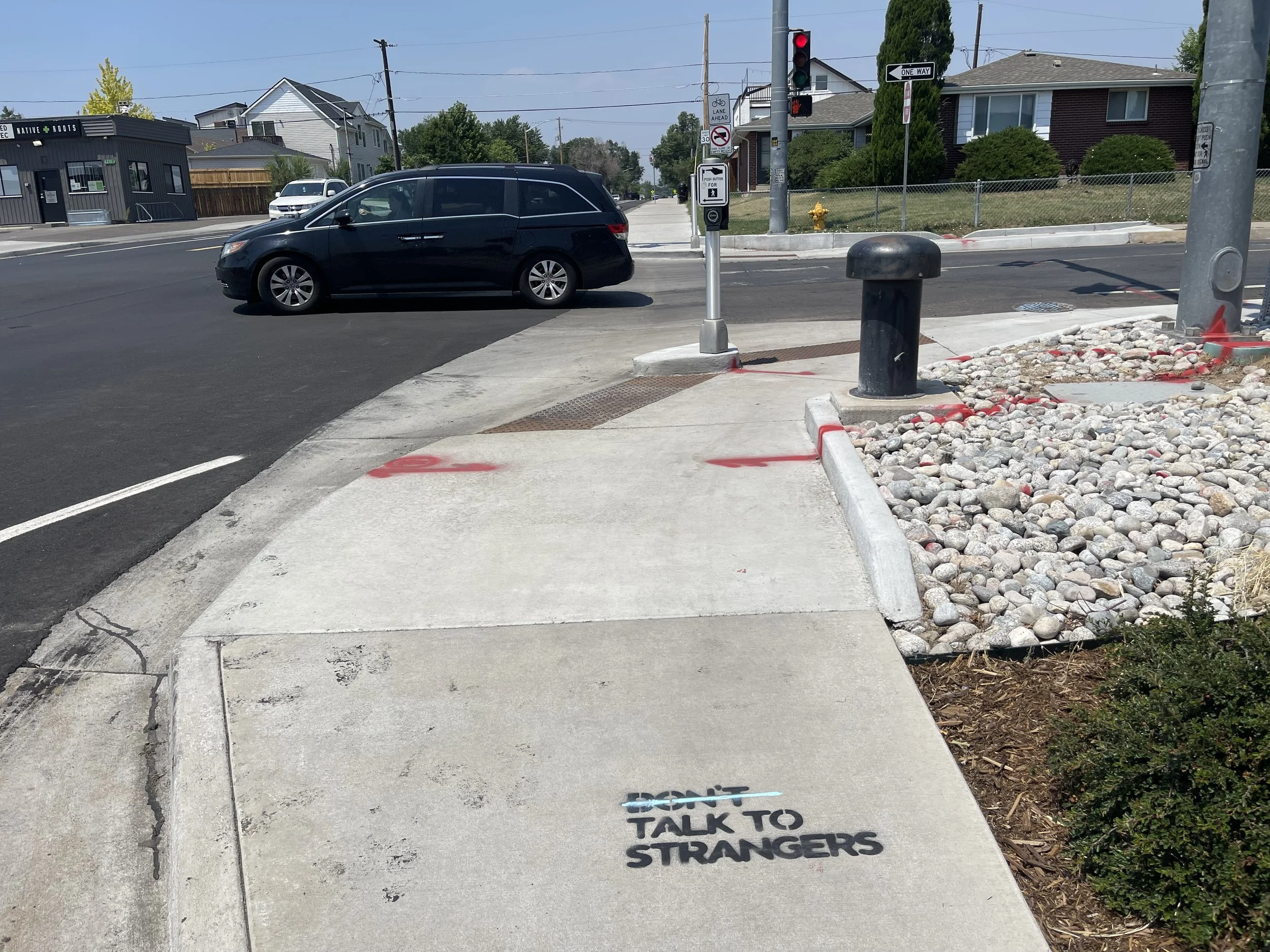
Don’t talk to strangers stencil by sidewalktattos
Street-level media works best when the format matches the moment. A launch built around nightlife, fashion week foot traffic, or a one-week pop-up needs a different ground game than a retail storefront trying to hold attention for a month.
That is why the stencils-versus-decals question matters. Both sit low in the visual field, both can catch people mid-stride, and both can feel more immediate than standard ad placements. Yet they behave very differently once you factor in surface, durability, placement rules, and the realities of public space.
For most brands, the choice comes down to one simple point: are you trying to create short-term visibility directly on pavement, or do you need a removable graphic accent that lives better on glass or other controlled surfaces?
Sidewalk stencils in street marketing campaigns
A sidewalk stencil is a custom-cut template used to spray a message, logo, or graphic directly onto pavement with eco-friendly temporary paint. In street marketing, that matters because the message becomes part of the walking path itself. People do not have to look up, pause, or change direction. The placement meets them exactly where they are already moving.
This is why stencils are often used near high-foot-traffic locations. Busy intersections, subway exits, shopping corridors, and event zones create natural repetition. A single stencil can make an impression. A mapped run of placements can turn a neighborhood into a guided path toward a store opening, launch event, or cultural moment.
The format is also honest about its temporary nature. Stencil longevity varies with foot traffic, weather, and paint, and a typical placement may last anywhere from a few days to a couple of weeks before fading. For brands, that can be a strength rather than a drawback. Short-lived media often feels timely, responsive, and tied to a live event rather than a static campaign.
Decals in brand activations and visual merchandising
“Decal” can mean different things in different marketing conversations. Some brands use the term loosely for any applied surface graphic. In practice, though, the most reliable use case is usually adhesive graphics on smooth, controlled surfaces.
Sidewalk Tattoos positions decals as durable accents for store windows and glass, which is a useful distinction. Decals can look sharp, polished, and highly legible for longer periods than temporary paint on pavement. They are also removable, which gives brands more predictability when the goal is to transform a retail frontage, activate a pop-up, or support an event venue with branded wayfinding.
That difference in surface is the real dividing line. Once a campaign moves into public sidewalks, printed adhesive graphics become far more complicated from both a practical and regulatory standpoint. On glass, they are often a clean fit. On pavement, they are not automatically the stronger option.
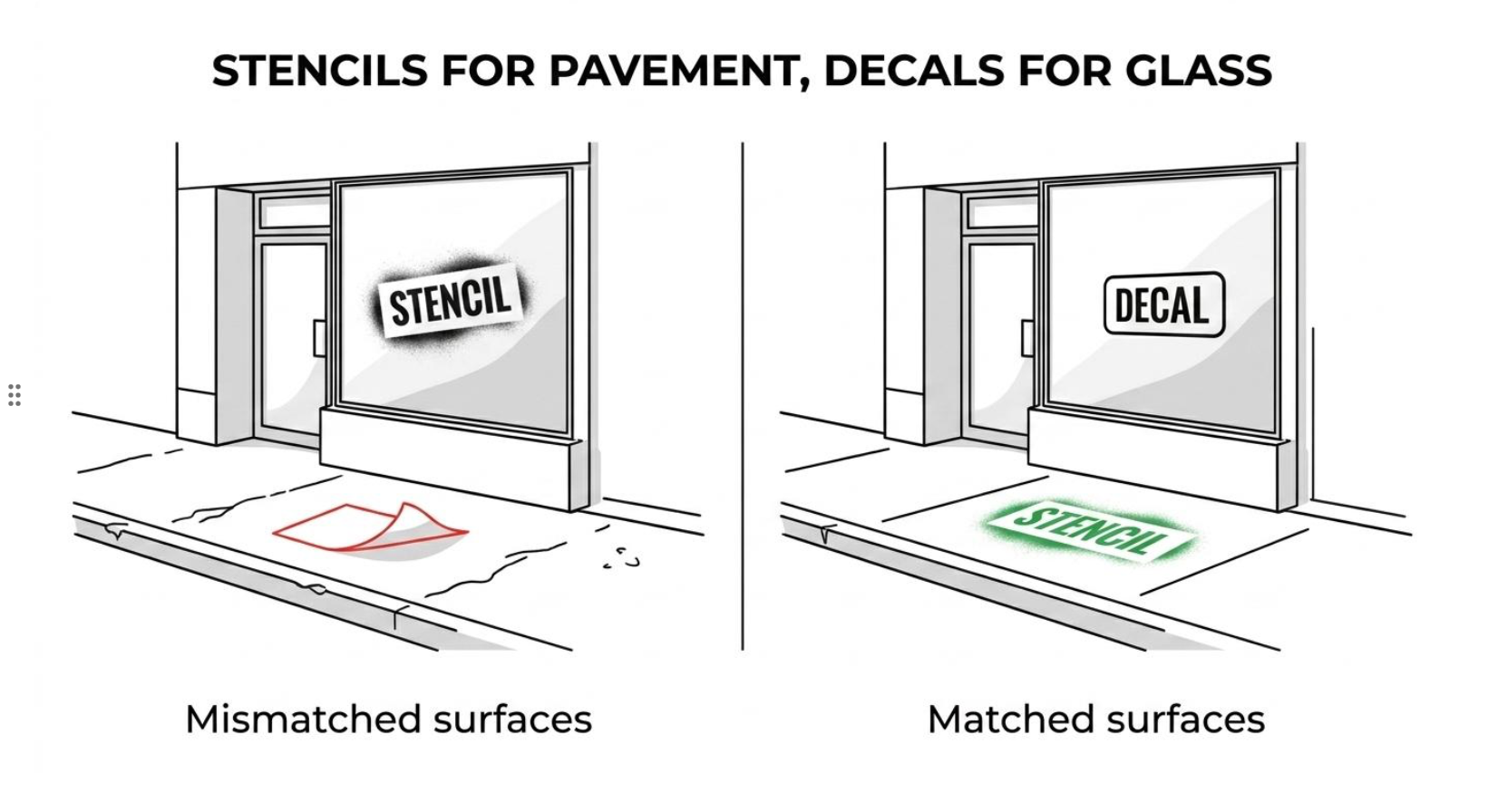
Difference between stencil and decal by sidewalktattos
After that basic distinction, the strengths separate pretty quickly:
Short-term pavement visibility
Window and glass branding
Event wayfinding
Repetition across a walking route
Retail frontage takeover
When sidewalk stencils work best for brand visibility
Stencils shine when the campaign needs urgency. Think product drops, music events, fashion activations, festival weeks, pop-ups, or citywide awareness pushes that need to feel alive right now. Their strength is not permanence. Their strength is context.
They also work well when a campaign benefits from multiple touches rather than a single hero placement. A poster wall may own one block. A stencil route can create rhythm across several blocks, reinforcing a brand message again and again as people move through a district.
For brands that want street energy without a bulky physical installation, stencils also offer speed. The format is lightweight, adaptable in scale, and well suited to mapped deployments with photo and geo documentation. That makes it easier to prove where placements landed and how the campaign was distributed.
A stencil-first strategy is often the better fit when the brief sounds like this:
You need reach: high-foot-traffic corridors matter more than long dwell time
You need urgency: the campaign is tied to a launch, event, or limited window
You want cultural fit: the visual language should feel native to the street
You need scale fast: multiple placements across a city matter more than one polished installation
When decals work best for windows, glass, and controlled environments
Decals earn their place when precision matters most. A storefront announcement, sponsor message, directional cue, or branded takeover of glass can benefit from the cleaner edges and steadier lifespan of printed adhesive graphics.
They are also useful when the audience is already at the destination. If the job is to convert passersby who are standing outside a venue, retail location, gallery, or showroom, window decals can frame the entrance and reinforce the campaign identity without relying on public pavement placement.
This is where many brands get clearer results by stopping the comparison early. If the visual needs to live on store windows and glass, use decals. If the visual needs to live on the street itself, stencils are usually the more natural format.
NYC sidewalk placement rules and temporary public artwork limits
New York City is one of the strongest places in the country for street visibility, but it is also a city where placement rules matter. Not every patch of sidewalk is fair game, and not every ground graphic belongs in the same permitting category.
According to NYC DOT Art, temporary public artwork on eligible NYC DOT infrastructure is only permitted in fully pedestrianized spaces, and those installations may remain for up to 11 months. Proposals are reviewed based on public safety, site suitability, artistic merit, and artwork durability. That is an important framework for anyone thinking about temporary sidewalk-based public art in New York.
The key phrase there is fully pedestrianized spaces. A busy standard sidewalk, even if it looks perfect from a traffic-count perspective, is not automatically an eligible site. That changes the planning conversation. A brand may love a location near a crosswalk or subway entrance, yet the legal and operational path may point elsewhere.
That does not make sidewalk-based work less valuable. It means the strategy must start with compliance, site review, and realistic expectations about what a surface can support. A strong campaign in New York is not just creative. It is also well planned around public safety and site suitability.
A useful screening approach looks like this:
Surface type: Is this a fully pedestrianized space or a standard sidewalk corridor?
Use case: Is the activation framed as temporary public artwork, event support, or storefront branding?
Safety review: Could the placement interfere with pedestrian movement or create confusion?
Durability window: Does the expected lifespan match the campaign period and the site conditions?
Choosing the right format for your campaign goals
The best choice starts with the campaign objective, not the material. Teams sometimes ask for decals because they want something “clean,” or ask for stencils because they want something “street.” Those instincts are useful, but they are not enough on their own.
A better framework is to match the format to the behavior you want from the audience. Do you want people to notice a brand while walking between destinations? Do you want to guide them toward a venue? Do you want a storefront to hold the look of the campaign for several weeks? Each of those asks points to a different solution.
Stencils are strong when movement is the medium. Decals are strong when the surface is controlled and the message needs to stay sharp. That means the sharper question is not “Which is better?” It is “Where will this graphic live, and what job should it do there?”
For many brands, the highest-performing answer is not either-or. It is a coordinated street presence where each format does the job it is naturally built to do. A launch can use stencils to pull attention through the neighborhood, wheat pasted posters to create visual density, and decals on store windows or venue glass to anchor the destination.
That kind of mix creates a stronger rhythm across the campaign:
Street-level attraction
Destination reinforcement
Repeat exposure
Better documentation across touchpoints
The upside is clear. When format, surface, and placement rules all match, the campaign feels less like borrowed media and more like it belongs in the city. That is when ground-level marketing starts to work at its best: visible, timely, and built for the way people actually move through a place.
Reach out for more information :
929.678.0235
