
Wheatpaste Advertising in California: A Statewide Pattern Across San Diego, LA, and San Francisco
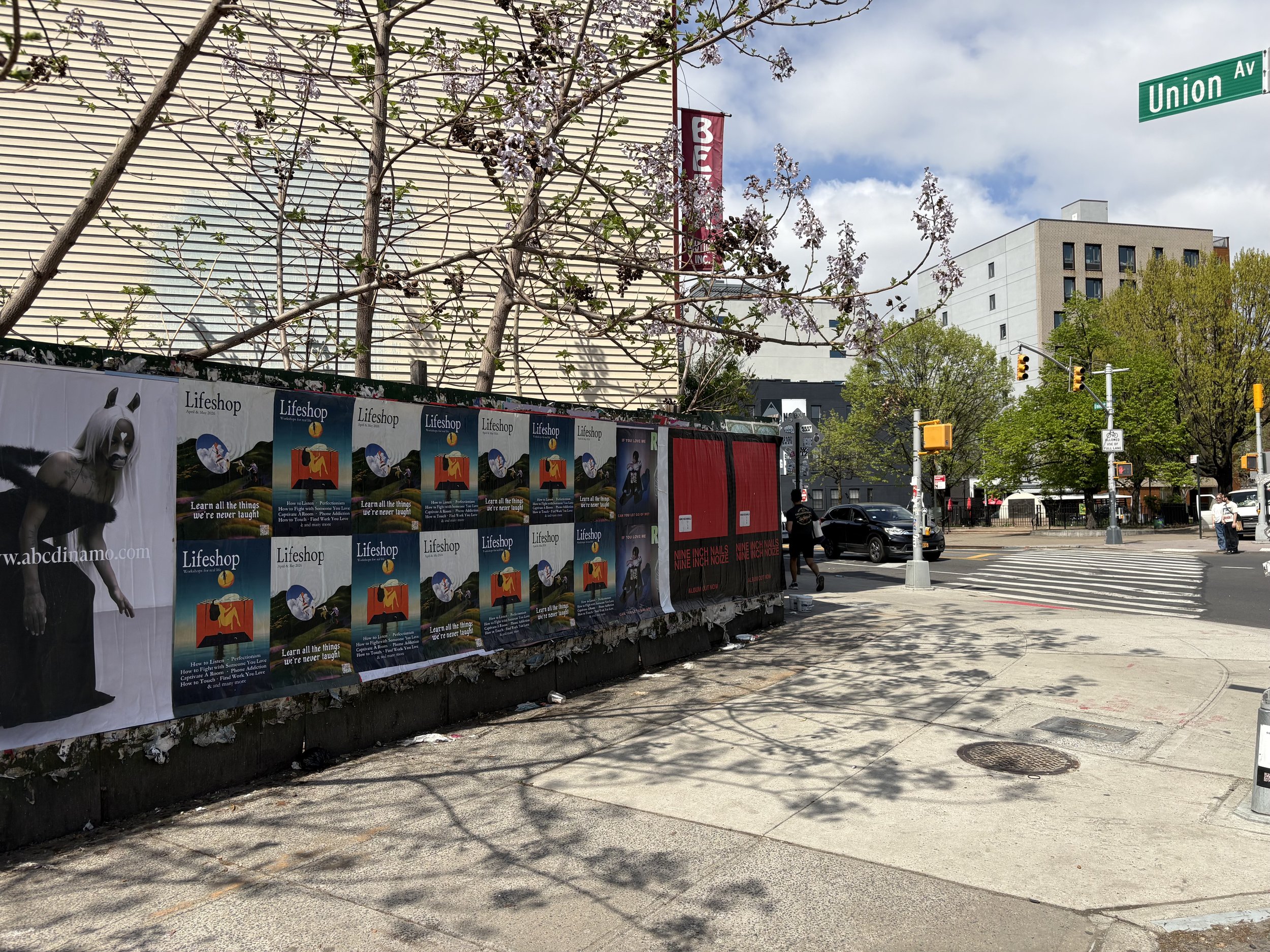
Wildposting campaign with wheatpasted posters at a busy intersection
California rewards brands that think beyond a single neighborhood. A poster run that feels strong in one district can become far more powerful when it repeats across multiple urban centers, with each market reinforcing the next. That is why wheatpaste advertising works so well across San Diego, Los Angeles, and San Francisco: the format is flexible, fast to deploy, and built for visible repetition.
For marketers trying to make a statewide impression, California is less about one big splash and more about a recognizable pattern. Street-level visibility in Southern California and the Bay Area creates momentum. A campaign seen in LA can gain extra weight when the same visual language appears in San Diego and San Francisco within days.
California wheatpaste advertising works best as a connected metro strategy
A statewide wheatpaste campaign is not simply a larger version of a local buy. Each city has its own pace, wall culture, density, audience mix, and posting rules. What stays consistent is the value of repetition at street level. Posters can build frequency quickly, especially when they are mapped carefully and installed in clusters that support the same message.
Sidewalk Tattoos approaches California as a network of city-specific activations rather than a one-size-fits-all rollout. That matters because Los Angeles, San Francisco, San Diego, Sacramento, and other markets do not behave the same way. The strongest statewide campaigns keep the creative consistent while adjusting placement strategy, timing, and documentation to match local conditions.
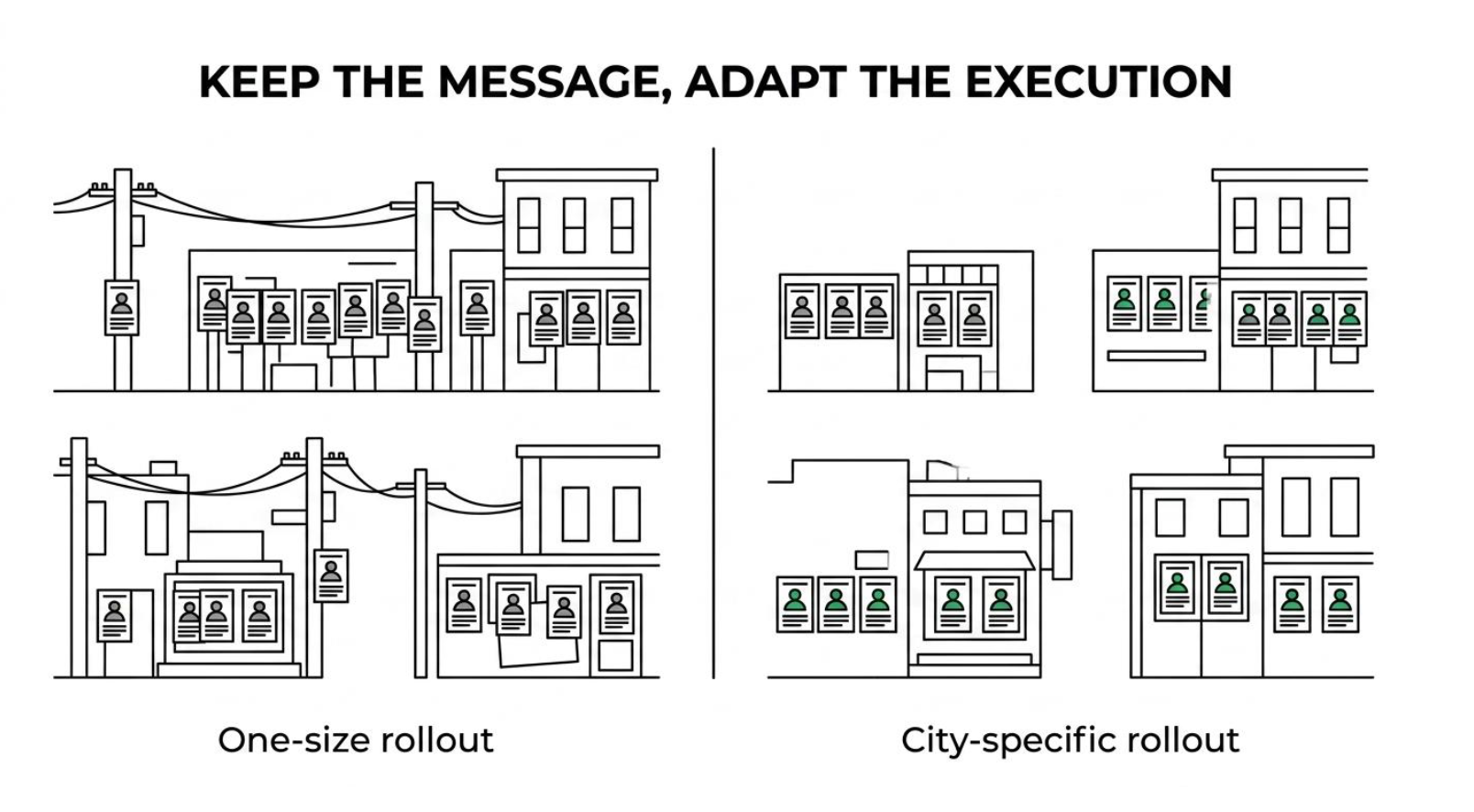
Posters illustration by sidewalktattos
This is where wheatpasting stands apart from many traditional media channels.
fast activation windows
neighborhood-level targeting
strong visual repetition
scalable multi-city coverage
photo and geo-tagged reporting
A statewide pattern also helps brands with different goals. A fashion label may want dense cultural impact in trend-forward districts. A startup may want rapid visibility around launch week. An event promoter may need a synchronized push that spans several cities before a fixed date. The medium can support all three, provided planning is disciplined and placements are handled with lawful permission and city-specific compliance in mind.
Los Angeles wheatpaste advertising favors scale, repetition, and neighborhood density
Los Angeles is the largest and most varied of the three markets. It rewards campaigns that understand how audiences move through distinct districts rather than through a single downtown core. A citywide poster strategy in LA often works best when it is broken into recognizable neighborhood clusters, from Downtown LA and Hollywood to Echo Park, Silver Lake, Venice, Fairfax, and Highland Park.
That neighborhood structure creates a special advantage for wheatpaste advertising. Posters do not need to feel isolated. They can appear as a repeating visual system across creative, nightlife, fashion, music, and commuting corridors. A well-planned LA run can make a brand feel present in the culture, not just present on a wall.
At the same time, Los Angeles has clear restrictions on unauthorized posting in public-space contexts. City code states that a person may not erect, maintain, paste, print, nail, tack, or otherwise fasten a poster, advertisement, or notice in a public place or on private property without lawful permission. The rule applies broadly to sidewalks, streets, alleys, curbstones, lampposts, poles, hydrants, bridge walls, and trees in public areas. In some dedicated public-way situations, existing structurally attached advertising signs may require a Revocable Permit from the Board of Public Works.
For brands, that means LA is a market where ambition must be matched by placement discipline. The city offers tremendous scale, but scale only matters when execution respects permissions, property boundaries, and the conditions attached to legal posting environments.
San Francisco wheatpaste posters thrive on concentration and design clarity
San Francisco is physically smaller than Los Angeles, yet it often produces a very strong street-media impact because of its density. Neighborhoods like SOMA and the Mission can concentrate pedestrian attention quickly, and a compact footprint allows a campaign to feel widely seen even with a modest number of placements.
That concentration changes how creative performs. In San Francisco, strong design clarity tends to matter more than message volume. A clean image, bold typography, and disciplined repetition can do more than copy-heavy art. Sidewalk Tattoos also offers standard 24x36-inch posters and larger 48x72-inch jumbo posters, giving brands room to match format to wall type and visibility goals. Typical poster life can run one to two weeks depending on weather and wall surface, which is useful when timing a launch, exhibition, release, or pop-up.
San Francisco also presents its own rule set. Local guidance notes that state and local laws regulate sign posting on public and private property. California Penal Code 556.1 is referenced as making it a misdemeanor to place or maintain advertising on property without the owner’s, lessee’s, or lawful possessor’s consent. Local rules also limit posting on street poles, including size restrictions for signs on certain poles, and prohibit posting on historic lampposts, traffic signals, and poles with directional signage.
The takeaway is simple: San Francisco can generate a sharp, high-frequency impression, but it asks for careful wall selection and close attention to what is off-limits in public-facing infrastructure.
San Diego wheatpaste campaigns reward clean execution and careful maintenance
San Diego is often discussed as a secondary California market, yet that misses the point. It is a major coastal city with strong local identity, active nightlife districts, tourism flows, and neighborhoods where street-level media can build real momentum. Areas commonly associated with campaign activity include the Gaslamp Quarter, North Park, Hillcrest, Midtown, and Downtown.
What stands out in San Diego is how clean execution influences performance. In a city where environment, appearance, and public-space order carry visible weight, poster campaigns benefit from neat installation, thoughtful mapping, and active maintenance standards. That is not just a branding issue. It also intersects with the city’s rules.
San Diego sign regulations state that sign supports must be placed entirely within the boundaries of the premises where the sign is located. The code also requires signs and sign supports to be maintained in a clean, safe, and graffiti-free condition. Paint or debris associated with signs must not litter public property or public rights-of-way. Separate city rules for parks and related public property also prohibit direct commercial advertising in those spaces.
That combination makes San Diego a strong market for organized, permission-based work that respects site boundaries and keeps materials controlled from installation through removal.
After looking at all three cities, several planning themes become clear:
Placement discipline: Public-facing infrastructure and public property restrictions differ by city, so approved locations matter.
Property consent: Lawful permission is not a formality. It is central to how a campaign is structured.
Maintenance standards: Clean walls, safe installs, and no debris are especially relevant in San Diego.
Creative consistency: One visual system can carry across all three markets while placement tactics change city by city.
Comparing Los Angeles, San Francisco, and San Diego wheatpaste conditions
The statewide pattern becomes easier to see when the three cities are compared side by side.
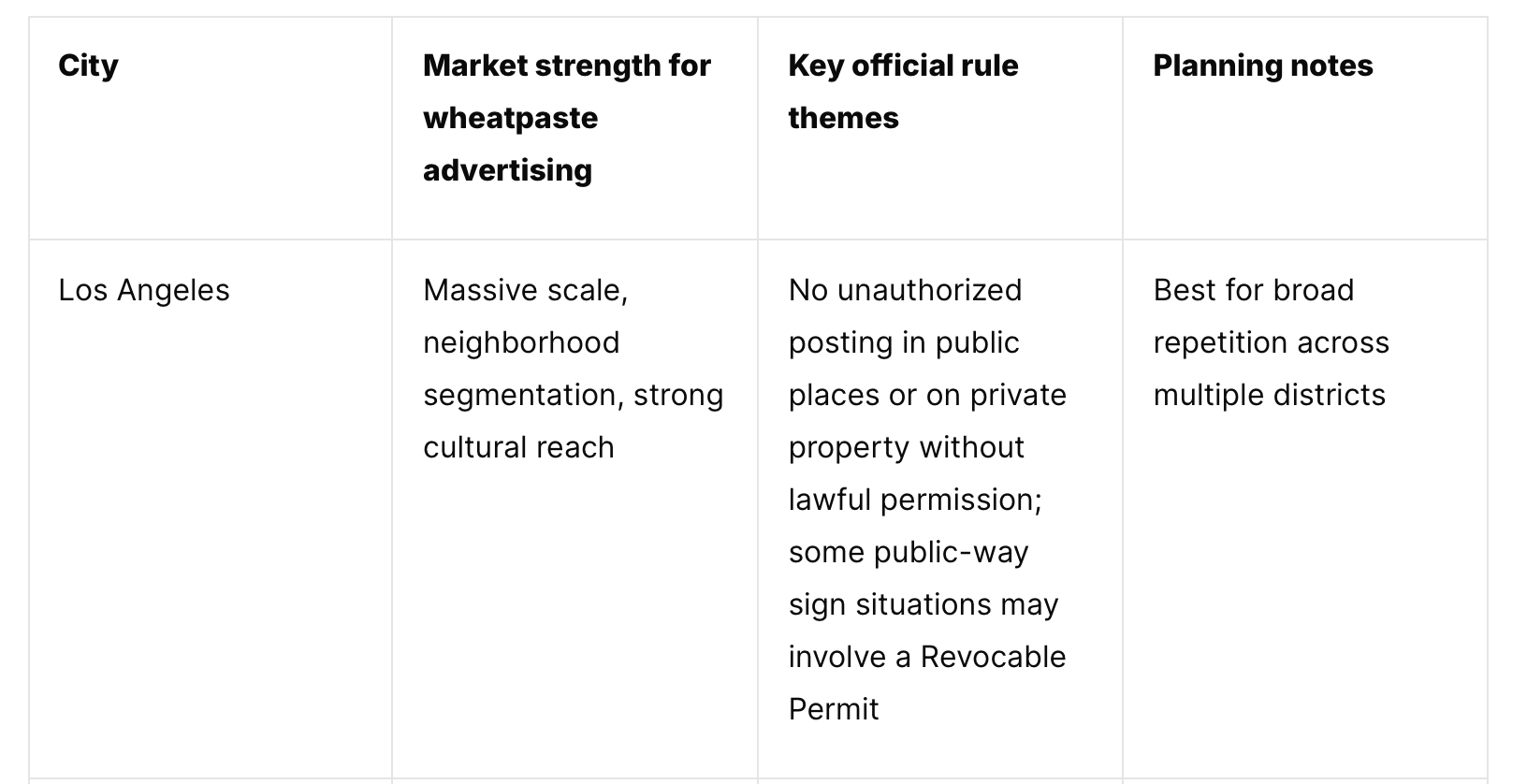
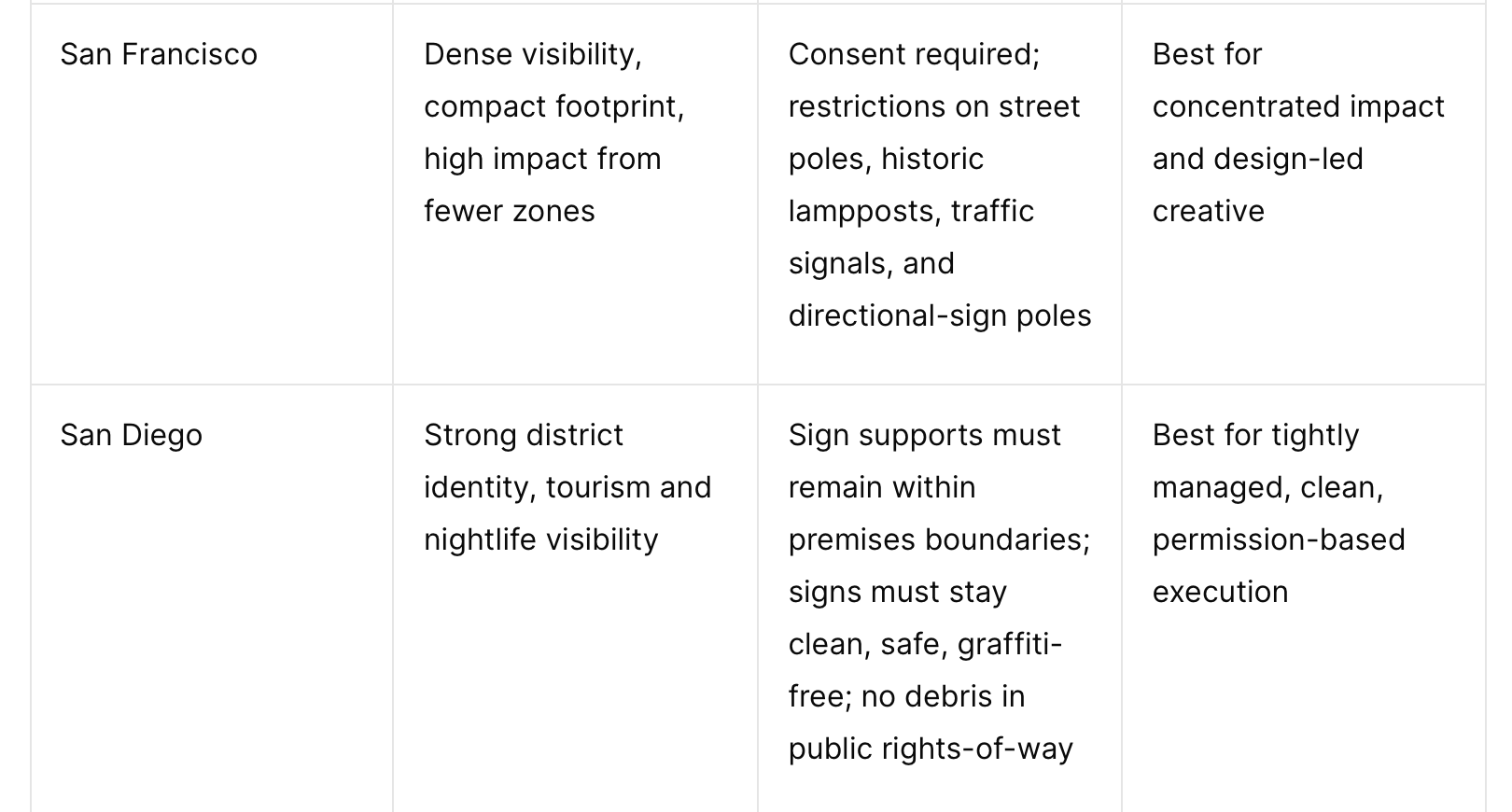
The practical meaning of this table is encouraging, not limiting. California is very workable for wheatpaste advertising when campaigns are built with city conditions in mind. A statewide buy does not need identical placement logic from market to market. It needs a common message, a coordinated schedule, and local execution standards that match each city.
Building a statewide wheatpaste campaign across California
The most effective statewide campaigns usually begin with one question: should the creative feel identical in every city, or should there be a local variation within a shared system? Both approaches can work. A music drop, product launch, or film push may benefit from strict consistency. A hospitality brand or event series may perform better with city-specific dates, locations, or taglines.
The next decision is sequencing. Some brands want a simultaneous push across San Diego, LA, and San Francisco for maximum statewide visibility within a short window. Others prefer a rolling release that starts in Los Angeles, moves south or north, and builds anticipation through timing.
A strong planning framework usually includes:
Creative format: Standard posters, jumbo posters, or a mix tied to wall types and viewing distance.
City mix: One flagship market plus two support cities, or equal weight across all three.
Documentation: Photo proof and geo-tagged reporting for visibility, accountability, and recap use.
Speed: Fast activation windows, often within 48 to 72 hours when timing is tight.
Many brands also benefit from combining wheatpaste posters with sidewalk stencil activations. That pairing can add another layer of repetition without changing the campaign’s visual language. Posters create vertical presence. Stencils extend the message onto pedestrian pathways and help turn a neighborhood into a more immersive media field.
Why statewide wheatpaste advertising creates more than local reach
A single city can create buzz. Three cities can create legitimacy.
When a campaign across California appears across California’s major urban markets, the brand starts to look larger than any one neighborhood. That shift matters for startups trying to look established, for artists trying to look unavoidable, and for agencies trying to give clients a visible footprint that feels immediate and cultural rather than distant and polished.
Statewide coverage also creates practical marketing value. Teams can repurpose photo sets across paid social, decks, investor updates, event recaps, and press outreach. Street media becomes both activation and content engine.
That dual value is one reason wheatpaste remains relevant even when media options keep multiplying.
What to plan before launching wheatpaste advertising in California
The strongest California runs tend to share the same habits. They move quickly, but not casually. They keep creative bold. They think in clusters, not isolated placements. They treat compliance as part of strategy, not as an afterthought.
Before launch, it helps to clarify a few non-negotiables:
target cities and neighborhoods
campaign dates
poster sizes
creative quantity
documentation needs
permission and compliance requirements
Sidewalk Tattoos supports California campaigns with mapped planning, custom poster installations, wheat pasting, sidewalk stencil activations, and geo-documented reporting across major cities in the state and beyond. For brands that want San Diego, Los Angeles, and San Francisco to work as one coordinated street-level media system, statewide coverage is not just possible. It is a very smart way to make the message stick.
If the goal is to cover California with one connected visual push, this is the moment to plan the rollout city by city and activate the state as a whole.
