
Wheatpasting in NYC: What the City Demands
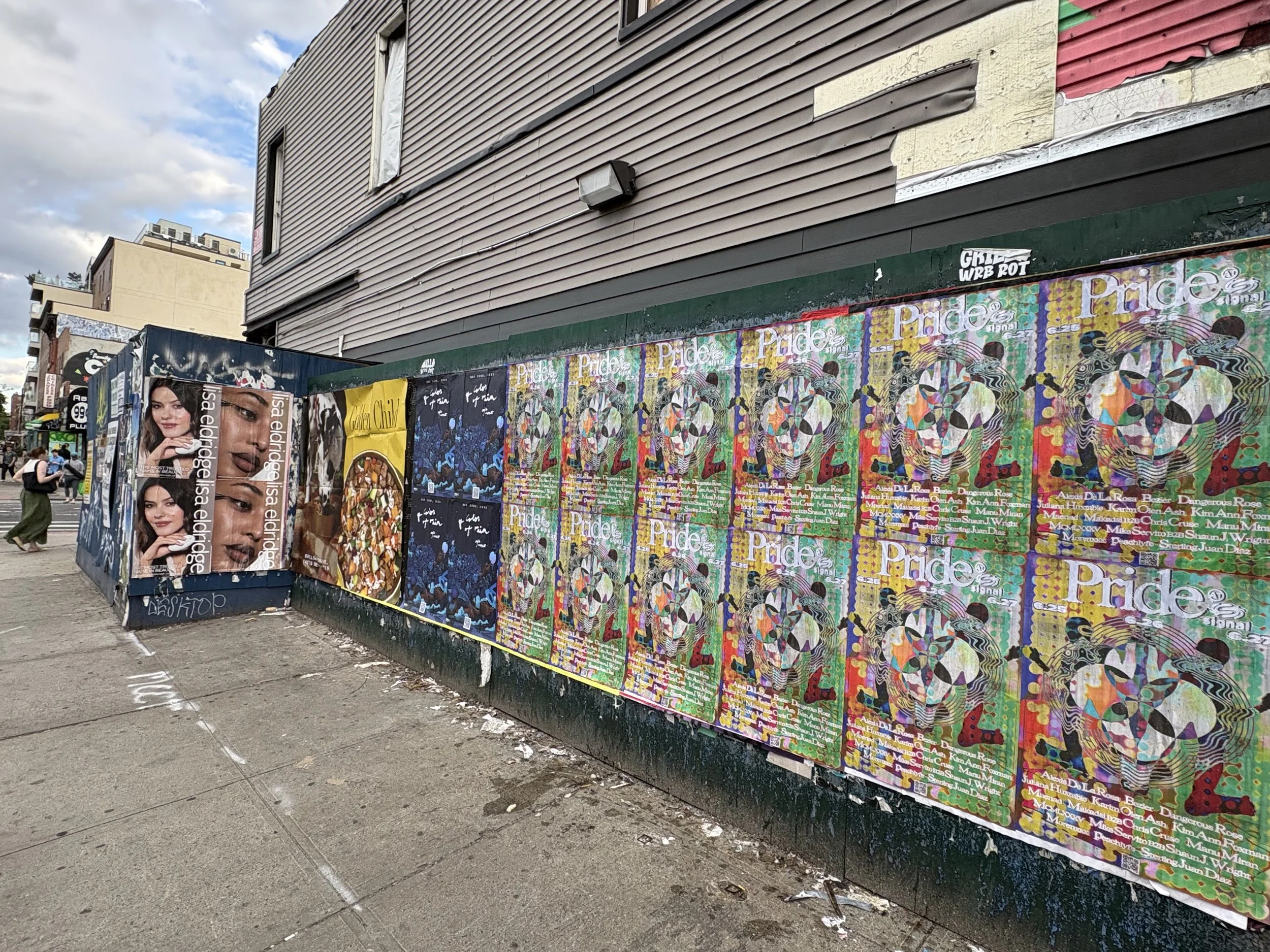
High-impact wildposting posters in New York City by sidewalktattos
New York rewards bold and punishes quiet. That is why wheatpasting in NYC is never just about printing a strong poster and sending a crew into the street. The city asks for more. More creative force. More placement discipline. More speed. More documentation. More respect for property, local conditions, and enforcement pressure.
Brands that treat NYC like a loose, open canvas usually learn fast that it is not. A wheatpaste campaign can create real street-level impact here, but only when the work is planned with precision and executed with permission on the right surfaces. In a city this dense, every wall competes with fashion, music, retail, nightlife, events, and a nonstop flow of visual noise. To land, a campaign has to be sharp from concept through install.
Why NYC wheatpasting demands more than a good poster
A poster that feels loud in another market can feel invisible in Manhattan, Brooklyn, or Queens. New York compresses attention. People move quickly, blocks change block by block, and audiences are exposed to thousands of visual prompts every day. Wheatpasting works here because it feels immediate and native to the street. It can meet people where they already are, at eye level, in motion, in neighborhoods that shape taste and conversation.
That same intensity raises the standard. In smaller cities, a few placements may be enough to create a sense of presence. In NYC, weak density reads as absence. A campaign needs repetition, smart route building, and creative that reads in a second or less. The best installs are legible from across the sidewalk, memorable at close range, and designed to feel intentional in the built environment.
This is also a market where context matters as much as volume. A poster outside the right venue, retail corridor, gallery cluster, or nightlife district can outperform a much larger scattershot run. Wheatpasting in NYC is street media, but it is also urban media planning.
NYC wheatpasting laws brands need to respect
The legal side is not a side issue in New York. It is part of the media plan.
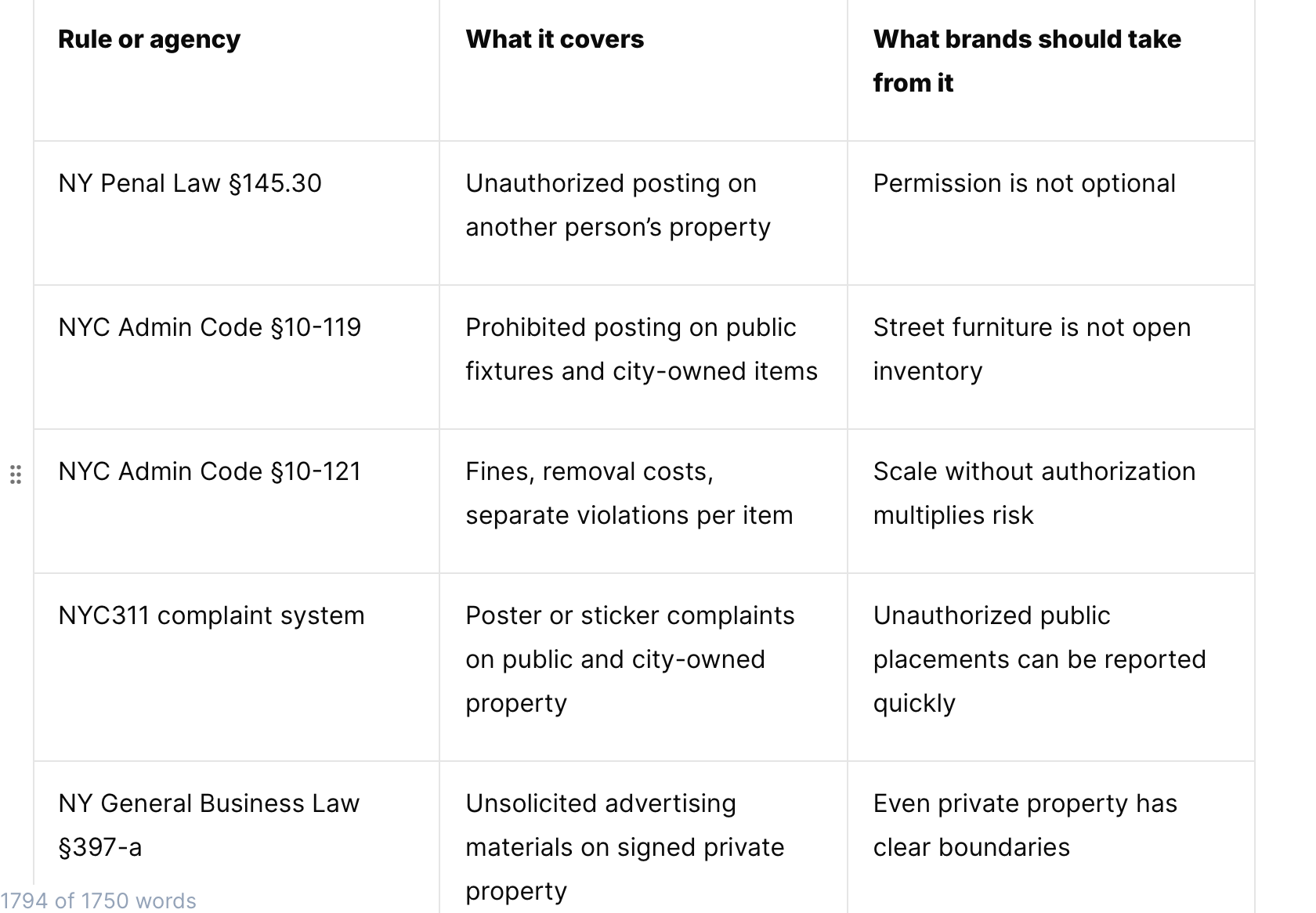
Under New York Penal Law §145.30, posting or affixing an advertisement or poster on another person’s property without the right to do so is a violation. For commercial advertising, the law creates a presumption that the vendor of the product, service, or entertainment caused the ad to be placed there. That means a brand name on the poster is not just branding. It can also become evidence.
NYC Administrative Code §10-119 bars posting or affixing material on a long list of public fixtures and city-owned items, including lampposts, traffic signs, hydrants, bus shelters, bridge structures, and public garbage bins. The code also creates a rebuttable presumption tied to the identifying information on the posted material. If a name, phone number, URL, or other identifier is on the piece, the city has a path to connect the posting to the advertiser.
NYC Administrative Code §10-121 adds financial weight. First offenses can bring fines of $75 to $150. Later offenses within a 12-month period can rise to $150 to $250. Each individual poster can count as a separate violation. The city can also recover removal costs. When scale is the strategy, per-item enforcement matters.
A separate New York law, General Business Law §397-a, adds another issue for private property in cities with populations above one million, including NYC. If a property owner posts the exact required sign stating “Do Not Place Unsolicited Advertising Materials On This Property,” unsolicited advertising materials can trigger a civil penalty of $250 to $1,000 per violation, up to $5,000 for materials placed on a single day.
wheatpasting regulations throughout the state by sidewalktattos
This is not legal advice, but the practical message is plain: unauthorized placement in NYC is not a gray-area shortcut. It can lead to violations, fines, and removal costs.
What legal pressure means for wheatpaste campaign planning in NYC
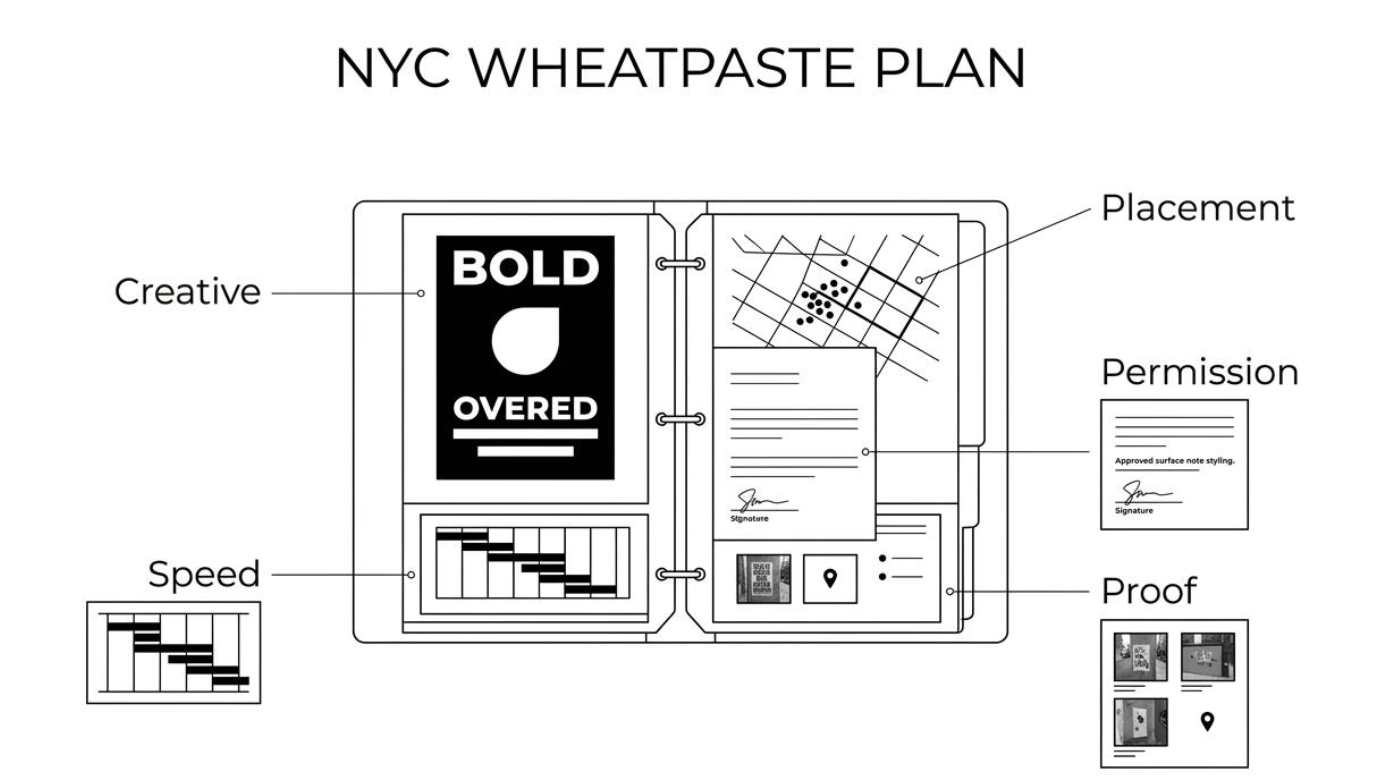
The city’s enforcement structure changes how strong operators plan campaigns. It pushes the work toward approved private property, authorized installations, and cleaner operational control. It also makes documentation valuable in two directions: proof of execution for the client, and proof that the placements were made where they were intended to be made.
wheatpasting plan illustration by sidewalktattos
NYC311 adds another layer. Illegal posters, flyers, decals, and stickers on public and city-owned property can be reported through a poster or sticker complaint. Private property removal is generally left to the owner or manager. That creates a split reality in the field. Public-facing unauthorized placements may be reported through a clear city channel. Private placements still depend on owner consent and property relationships.
The smartest response is not to retreat from wheatpasting. It is to run it like serious media.
After that reality sets in, the operating priorities become clear:
Permission-first placement
Neighborhood-specific mapping
Fast installation windows
Strong photo proof
Simple, bold creative
Tight field management
Wheatpaste creative strategy for New York streets
In NYC, good design is less about decoration and more about force. A passerby gives a poster a glance, not a study. That glance has to carry the message. If the creative needs explanation, the street will move on.
That usually means fewer words, larger type, stronger contrast, and a cleaner focal point. Event promotion, product launches, artist drops, retail openings, and brand announcements all benefit from this discipline. The work should make sense at ten feet and still reward someone who stops at two feet.
Scale matters too. A single poster can work. A wall that stacks the same message can dominate a block face. Repetition makes memory. It also creates the visual authority that brands want from street media in New York.
Weather and surface type affect campaign life, so creative needs to assume a finite window. Wheatpaste posters in NYC can last from several days to a few weeks depending on rain, wind, heat, traffic, and substrate. That short life is not a weakness. It creates urgency. Street advertising that feels present now often feels more valuable than media that simply sits.
NYC placement and neighborhood mapping for wheatpasting
Placement in New York is strategy, not guesswork. A fashion label may want downtown Manhattan and key Brooklyn retail corridors. A music release may perform best around venue clusters, nightlife routes, and dense youth foot traffic. A tech brand may need proximity to startup neighborhoods, commuter flows, and event spaces. The city is one market on paper, but many different street cultures on the ground.
Good mapping also accounts for cadence. Morning commuter routes, evening entertainment zones, weekend shopping streets, and late-night districts create different visibility patterns. A campaign that works in SoHo may need a different density model in Williamsburg or the Lower East Side. Even within the same borough, poster behavior changes with block texture, storefront turnover, and audience pace.
The most effective route plans usually share a few traits:
Audience fit: Build around who actually moves through the area
Density logic: Cluster placements so the campaign feels present, not scattered
Creative fit: Match poster size and visual style to the physical environment
Timing: Install close enough to the campaign moment to capture peak attention
A mapped campaign is what turns wheatpasting from a tactic into media inventory.
Documentation and reporting for NYC wheatpaste campaigns
If a campaign is not documented, it is hard to measure, hard to verify, and hard to build on next time.
Photo proof and geo-tagged reporting matter more in NYC because the city moves fast. Install conditions change quickly. Posters may be covered, removed, weathered, or blended into fresh street layers. Strong reporting gives marketers a usable record of what ran, where it ran, and how the route was built. It also helps agencies compare neighborhood performance and refine future takeovers.
For brand teams, documentation supports more than accountability. It extends the life of the campaign into social recaps, investor decks, internal reporting, PR materials, and launch archives. Street work is temporary by nature. Good documentation lets it travel farther than the wall.
Speed and execution standards for NYC street campaigns
New York rarely waits for perfect timing. Product drops move. Event dates lock. Album releases shift. Fashion calendars tighten. That is why Fast activation is valuable almost as much as concept.
A strong street partner needs to move from planning to install quickly while still protecting placement quality. That includes route mapping, print coordination, field deployment, and proof collection. Fast activation is valuable, but rushed thinking is expensive. The city is too demanding for loose logistics.
The operational standard should look something like this:
Clear scope: Boroughs, quantities, format mix, timing
Approved surfaces: Private property or authorized locations only
Field discipline: Consistent placement, neat installs, route accuracy
Proof package: Photos, geotags, and campaign recap
When these pieces are in place, wheatpasting becomes one of the fastest ways to put a brand into the physical conversation of New York.
What brands should prepare before launching NYC wheatpasting
The most successful campaigns usually start with a simple shift in mindset. Do not ask how cheaply or loosely the city can be covered. Ask what New York requires to make the work feel real, visible, and worth talking about.
That means clarifying the audience, tightening the message, choosing neighborhoods with purpose, and building enough density to matter. It also means treating compliance and property rights as part of campaign quality, not as friction.
A few preparation points tend to separate strong launches from forgettable ones:
Message first: one idea, one visual priority, one fast read
Neighborhood logic: place where the audience already gathers
Street durability: plan for weather, wear, and short campaign life
Reporting value: capture the install so the campaign keeps working after the wall
Brands that get NYC right do not arrive timidly. They arrive prepared.
If the goal is to run New York with wheat pasting, the answer is not more noise for its own sake. It is bold creative, smart density, authorized placements, sharp timing, and documented execution. Sidewalk Tattoos builds mapped wheat pasting, sidewalk stencil activations, and custom poster installations with photo and geo documentation across NYC and beyond, often on fast timelines. When the city asks for precision and presence at the same time, that is the standard worth meeting.
Reach out for more information :
929.678.0235
