
Why Online Businesses Should Be Wheatpasting
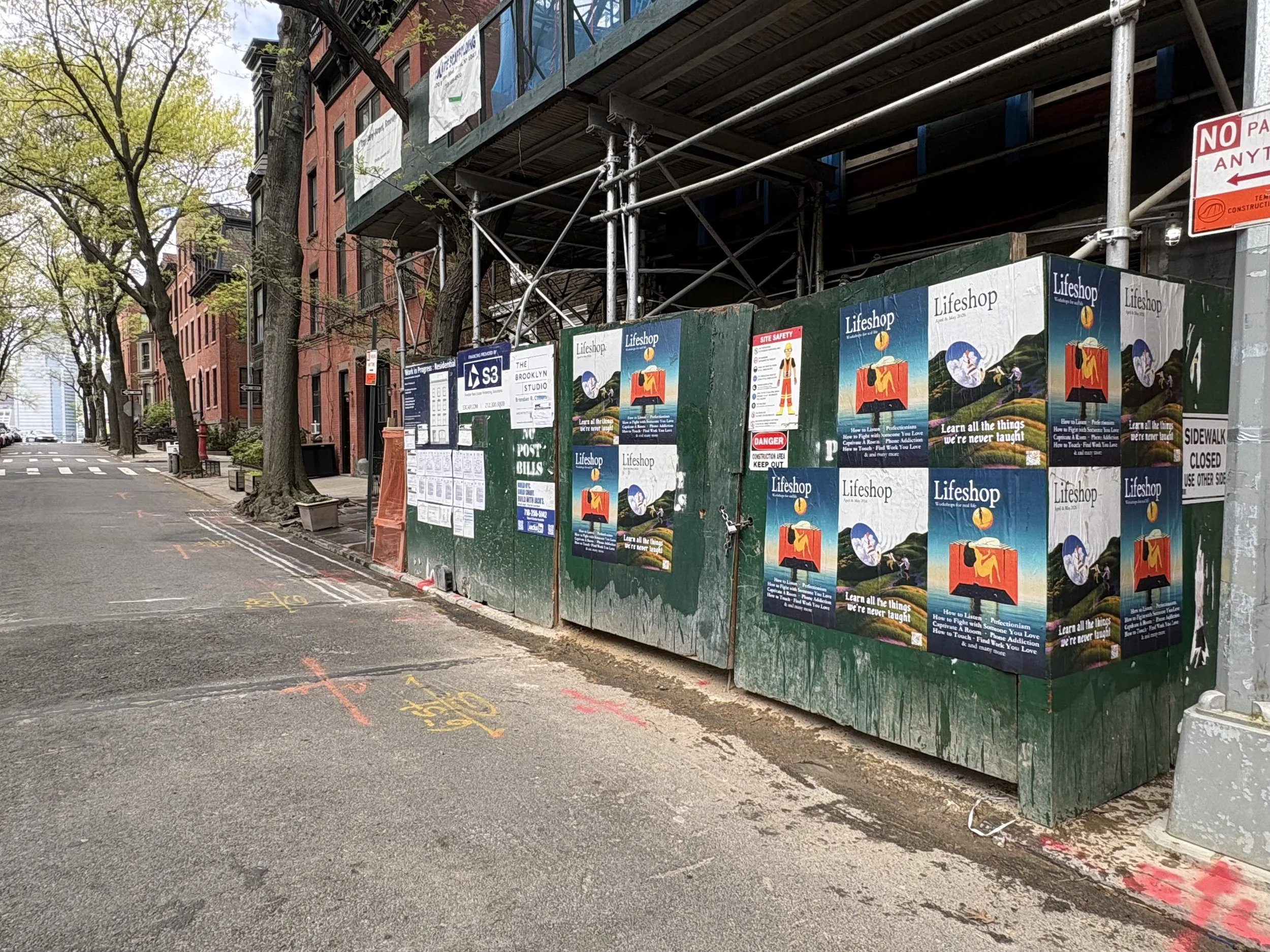
Street poster installation by sidewalktattos
Online businesses are built to move fast, test fast, and scale fast. That speed is powerful, but it also creates a blind spot. Many digital-first brands spend nearly all of their attention inside platforms they do not control, competing for shrinking attention in feeds, search results, inboxes, and video pre-roll.
A real-world presence changes that equation.
Wheat pasting gives online brands a way to show up in daily life, not just on screens. It turns walls, corridors of foot traffic, nightlife zones, retail districts, and cultural neighborhoods into high-visibility media. For brands that live online but want to feel larger, more credible, and more present, it is one of the most direct ways to move from impression to memory.
Why online brands need real-world brand visibility
Digital advertising is still essential, yet audience behavior is getting harder for online businesses every year. People skip, mute, close, scroll past, and block ads with remarkable discipline. Gartner reported that 52% of U.S. consumers said they take steps to actively block ads, and another survey found 43% say they do everything they can to avoid and block them.
That matters because online brands often rely on interruption-based channels. If the audience is trained to ignore interruption, efficiency starts to slip. Creative has to work harder. Frequency becomes expensive. Performance channels carry more pressure than they should.
Street media does something different. It does not ask for a click in the same way. It enters the audience’s field of view while they are commuting, meeting friends, shopping, walking to work, or heading to an event.
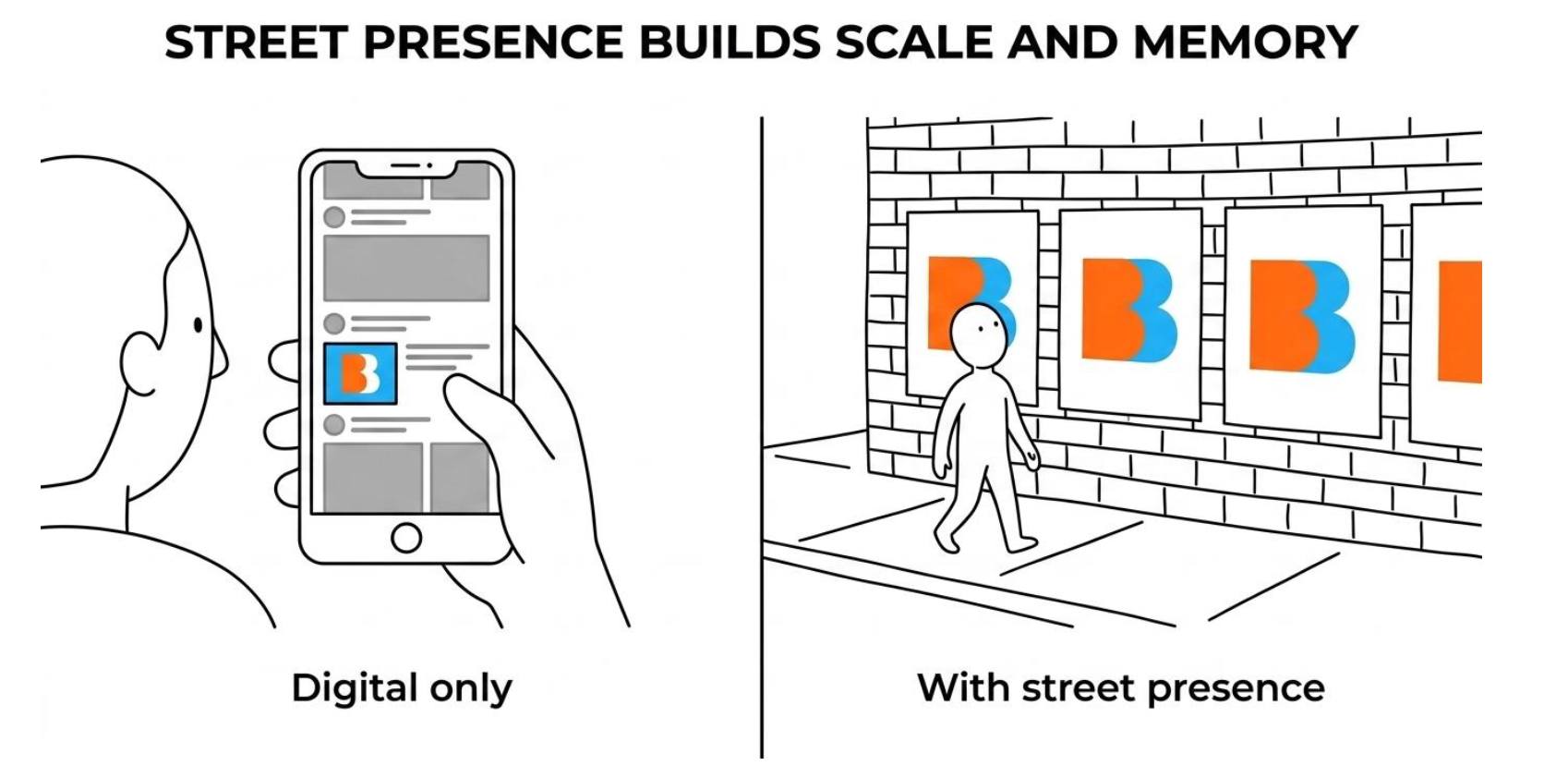
The power of wheatpasting throughout society brain by sidewalktattos
Out-of-home advertising continues to grow for a reason. The Out of Home Advertising Association of America reported that U.S. out-of-home revenue reached a record $9.46 billion in 2025, marking 19 consecutive quarters of growth.
That growth signals something simple: physical media still gets noticed.
Why wheat pasting works when digital ads get tuned out
Wheat pasting is not just poster placement. Done well, it is urban media strategy. It creates repetition in neighborhoods that matter, and it places a brand inside the rhythm of a city.
A feed ad appears and disappears in seconds. A wheat paste takeover can stay in view across multiple blocks, multiple days, and multiple audience moments. The brand is encountered passively, then again, then again. That repetition builds familiarity without demanding immediate action.
For online businesses, this is especially useful because many of them face three common challenges at once:
rising customer acquisition costs
weak brand recall outside paid media
limited trust signals in the physical world
Wheat pasting helps address all three. It broadens awareness beyond platform inventory, gives people a memorable visual cue, and signals that the brand is active enough to exist in public space, not just inside a browser tab.
Wheat pasting and out-of-home advertising reach during daily routines
One reason out-of-home remains strong is that it reaches people during routines they cannot scroll away from. Commuting, walking, waiting, traveling, and moving through entertainment districts are all moments where attention behaves differently. The audience is not necessarily looking for advertising, but they are highly responsive to bold visuals, concise messaging, and repeated placement.
This is where wheat pasting has an edge over more polished formats. It often feels immediate, cultural, and local. It can look like a brand belongs to the city rather than renting a corner of it.
That matters for brands targeting:
Gen Z and younger millennials
startup ecosystems in major metro areas
culture-driven early adopters
A recent OOH study from OAAA on travel behavior also showed how out-of-home influences people while they are in motion. The broader lesson reaches beyond travel. Physical media performs well when people are out in the world making choices in context, not only when they are seated and actively shopping online.
How wheat pasting supports online business growth
The strongest argument for wheat pasting is not that it replaces digital. It is that it gives digital a stronger stage.
When a person sees a brand on the street and later encounters it in social, search, or streaming, the second touch feels warmer. Click-through may improve. Brand search may rise. Social mentions may become more organic. Influencer posts may perform better because the brand already feels present.
Here is a simple way to think about it:
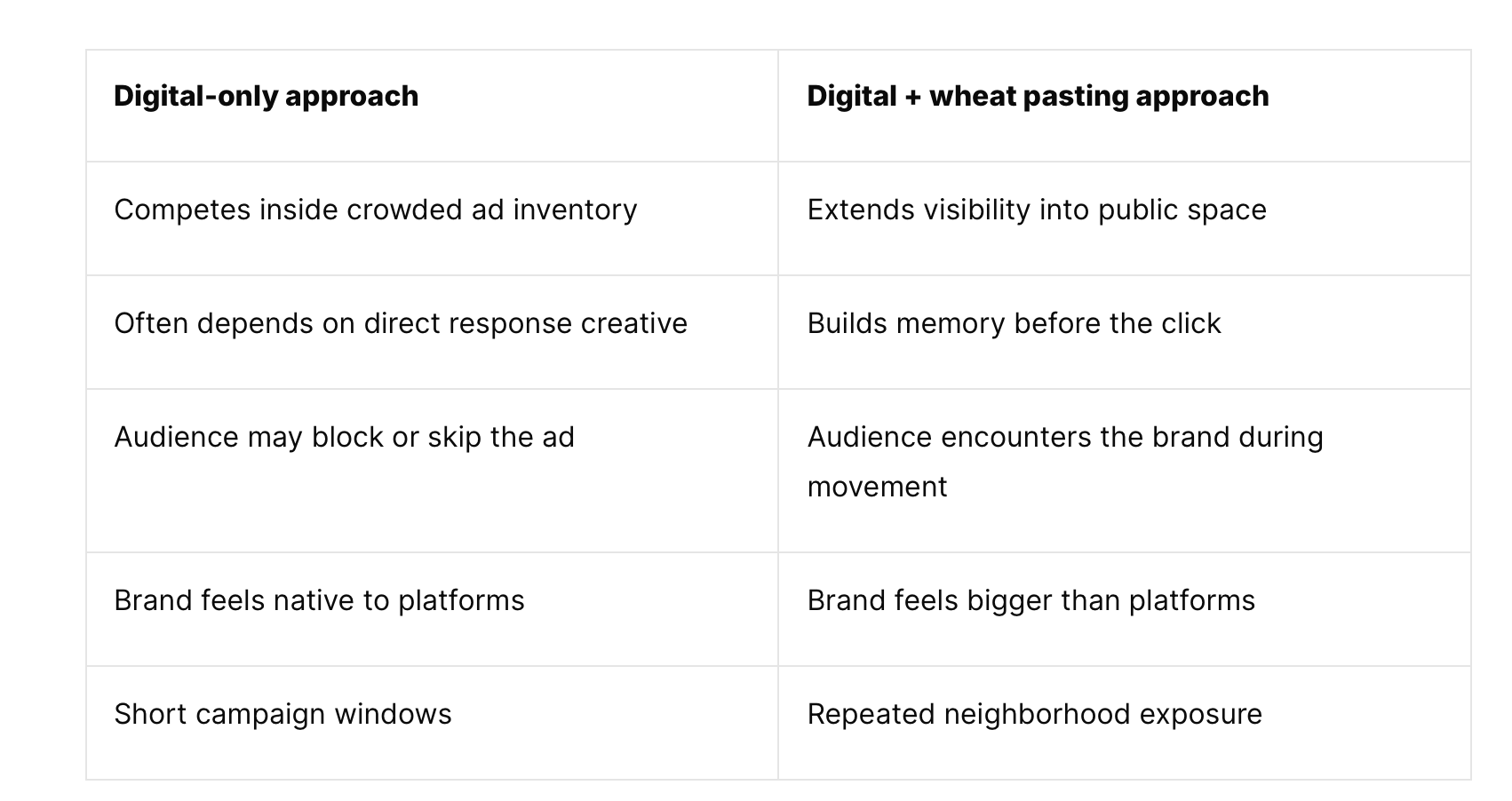
Digital vs Wheatpasting marketing by sidewalktattos
This is why wheat pasting often works well around launches, drops, pop-ups, funding announcements, new city expansion, creator collaborations, and event promotion. It gives the campaign a sense of momentum that pure digital can struggle to create on its own.
What online brands gain from wheat paste poster campaigns
A strong street poster campaign can do more than generate awareness. It can shape perception.
If the creative is sharp and the placement is strategic, wheat pasting can make an online business appear more established, more culturally aware, and more confident. That shift is valuable for brands that are still building legitimacy in crowded categories.
After the right kind of introductory paragraph like this, a short list helps clarify the business value:
Brand scale: A street presence makes a small or mid-sized online company feel larger.
Cultural relevance: Posters in the right districts place the brand near scenes and communities that matter.
Launch energy: A citywide burst creates urgency around a release, opening, or campaign window.
Social amplification: People photograph walls, corners, and repeated takeovers, then post them.
Cross-channel lift: Street media strengthens the next impression in paid social, search, email, and creator content.
The best campaigns are visually disciplined. One message. One image system. One clear reason to remember the brand.
What a wheat pasting campaign looks like in practice
Execution matters as much as creative. A weak rollout can turn a good idea into background noise. A mapped rollout can turn the same idea into a city presence.
Sidewalk Tattoos specializes in wheat pasting posters, sidewalk stencils, and custom installations, with campaigns executed across the U.S. and internationally. Poster sizes can range from 24" x 36" to 48" x 72", which gives brands room to scale from tactical neighborhood placement to larger visual statements.
A well-run campaign usually includes location planning, production, installation scheduling, and documentation. Photo proof and geo-tagged reporting are especially useful for online brands because they connect a physical campaign back to internal marketing workflows. Street media becomes trackable, referenceable, and easier to share with stakeholders.
A few campaign building blocks tend to matter most:
neighborhood mapping
high-foot-traffic corridors
nightlife and retail adjacency
creative suited for quick reading
photo and geo documentation
Fast turnaround also changes the value of the format. When installation can happen within 48 to 72 hours, wheat pasting becomes practical for short lead-time campaigns, not just long planning cycles.
Wheat pasting campaign planning and legal considerations
Street media works best when it is planned professionally. That includes compliance.
Posting rules vary by city, property type, and placement category. In some jurisdictions, posting advertisements in a street right-of-way or on the exterior of a public building without permission is prohibited. Portland’s city code is one clear example. That means online businesses should not treat wheat pasting as random postering. The smart approach is to work with a team that understands local conditions, permitted opportunities, and responsible installation methods.
This part is not glamorous, but it protects the campaign and the brand. A street activation should feel bold in public, not careless behind the scenes.
A practical planning process usually includes:
Placement review: Confirm where installations can and cannot go.
Material choices: Use temporary, eco-conscious materials where appropriate.
Local execution: Match the city’s realities rather than forcing a generic plan.
Documentation: Capture proof of placement for accountability and reporting.
Done properly, wheat pasting keeps its edge while staying organized, efficient, and brand-safe.
Which online businesses should consider wheat pasting first
Not every online brand needs the same media mix. Some categories gain more from street presence because their growth depends on identity, timing, and talk value.
Wheat pasting is especially compelling for businesses that need to be seen before they are searched. That includes brands where aesthetics, scene affiliation, and cultural timing influence customer response.
The format often makes sense for:
direct-to-consumer product launches
fashion labels and capsule drops
music releases and live events
apps entering major metros
creator-led brands
restaurants, hospitality, and nightlife concepts with strong digital roots
It can also be highly effective for B2B startups with a consumer-facing angle, especially during conferences, hiring pushes, city activations, or fundraising milestones. A poster campaign in the right district can say, “we are here,” with more force than a sponsored post ever could.
How to connect wheat pasting with digital performance marketing
The strongest street campaigns are not isolated. They are tied to the rest of the marketing system.
A wheat paste campaign can mirror social creative, echo landing page messaging, support creator partnerships, and drive search interest with a simple, memorable phrase. It can also become content itself. Teams regularly use installation photos and neighborhood shots across paid social, organic posts, email, PR outreach, and sales decks.
That means the street does not sit outside the funnel. It feeds the funnel.
There are a few smart ways to connect the channels without overcomplicating the message:
Use consistent visuals: Let the poster art match paid and organic creative.
Keep copy short: Street media should be readable in seconds.
Time the rollout: Install close to a drop, launch, or live moment.
Document everything: Turn proof-of-posting into content and reporting.
Map by audience: Choose neighborhoods based on real customer behavior, not guesswork.
When that coordination is in place, wheat pasting stops being a novelty. It becomes a serious awareness channel with real-world outcomes.
Why the street still matters for digital-first brands
A digital business does not become more modern by staying invisible offline. In many cases, the opposite is true. The brands that feel most current are often the ones that understand how physical and digital presence reinforce each other.
Wheat pasting is powerful because it gives online businesses scale, texture, and context. It places a brand in cities where conversations happen. It reaches people during daily routines. It works around ad avoidance rather than fighting it. And it creates the kind of repeated public visibility that many online-only strategies lack.
For brands ready to move beyond the feed, the street is open. Sidewalk Tattoos plans and executes wheat pasting campaigns with mapped placement, photo and geo documentation, and city-ready rollout across the U.S. and abroad. If your brand needs real-world presence, now is a good time to get on the street.
Reach out for more information :
929.678.0235
