
Wheatpasting vs Permitted Poster Locations: What You Actually Pay For
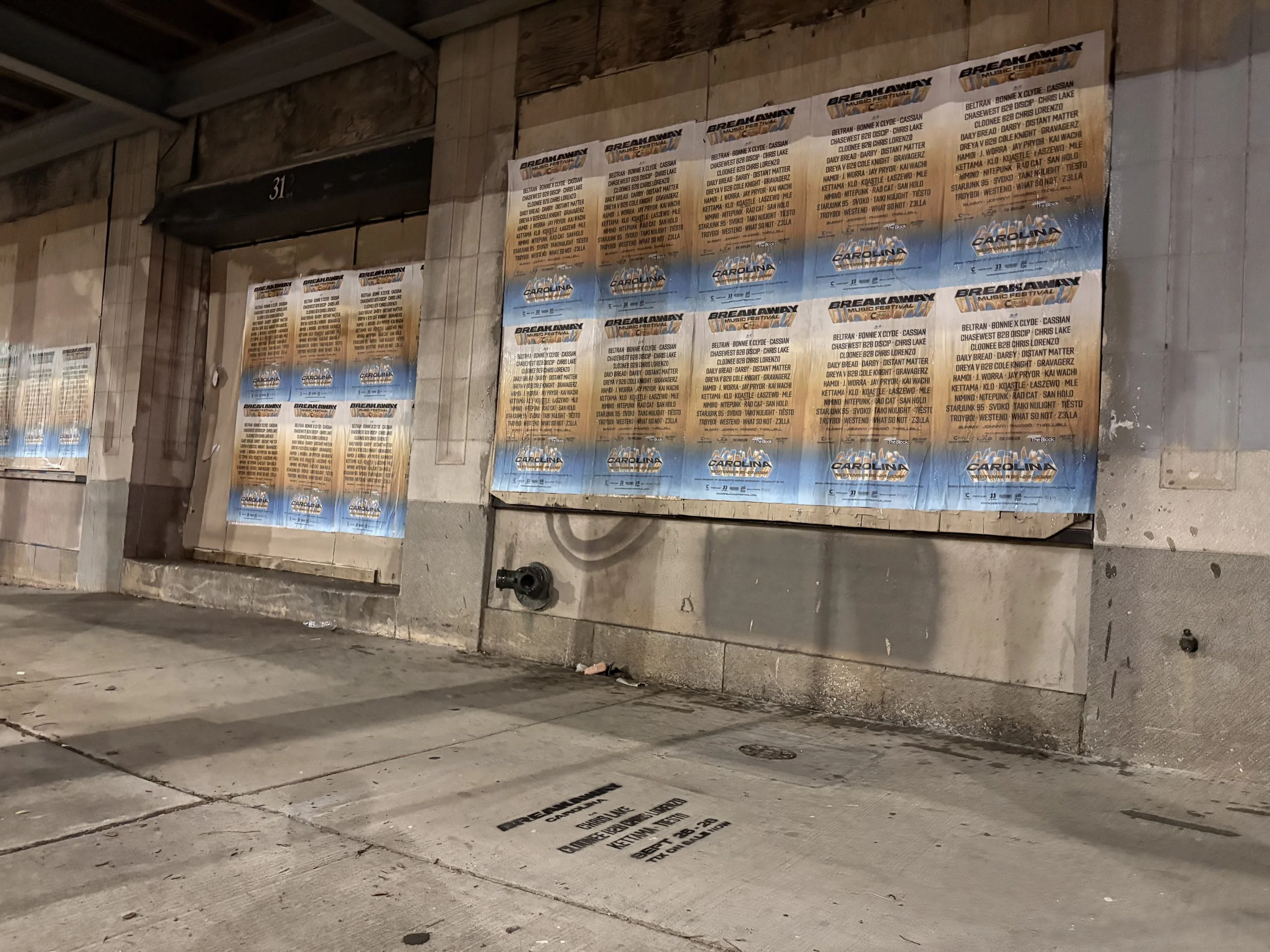
Poster installation by sidewalktattos
When marketers compare poster tactics, the first instinct is to look at the posted fee. A permitted board has a clear price. A wheatpaste campaign often looks less formal, so people assume the cost story is simple. It is not.
What you are really paying for is a mix of permission, placement, scale, labor, speed, and risk. In many cities, a permitted poster location or managed posting board can cost thousands for one spot or one short flight. A wheatpaste install can spread the same message across multiple neighborhoods for less, especially when the campaign is built for repetition and citywide presence. That does not mean every wheatpaste plan is automatically cheap, or automatically allowed. It means the budget buys something very different.
Permitted poster locations charge for control, not broad reach
A permitted poster board is a controlled media product. You are paying for the right to occupy a defined space under a defined set of rules. The placement is predictable. The format is fixed. The owner, operator, or city authority decides what fits, how long it stays up, and what creative standards apply.
That clarity has real value. Brands that need a known address, a formal booking process, and a cleaner compliance path may prefer it. The tradeoff is that control is rarely the same as saturation. One approved location, even in a strong corridor, is still one location.
Official city rules make that gap easy to see. Some channels sound inexpensive on paper, yet the permission is narrow and the placement rules are strict.
Wheatpasting budgets pay for repetition across the city
Wheatpasting is usually evaluated the wrong way. People ask what one wall costs when the stronger question is what a full urban footprint costs. Street visibility works through repetition. The same poster seen in SoHo, Silver Lake, Wicker Park, Bushwick, or the blocks around a venue starts to feel like a moment rather than a lonely ad.
That is why many brands choose wheatpasting when they want cultural presence, not just one approved address. A citywide poster run can put the message in front of people during commutes, late-night foot traffic, retail walks, and event lines. It feels native to the street because it is part of the street.
A serious wheatpaste budget is not only paying for paper and paste. It often covers production, route planning, installer labor, timing, documentation, and campaign density.
printing and posting materials
installer labor and route density
neighborhood selection
overnight or early-morning deployment
photo proof
geo-location tracking
replacement rounds where needed
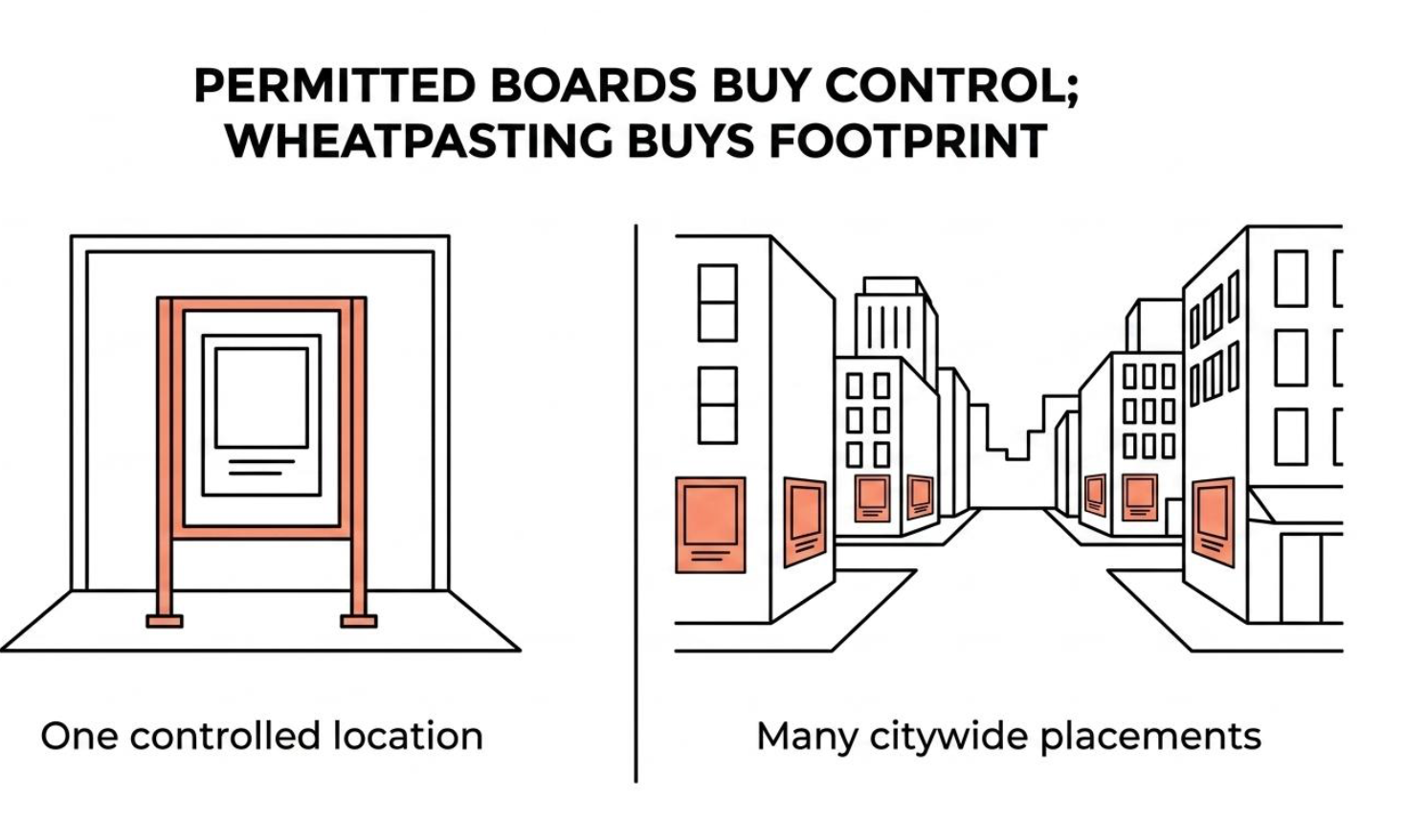
This is where the cost story changes. A permitted board often concentrates spend into one unit of real estate. A wheatpaste campaign often spreads spend across a system of placements. If the objective is total city presence, that spread can be more efficient than paying premium rates for isolated official boards.
The real pricing difference is permission versus footprint
A permitted board and a wheatpaste campaign are not interchangeable line items. They answer different media questions.
One buys legal occupancy of a specific, limited placement. The other, when planned responsibly, buys distribution and frequency across a live urban environment. The cheapest version of wheatpasting is unauthorized public posting, and that version can carry fines, removal costs, and wasted production. The better comparison is between a managed street campaign and a managed permitted location.
That makes the budget framework much clearer.
Permission: a right to use a defined space under explicit rules
Footprint: how much of the city the campaign can actually touch
Risk: fines, civil penalties, takedowns, and cleanup exposure
Operations: printing, crews, transport, paste, installation windows
Proof: mapped documentation, photography, and geo-location tracking
Speed: how fast the message appears across multiple neighborhoods
Brands that skip this framework often compare apples to bricks. A single approved board can look expensive if your goal is reach. A wheatpaste campaign can look risky if the plan ignores permission, local rules, or property consent. Good planning fixes both problems by making the objective explicit before the budget is set.
City permit rules and enforcement reshape the poster math
Local rules matter more than most media plans admit. A poster strategy that seems inexpensive in one market can become costly in another after permits, format restrictions, and enforcement are factored in.
Savannah offers a useful example. The city issues permits for chalk menu boards at $200 per year, but those boards cannot include posters or other printed materials, and they cannot obstruct the public right-of-way. That is a legal advertising tool, yes, but it is not poster distribution. A marketer reading only the fee would miss the real constraint.
Montréal shows a different angle. Advertising materials may be distributed at no extra cost when the distributor already has a valid commercial and professional activity permit. That sounds favorable, but the city still limits where materials may be left. No private property drop is allowed without the occupant’s consent, indicated through the city’s participation system. So the budget benefit comes with a permissions framework, not open placement freedom.
Mount Vernon makes the point even more clearly. The city sets low prices for billposting and handbill licenses, yet it also bars placing handbills, signs, posters, or advertisements on sidewalks, streets, alleys, and other public places. A license can be real, and still leave little room for the kind of street presence many brands picture when they say “posters.”
Then there is enforcement. New York City’s illegal sign provisions allow fines that can climb to $1,000 for a second or later violation within a twelve-month period, plus removal costs. Each unauthorized poster or handbill can be treated as a separate violation. Once a campaign is exposed to that structure, the “low-cost” story falls apart very fast.
Single-location certainty and citywide repetition are different media buys
A permitted board gives certainty at one address; a distributed wheatpaste campaign gives recurring visibility across the routes people actually walk.
What brands are really buying when they choose wheatpasting
When a brand chooses wheatpasting over a permitted poster board, the appeal is usually not rule avoidance. The appeal is density. One creative asset can appear again and again, building familiarity through repetition rather than asking one board to do all the work.
That repetition is especially useful for launches, fashion drops, music releases, pop-ups, conferences, nightlife events, and challenger brands that need to look present in culture quickly. The street becomes a network rather than a single unit.
Professional execution also adds discipline to the format. A mapped campaign can be routed by neighborhood, documented with photos, and tracked by location. That matters to marketers who need proof, internal reporting, and a record of where the media appeared. It also makes it easier to compare street activation against digital out-of-home, paid social, or event spend.
Sidewalk Tattoos, for example, structures street campaigns around mapped installations, geo-tagged documentation, and fast deployment windows across U.S. and international markets. That kind of operating model helps turn a street tactic into a measurable media buy rather than an improvised posting run.
How to compare poster options before you approve the spend
Before approving a poster budget, it helps to stop asking, “What is the cheapest way to get up?” and start asking, “What result am I paying for?”
If the goal is formal permission in a highly controlled location, a permitted board may be the better fit even at a higher unit price. If the goal is broad city visibility, repeat exposure, and a look that feels native to street culture, wheatpasting may create more impact per dollar.
The key questions are practical:
How many people need to see it: one corridor, several neighborhoods, or an entire city
How fast does it need to launch: a long booking cycle or a rapid 48 to 72 hour activation
What proof is required: simple placement confirmation or detailed mapped reporting
What risk can the brand accept: strictly permitted media only or a broader street plan built around approved methods and local rules
What creative format fits the message: a fixed board unit, wild posting style, or a combined poster and sidewalk stencil activation
That set of questions usually exposes the real budget logic. A single premium location can be perfect when place matters more than repetition. A citywide wheatpaste campaign can be the stronger buy when momentum, frequency, and visual saturation matter more.
If your team is weighing both paths, the smartest next step is to scope the market, the rules, and the visibility goal together. That is where street media gets clearer. If the aim is to cover a city instead of renting one expensive square of it, Sidewalk Tattoos can map a wheat pasting plan, document it, and get it moving quickly.
Reach out for more information :
929.678.0235
