
Discover the Power of Footprint Trails and QR Codes in Marketing
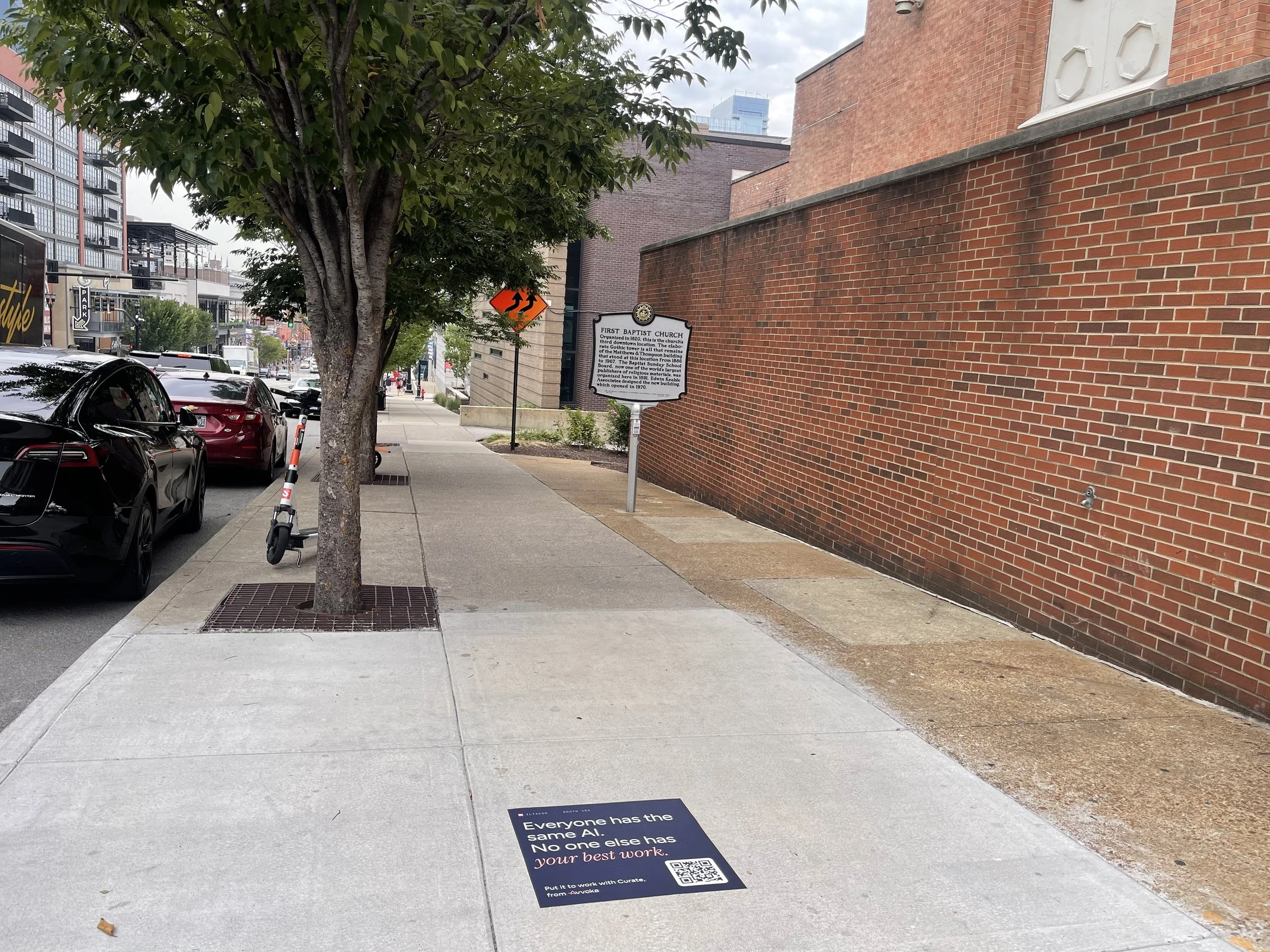
Avvoka sidewalk decal with a QR code By sidewalktattos
Street marketing gets stronger when it does more than create a visual moment. The best activations shape movement, set a direction, and give people an easy next step. That is where footprint trails and QR codes stand out.
A footprint-style campaign can turn a sidewalk into a path. A QR code can turn that path into a measurable response. When the two are planned together, street media stops being only atmospheric and starts working like a guided conversion system, right at ground level.
Precision street marketing works when placement drives action
Street media is often discussed in broad terms: visibility, buzz, urban presence, cultural relevance. Those benefits matter. Still, the precision side is what separates a memorable activation from one that also produces useful data.
A footprint trail is a simple idea with sharp execution value. Repeated shapes, directional arrows, footsteps, or stencil marks pull attention forward. They can guide pedestrians toward a storefront, a poster installation, a launch event, a pop-up, or a branded moment placed just beyond the next corner.
That precision depends on route logic. People do not move through cities randomly. They enter transit stations, cross at predictable points, pause at food lines, queue outside venues, and cluster near retail corridors. A well-planned ground campaign takes advantage of those patterns instead of fighting them.
Sometimes the shortest distance between awareness and action is literally a few feet of pavement.
Sidewalk stencils versus sidewalk decals for QR code campaigns
Brands often group stencils and decals together because both live on the ground plane. Operationally, they do different jobs.
Stencil Advertisement by sidewalktattos
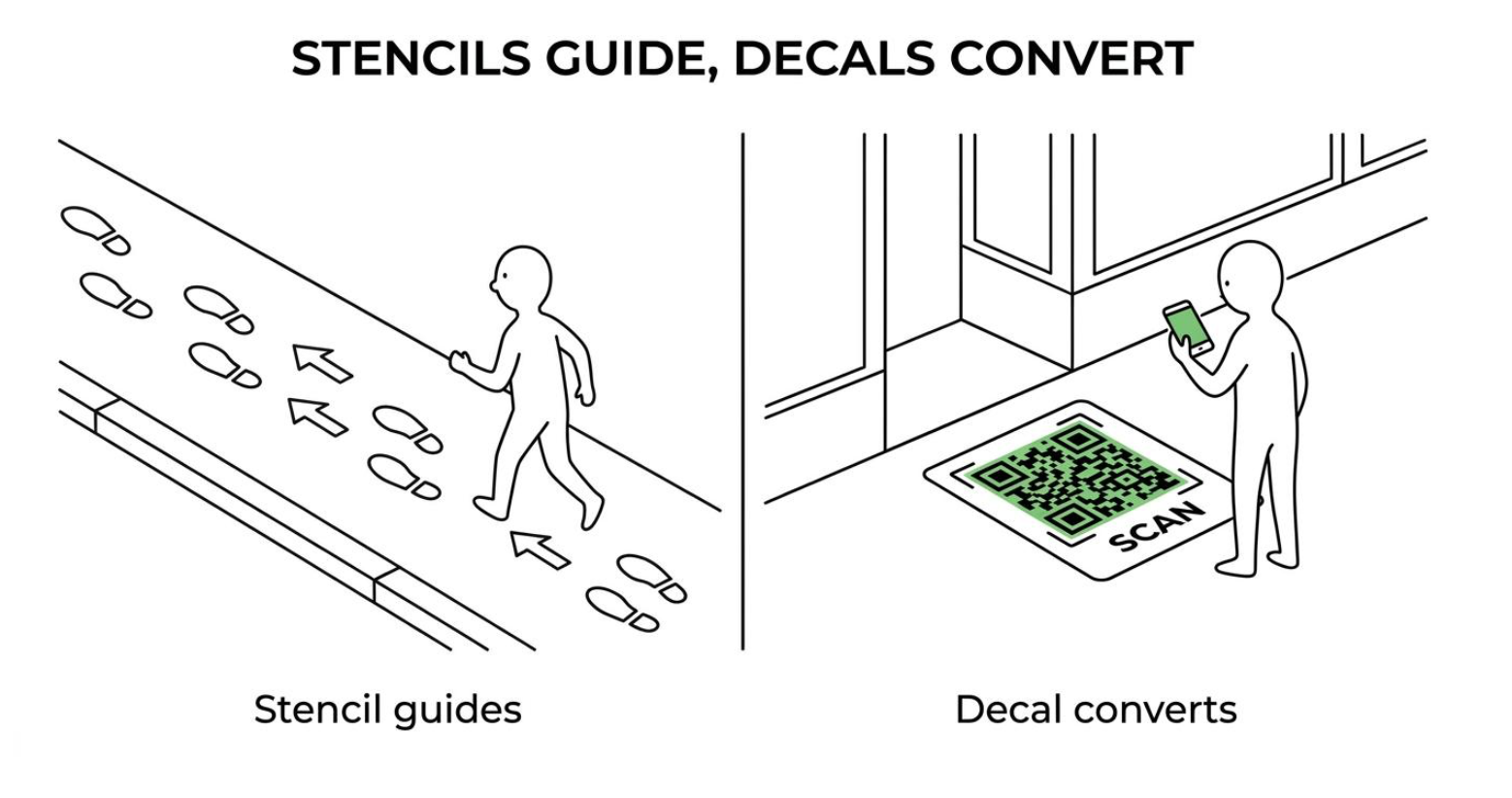
A stencil is ideal for repetition, route building, and fast directional impact. It is strong for shape, logo marks, arrows, words, and footprint motifs. It is not the right surface for a QR code. Sidewalk decals can carry a QR code. Stencils generally cannot do that dependably.
That distinction matters when a campaign needs both guidance and measurement. The stencil can move people through space. The decal can capture the scan at the right stopping point.
In practice, the strongest setup is often a hybrid one. Sidewalk Tattoos has described campaigns that pair a large-format wall moment with stencil footprints guiding pedestrians toward it, then use a ground-level QR destination for a drop, contest, or event RSVP. That pairing makes creative sense and reporting sense at the same time.
Footprint trails guide foot traffic with route logic and density
A footprint trail works because it meets people in motion. Most outdoor ads are seen while someone is passing by. Ground graphics can shape that passing behavior with a sequence rather than a single impression.
The design does not need to be complicated. Repetition is usually more effective than decoration. A clear footprint pattern, consistent spacing, and a destination point create an intuitive cue. People read it quickly. They know where to look next. They keep moving.
Sidewalk Tattoos describes this planning model around route logic, density, timing, and documentation. Those four ideas are useful because they keep the activation grounded in actual pedestrian behavior, not just creative preference.
After that strategic layer is set, a footprint trail usually needs to answer a few simple physical questions:
entry points
turn decisions
destination visibility
dwell spots
Density matters too. Too few marks and the path disappears. Too many and the message starts to feel noisy. The right spacing depends on pace, line of sight, and the number of environmental distractions on the block.
QR codes create measurable street marketing outcomes
Once pedestrians reach the action point, the QR code takes over. This is where street media shifts from directional branding into accountable performance.
The value is straightforward. A campaign-tracked link can connect the scan to a landing page, RSVP form, ticket page, coupon, waitlist, product drop, or store locator. That gives marketers a way to compare neighborhoods, creative variants, event days, and install patterns.
Official guidance supports that measurement mindset. The U.S. Department of Energy recommends tracking QR code usage, including scans and link clicks, to judge whether communications are working. It also advises printing a shortened link below the code so people who do not scan can still reach the destination page. That is a useful street-level best practice, especially in fast-moving public spaces where not every person will pause long enough to open a camera app.
Adoption is there too. A 2025 GS1 US survey reported that 66% of U.S. adults said they would scan a QR code on food packaging to access freshness, ingredients, and shelf-life information. Different context, same behavior signal: people are comfortable using QR codes when the value exchange is clear.
What should be measured depends on the campaign goal:
QR scans: Raw response volume by location, daypart, and creative version
Landing page visits: Confirmation that scans became actual site sessions
Promo code use: Direct tie between street exposure and redemption
Store traffic: Lift during activation windows near retail destinations
Event attendance: RSVPs, check-ins, and attendance tied to the campaign route
A QR code is not automatically effective because it exists. It needs a reason. “Scan for more” is weak. “Scan for tonight’s guest list,” “Scan for the drop map,” or “Scan for 20% off before 6 PM” gives the pedestrian a real prompt.
QR code safety matters in public marketing activations
Public trust is part of performance. If a QR code looks questionable, response falls fast.
That concern is not theoretical. APWG reported that Mimecast detected more than 1.7 million unique malicious QR codes between October 1, 2024 and March 31, 2025. The same report noted an average of 2.7 million emails with QR codes attached daily during that period. Even though those findings focus heavily on email abuse, they reinforce a broader point: people are right to be cautious.
Brands can make legitimate street QR campaigns feel safer and more credible with a few operational choices:
Visible brand cues: logo, campaign name, and a clear call to action near the code
Readable URL: print a short destination link below the QR code
Stable destination: avoid confusing redirect chains or link swapping
Clean design: strong contrast, enough quiet space, and no visual clutter around the code
A safe-looking QR is also a better-performing QR. Credibility and conversion are closely linked when the interaction happens in seconds on a busy sidewalk.
High-foot-traffic locations make sidewalk media practical
Precision only matters if enough people pass through the route. That is why pedestrian activity data matters when choosing blocks, corners, and venue corridors.
Recent downtown reporting backs this up. Downtown Portland Clean & Safe reported roughly 32 million pedestrians in the district during 2025, up from 30 million in 2024, with a 5.5% year-over-year increase. The report also said annual foot traffic increased each year from 2021 through 2025. Numbers like that help explain why sidewalk media remains practical in major city cores.
High foot traffic alone is not enough, though. The best placements usually combine volume with intent. A corridor near a concert venue behaves differently from a lunchtime office path. A fashion retail block behaves differently from a convention center perimeter. Good planning looks at both count and context.
That is where mapped deployment becomes valuable. When installations are documented with photos and geo-tagged reporting, marketers can compare what was planned against what was placed, then tie it back to scans, visits, or attendance later.
Building a footprint trail campaign from first sight to scan
The strongest footprint trail campaigns feel simple to the pedestrian and highly structured behind the scenes. A person sees a mark, follows the path, reaches the destination, scans, and acts. What looks intuitive on the street usually comes from disciplined planning.
A practical build often starts with a visual anchor. That anchor might be a poster installation, a storefront, a branded sampling point, or an event check-in zone. From there, the trail works backward through likely pedestrian approach paths. The QR code is placed where people are most likely to slow down, not where they are still rushing through an intersection.
A solid framework often looks like this:
Anchor the destination with a strong visual moment that rewards attention.
Guide the approach using stencils or footprint marks planned around route logic and density.
Place the QR decal at the pause point where pedestrians can scan safely and comfortably.
Track the response with campaign-specific links, promo codes, landing pages, and attendance or store traffic data.
This is also why stencil-only campaigns and QR-led campaigns should not be treated as interchangeable. The stencil is directional media. The decal is interactive media. Together, they create a sharper street funnel than either one can create alone.
For brands that want measurable street-level activation, that distinction opens up better campaign design. A footprint trail can pull attention through a city block with confidence. A QR-enabled decal can capture the response. If you want to build that kind of mapped, documented campaign with sidewalk stencils, decals, wheat pasting, or a combined takeover, contact Sidewalk Tattoos to get started.
Reach out for more information :
929.678.0235
