
What to Expect the First Time You Run a Street Marketing Campaign: A Complete Guide
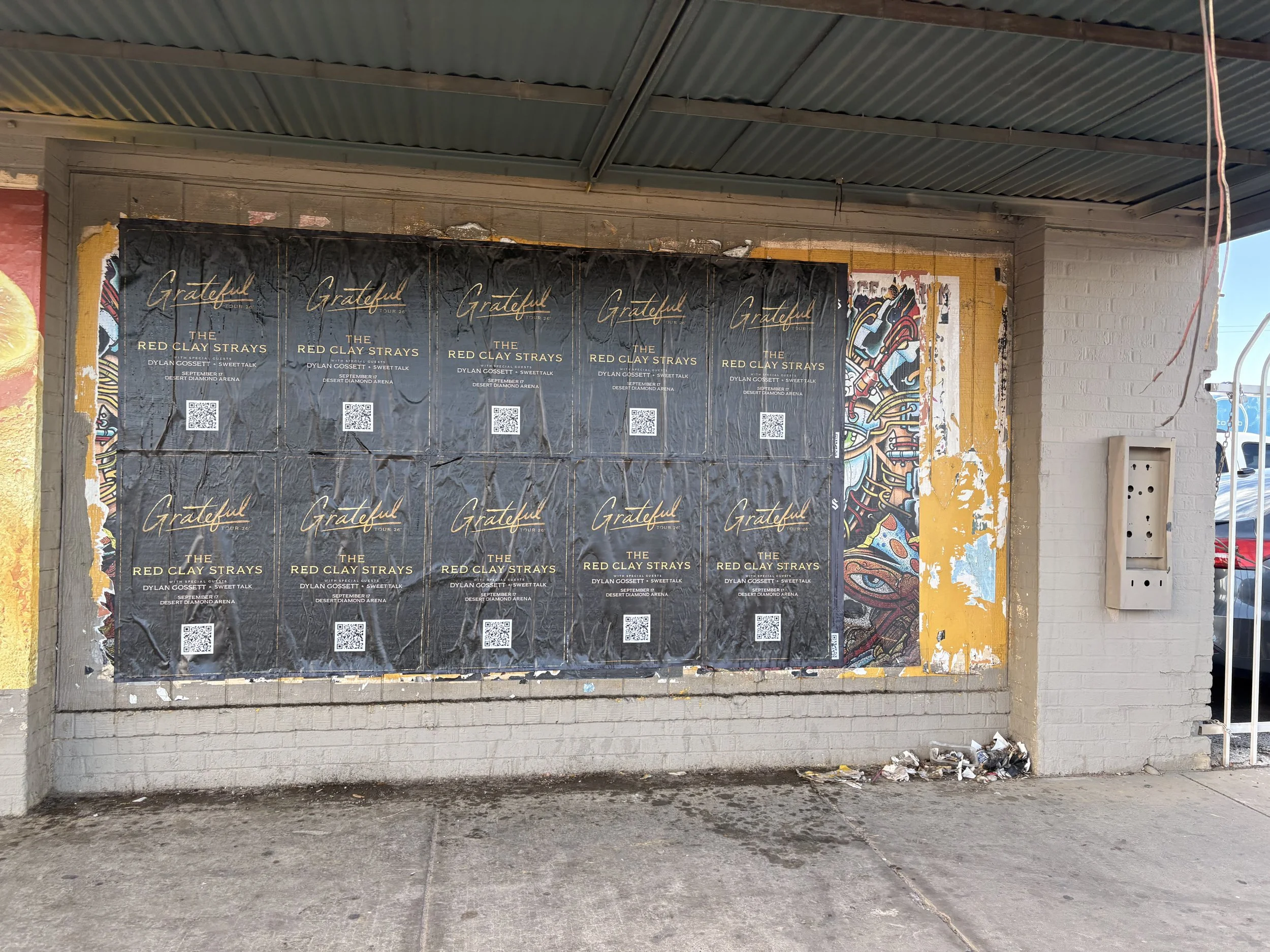
Red Clay Strays wheatpaste posters by sidewalktattos
The first street marketing campaign usually feels exciting right up until the practical questions start coming in. Where should it go? How many placements are enough? What will the creative need to look like on a wall or sidewalk instead of a phone screen? How do you know whether it worked?
That uncertainty is normal. Street marketing looks spontaneous to the public, but strong campaigns are planned with discipline. The brands that get the most from wheat pasting, sidewalk stencils, and poster installations tend to treat the first run as a focused launch, not a gamble.
Why first-time street marketing campaigns are worth the effort
Street-level media has real momentum behind it. The Out of Home Advertising Association of America reported that U.S. OOH revenue reached a record $9.46 billion in 2025, with 19 consecutive quarters of growth. That matters because it shows brands are still investing in public-space visibility, even while digital channels remain crowded and expensive.
Street campaigns also can create measurable brand effects. Nielsen reported that a 2023 OOH campaign for Luxottica delivered 1.31x greater efficiency than the previous year’s effort, along with a +4.0% lift in unaided awareness and a +1.9% relative uplift in purchase intent. A first campaign does not need to be massive to matter. It needs to be well placed, clearly designed, and documented carefully.
For many first-time advertisers, the real appeal is simple: street marketing puts a brand in front of people where they move, wait, commute, shop, and meet.
How a first street marketing campaign starts
Most first campaigns begin with a short planning phase that answers three basic questions: who needs to see this, where do they spend time, and what action should they take after exposure. That action might be visiting a pop-up, scanning a QR code, following a social account, remembering a launch date, or simply building familiarity in a neighborhood that matters.
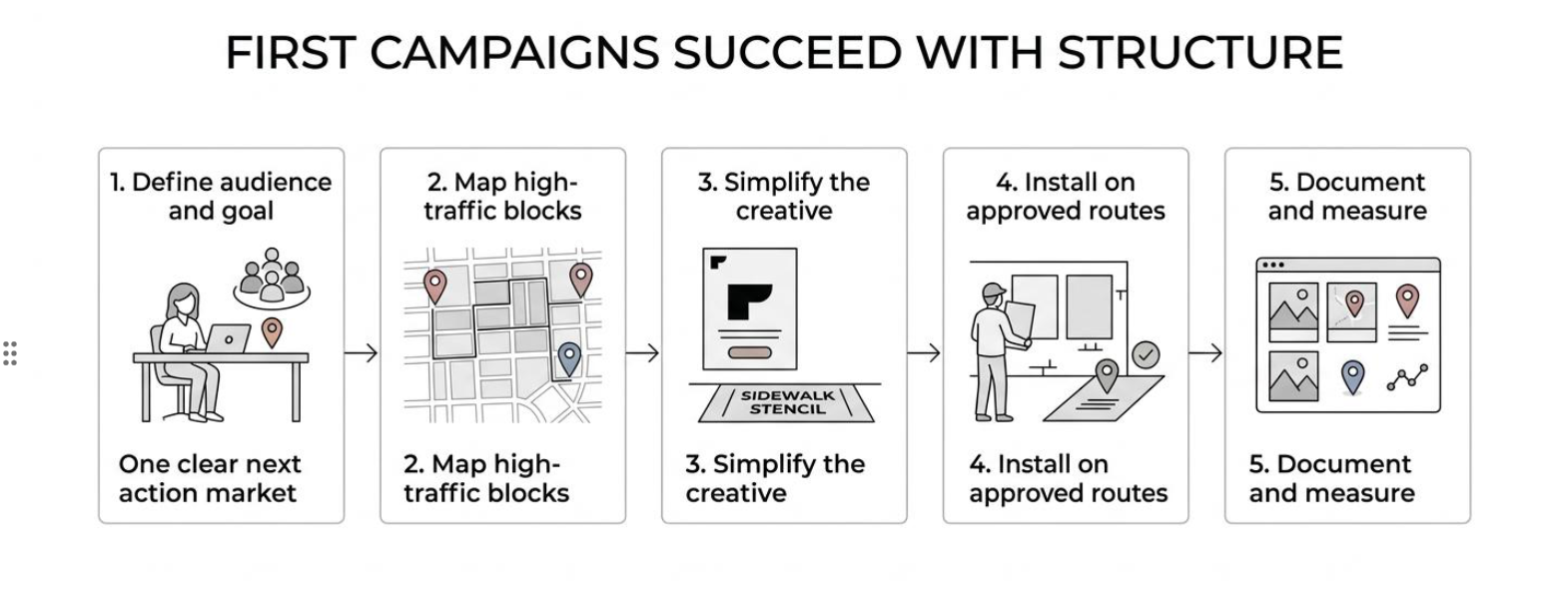
Campaign structure by Sidewalktattos
This phase is also where format decisions happen. Wheat pasting and sidewalk stencils do different jobs. Posters can create repeated visual impact at eye level across a district. Sidewalk stencils catch attention at ground level near intersections, subway exits, retail corridors, and event zones. A combined campaign often works best because it creates more than one touchpoint in the same area.
At Sidewalk Tattoos, campaigns often start with a mapped recommendation based on city, timing, audience density, and creative format. For first-time clients, that early structure removes a lot of guesswork.
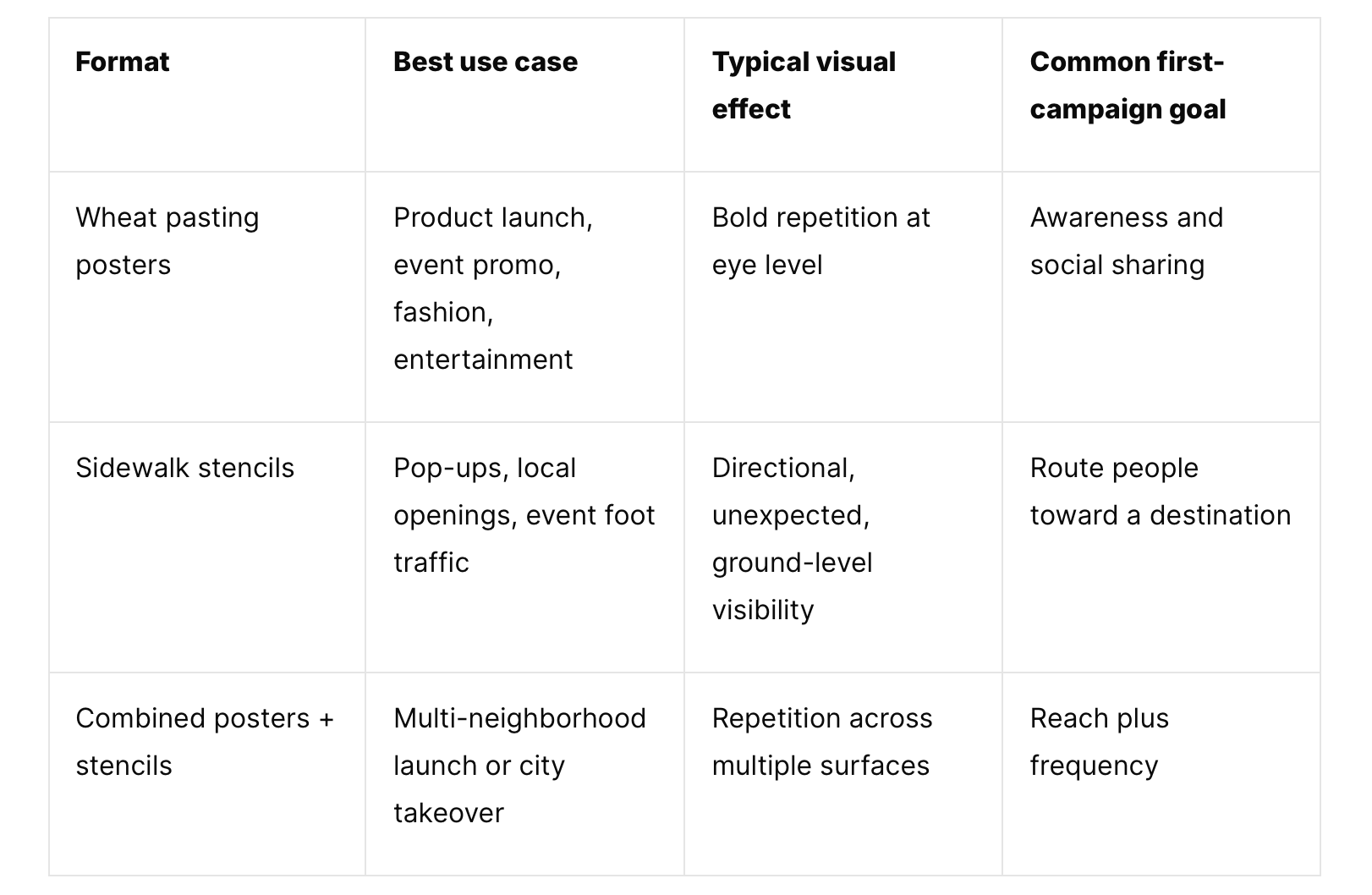
Marketing strategy use by sidewalktattos
What happens during street marketing site mapping and city selection
A first campaign rarely starts with printing. It starts with geography.
The team planning the activation will look at neighborhoods, pedestrian flow, retail clusters, nightlife patterns, commuter routes, and any location that matches the audience. A fashion label may want trend-forward shopping districts. A startup may want tech corridors and transit-heavy blocks. An event promoter may want placements that build momentum around the venue several days in advance.
The strongest mapping plans think about how someone physically moves through an area. A person might pass a poster wall near a train stop, then see a stencil near a coffee shop, then notice another placement closer to the venue. That repetition builds recall without needing a massive budget.
A site plan often weighs factors like these:
Foot traffic
Cultural fit
Commuter paths
Retail adjacency
Event proximity
Photo visibility
Repetition across a neighborhood
In company case examples, Sidewalk Tattoos has shown how local targeting works in practice. A Soho pop-up campaign used 100 sidewalk stencil hits near busy intersections, subway exits, and shopping streets to pull attention toward the activation area. That is a useful model for first-timers because it shows that placement strategy matters just as much as the artwork.
What to expect from street marketing creative development
Street creative needs to communicate faster than most digital ads. People are walking, crossing, chatting, commuting, or glancing while carrying coffee. A design that looks great in a brand deck can fail outdoors if it asks too much from the viewer.
The most effective first campaign creative is usually direct. One idea. One focal point. One message. A launch date, product name, artist, brand mark, URL, or QR code. If there is too much copy, the street will strip the message down for you, and not in a good way.
Scale matters too. Sidewalk Tattoos notes that sidewalk stencil formats can range from 6" x 60" to 48" x 48", while wheat-paste posters can range from 24" x 36" to 48" x 72". Those dimensions shape legibility, layout, and how much information should appear on the piece.
A good creative review for a first campaign usually asks:
Can someone grasp the message in two seconds?
Is the brand name easy to spot?
Will the design stay clear from several feet away?
Does the call to action feel realistic for the street setting?
That kind of discipline often leads to better work. Street media rewards confidence and clarity.
What legal placement and city rules mean for street marketing
This is one of the biggest surprises for first-time clients: public space is not a free-for-all. Street marketing works best when placement is lawful, informed by local rules, and handled by teams that know the difference between high-visibility opportunities and restricted surfaces.
Cities can be strict about where advertisements may appear, especially in the public right-of-way. Portland’s code, for example, states that it is unlawful to post notices or advertisements anywhere on a street right-of-way or on the exterior of a public building. The city also allows improperly posted ads to be removed after a removal request. Rules vary by market, which is why local knowledge matters.
That does not mean the channel is off-limits. It means the campaign needs to be planned responsibly. Experienced street marketing teams assess what is appropriate in each city, how temporary materials are used, and which placements fit campaign goals without creating unnecessary risk.
For a first campaign, this is one of the strongest reasons to work with a team that already operates at scale. Legal and practical judgment is part of execution, not an afterthought.
What street marketing production and installation day looks like
Once the creative is approved and the locations are mapped, production moves quickly. Posters are printed to spec, stencil materials are prepared, routes are organized, and installers work from the deployment plan. On a first campaign, this stage often feels much faster than clients expect.
That speed is one of the channel’s strengths. Sidewalk Tattoos has documented campaigns activated across multiple cities on tight turnarounds, including a case study where a True Religion wheat-paste campaign in Houston was completed within 24 hours of receiving final artwork and executed across 18 cities within 24 hours. Not every campaign moves that fast, but 48 to 72 hours is often realistic when assets and approvals are ready.
Installation day itself is structured, even when the result feels raw and organic in the street.
Routing: Teams follow mapped zones rather than improvising placement block by block
Materials: Temporary, eco-conscious methods are often used for wheat pasting and stencil work
Documentation: Photos are captured as placements go live
Coverage: The goal is consistent neighborhood saturation, not random isolated hits
For first-time clients, one helpful mindset shift is this: the value is not in a single perfect placement. It is in the pattern created across an area.
How first-time street marketing campaigns are documented and measured
A first campaign should never end with, “We think it went up.” It should end with proof of execution.
That is why documentation matters so much. Sidewalk Tattoos states that campaigns are supported with photo documentation and geo-location tracking so clients can see where placements landed. For brands running street marketing for the first time, this turns an analog-looking channel into something much more accountable.
Measurement can happen at several levels. Some brands care about delivery and visual coverage. Others want to track scans, visits, code redemptions, event turnout, or spikes in local social engagement. The right metric depends on the job the campaign is supposed to do.
Useful first-campaign metrics often include:
Placement proof: Photos, timestamps, and mapped locations
Traffic signals: QR scans, landing page visits, promo code use
Brand effects: Recall, awareness, and purchase intent
Short-term sales lift
Pop-up attendance
Social mentions in target neighborhoods
This is where expectations should stay realistic. Street marketing can create sharp visibility and strong memorability, but it is often one part of a wider launch mix. The strongest read usually comes when outdoor activity is paired with social content, PR, retail activity, or event programming.
Common surprises during a first street marketing campaign
First-time clients are often surprised by how strategic the process is. The public sees bold visuals on walls and sidewalks. Behind that, there is audience planning, route building, production timing, local market judgment, and reporting.
Another common surprise is how much creative restraint helps. Street work is not the place for five messages competing with each other. Brands that simplify their message usually get better results because the environment is already noisy.
Clients are also often surprised by how local a campaign can feel, even when it runs in many cities. Street-level media is excellent at giving a launch neighborhood relevance. A national brand can still feel close to the block when placements are chosen well.
A few early lessons tend to come up again and again:
Smaller, denser coverage can outperform scattered volume
Repetition matters more than novelty alone
Neighborhood context shapes perception
Fast reporting builds confidence for the next campaign
How to plan your first street marketing campaign with confidence
The best first campaign is not the biggest one. It is the one with a clear audience, focused geography, strong creative, lawful placement, and solid documentation.
That is why many brands start with one city, one product push, one event window, or one key neighborhood cluster. Once the team sees how the channel performs, scaling into more cities or a larger takeover becomes much easier.
If you are planning your first wheat-paste or sidewalk stencil activation, a good partner can walk you through the full process from mapping and creative guidance to installation and geo-tagged reporting. Sidewalk Tattoos runs street-level campaigns across major U.S. cities and international markets, with fast activation timelines and documented execution. If you are ready to put your brand into the streets with a plan that makes sense, contact us to get started.
