
Why AI Companies Are Targeting San Francisco for Wheatpasting
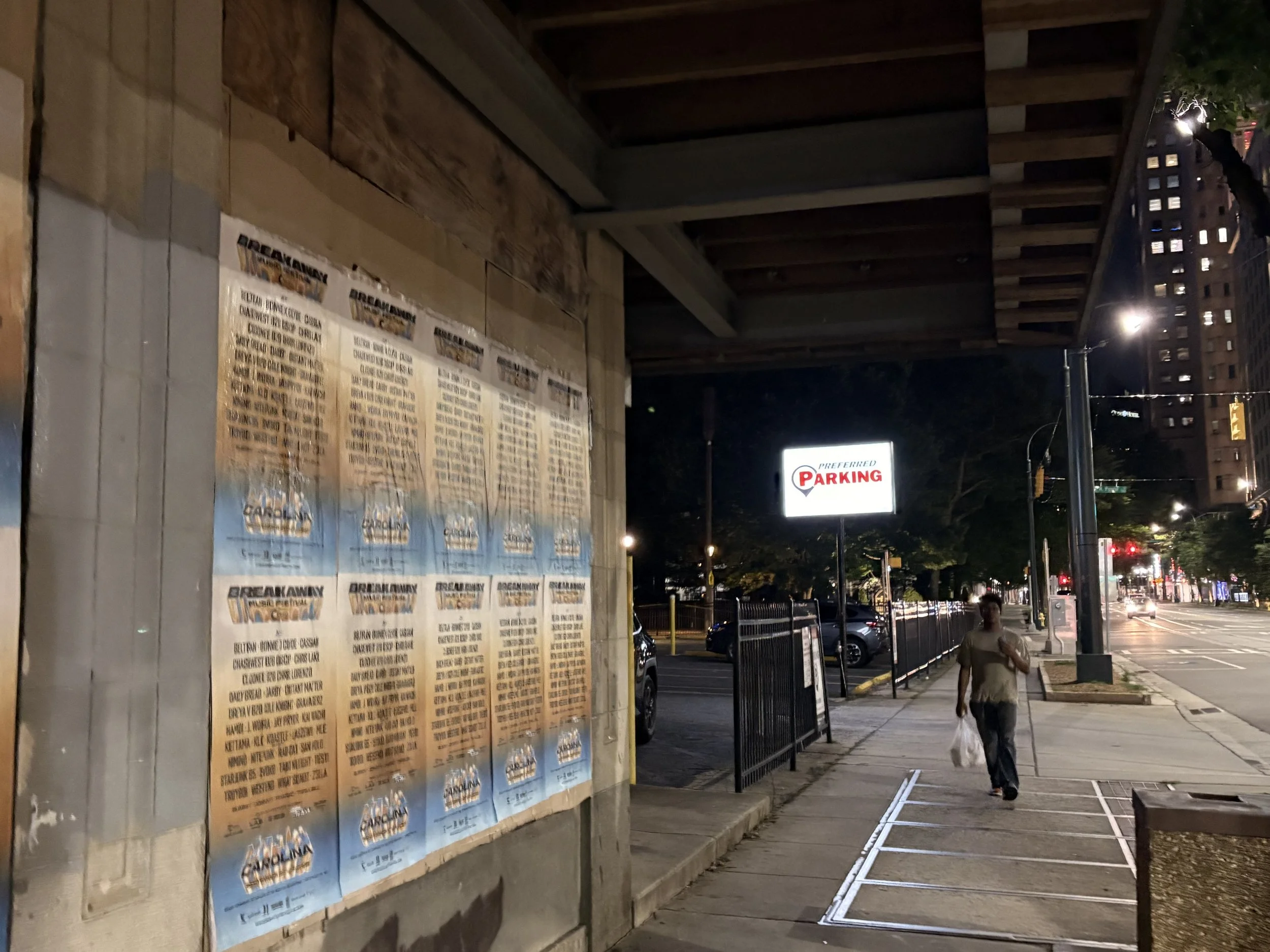
Wheatpasting campaign installed by sidewalktattos
San Francisco has become one of the few places where an AI brand can feel both early and everywhere at the same time. A company might launch a new model in the morning, trend on X by lunch, and still decide that the smartest next move is a physical poster campaign by evening.
That choice is not nostalgia. It is strategy.
When AI companies turn to wheatpasting in San Francisco, they are responding to a city with concentrated capital, dense technical audiences, and street environments that reward repetition. Sidewalks, construction barriers, storefront adjacencies, and poster walls give brands a way to move beyond algorithmic feeds and into daily life. In a market where every startup is fighting for mindshare, being seen offline can shape how a company is remembered online.
San Francisco AI funding makes the city a branding battleground
San Francisco is not just another tech market. It is still the center of gravity for AI attention in the United States, and that matters for outdoor campaigns.
Crunchbase reported in March 2025 that the Bay Area remains far ahead of other U.S. metro areas in the AI funding race, with the most heavily funded generative AI players concentrated around San Francisco. Stanford HAI’s 2026 AI Index adds scale to that picture: U.S. private investment in AI reached $285.88 billion in 2025, up 160.2% from 2024, with 1,953 newly funded AI companies in the country. Not all of that activity lives in San Francisco, of course, but a very large share of attention, media coverage, founder presence, and investor energy still runs through the Bay Area.
That concentration creates a simple marketing problem: strong products alone do not guarantee visibility.
A local example helps clarify the stakes. Crunchbase identified Anthropic as a San Francisco-based AI startup and reported its $3.5 billion funding round in 2025, valuing the company at $61.5 billion. When companies of that scale operate in the same city as seed-stage and Series A challengers, every brand has to work harder to stay visible. Wheatpaste campaigns answer that pressure with something digital channels rarely guarantee: unavoidable public presence.
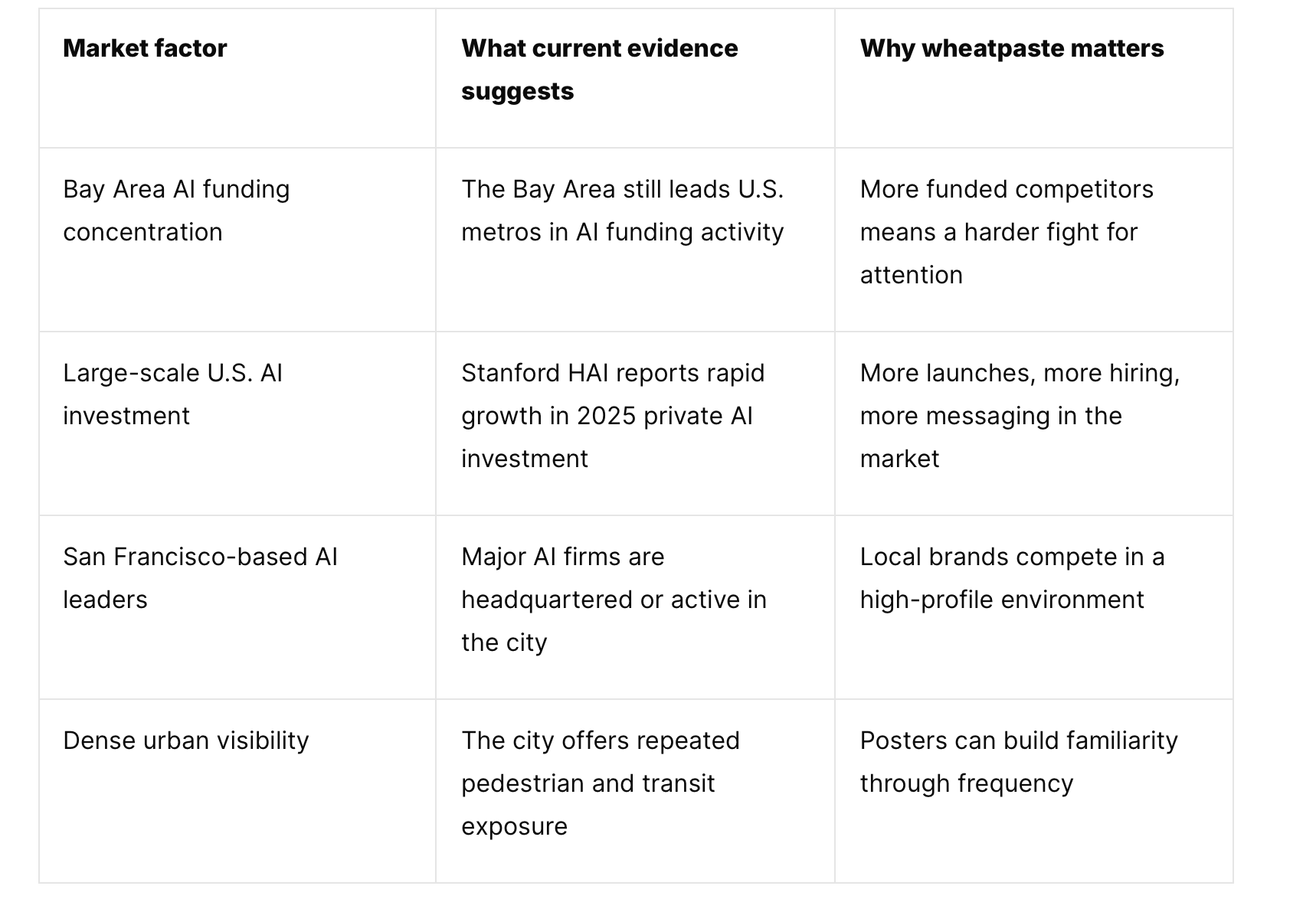
The importance of wheatpasting for Ai companies by sidewalktattos
San Francisco foot traffic gives wheatpaste posters repeated exposure
Street advertising works best when people encounter it more than once. San Francisco offers exactly that pattern.
The City and County of San Francisco’s economic reporting tracks monthly downtown employee and visitor foot traffic against 2019 levels and separately follows Muni Metro subway ridership and downtown BART exits. Those numbers shift month to month, and the city has noted periods where downtown traffic dips below trend. Even with that nuance, the reporting confirms a point marketers care about: downtown San Francisco still functions as a repeat-exposure environment shaped by commuters, visitors, meetings, events, and transit flows.
That repeat exposure is where wheatpasting becomes more than a poster on a wall.
When a brand appears near stations, office corridors, nightlife routes, and neighborhood connectors, the same audience can see the message several times in a week. The first view creates recognition. The second adds memory. The third starts to feel like momentum. For AI brands, that sequence is powerful because many buyers, engineers, and investors need several touches before a company name sticks.
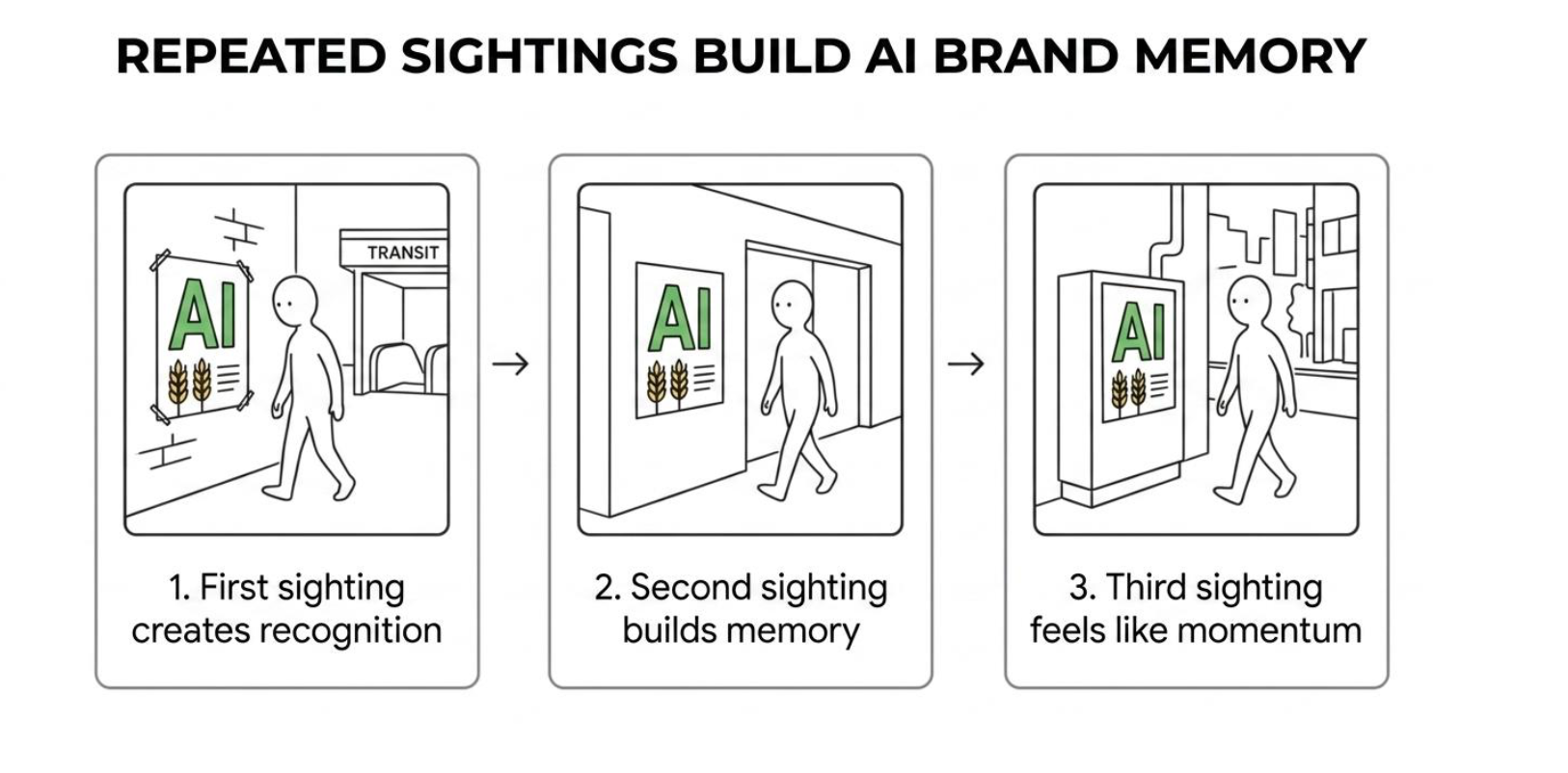
AI benefits illustration from sidewalktattos
A well-mapped street campaign can support that pattern in ways banner ads often cannot.
Why wheatpasting fits AI brand positioning in San Francisco
AI brands sell more than software. They sell trust, ambition, relevance, and a point of view about the future. Wheatpasting helps communicate those traits in a city where design language and cultural context matter.
Sidewalk Tattoos has framed San Francisco wheatpasting for AI companies as a way to bring brand messaging out of digital feeds and into neighborhood-level visibility. That framing fits the city. San Francisco has a long history of public graphic culture, independent art, startup velocity, and countercultural aesthetics. A poster campaign can make an AI company feel more present, more human, and less trapped inside browser tabs.
That shift matters because many AI categories now look crowded at first glance. Landing pages can feel interchangeable. Paid social gets skimmed. Search ads catch intent, but they rarely create atmosphere. Wheatpaste installs, by contrast, can create a sense that a company is part of the city’s conversation.
After a clear campaign setup, the benefits are easy to spot:
repeated urban visibility
neighborhood credibility
fast launch timing
social amplification from street photos
stronger recall during hiring and fundraising cycles
For AI brands, there is another advantage: posters can say a lot with very little. A sharp visual system, a memorable line, and disciplined placement can make an early-stage company look focused rather than noisy.
Mission District, Market Street, and transit corridors shape campaign value
Not every wall in San Francisco performs the same way. Good wheatpasting depends on context, route behavior, and the type of audience a brand wants to reach.
The Mission District is often effective for brands that want creative energy, younger audiences, nightlife adjacency, and a street-culture frame. A repeated poster presence there can feel current rather than corporate. Sidewalk Tattoos has described the effect as a kind of citywide storyline, where repeated placement across a week makes the campaign feel alive.
Market Street serves a different role. It is less about subcultural credibility and more about volume, circulation, and business visibility. For AI companies speaking to operators, enterprise buyers, candidates, or investors, this kind of corridor can support broad recognition.
Transit-linked placements bring their own strength. BART exits, Muni-linked corridors, and walkable downtown routes give campaigns a high chance of repeated impressions among people who work in or move through the city regularly.
A practical placement strategy often balances several zones:
Market Street: broad exposure near business traffic and daily circulation
Mission District: cultural relevance and shareable visual energy
Downtown connectors: strong repetition near offices, events, and meetings
Transit-adjacent routes: recall built through commuter habits
The point is not to cover every neighborhood. It is to place creative where the right audience is already in motion.
Why posters can outperform feeds for early-stage AI attention
Digital advertising still matters. It captures demand, supports retargeting, and can move prospects toward demo requests or signups. Yet AI brands in San Francisco often face a familiar problem: they are marketing to people who are already drowning in screens.
Founders are online all day. Engineers are online all day. Investors are online all day. Product teams, recruiters, and event attendees spend most of their attention inside dashboards, inboxes, and social timelines. A street poster interrupts that pattern because it appears in a different mental setting. It asks for attention during movement, not during scrolling.
A wheatpaste install also carries a different social signal. When people see a campaign on the street, photograph it, and share it, the brand gains a second layer of distribution that feels more organic than a paid ad impression. The poster becomes both media and content.
This is one reason AI brands in San Francisco keep returning to physical takeovers. The city’s sidewalks can generate online conversation while still delivering offline frequency.
What strong AI wheatpaste campaigns in San Francisco include
Effective campaigns are rarely complicated. They are disciplined.
The strongest work usually combines visual confidence with a tight media plan. The goal is not to say everything about the product. The goal is to make the right people remember the name, the promise, and the tone of the company.
A strong San Francisco rollout often includes:
One dominant message: a headline or idea that can be read in seconds
Consistent visual language: color, typography, and layout that hold together across many placements
Mapped placement logic: walls selected by audience density, route behavior, and neighborhood fit
Photo and geo documentation: proof of execution and a usable reporting layer for the client
Fast timing: launches tied to funding news, product releases, recruiting pushes, or events
This is where execution quality matters. Street campaigns can look spontaneous, but the best ones are tightly coordinated. Poster quantity, wall adjacency, timing, documentation, and neighborhood sequencing all shape results.
For brands moving quickly, speed is part of the appeal. Sidewalk Tattoos focuses on mapped, documented street-level campaigns at scale, with wheat pasting and stencil activations deployed across U.S. cities and internationally, often on accelerated timelines. That kind of operating model fits AI companies well because product cycles, announcements, and competitive moments move fast.
San Francisco wheatpasting works especially well for specific AI goals
Not every AI company wants the same outcome from an outdoor campaign. Some want investor and media familiarity. Some want developers to remember the name. Some need hiring visibility before a major push. Others want a city-level splash around a launch or conference week.
Wheatpasting can support all of those goals if the message is built for the street rather than copied from a pitch deck.
A few use cases stand out:
brand launch in a crowded category
recruiting visibility near talent hubs
conference-week domination
product release amplification
cultural repositioning for a technical brand
A poster campaign can also work as a confidence signal. In a city where many AI companies feel abstract, public placement says the brand is active, funded, and willing to claim space.
Planning a San Francisco wheatpaste rollout for an AI brand
San Francisco rewards brands that show up with intent. AI companies know the city sets the tone for product culture, venture attention, and industry narrative across the Bay Area and well beyond it. That is why so many of them are moving from screens to sidewalks.
Wheatpaste installs win attention here because they meet the city on its own terms: fast-moving, visually literate, neighborhood-driven, and highly social. They turn walls into repeated proof that a brand is part of the moment.
For companies ready to move, a street campaign does not need months of runway. It needs a strong concept, smart placement, and reliable execution. Sidewalk Tattoos handles wheat pasting, stencil activations, custom poster installations, mapping, geo-tagged documentation, and street-level campaigns at scale for brands that want visible presence at street level.
If your AI company is ready to claim San Francisco walls, now is a very good time to start the conversation.
