
Embracing the Outdoors: Marketing Street Art on the Street
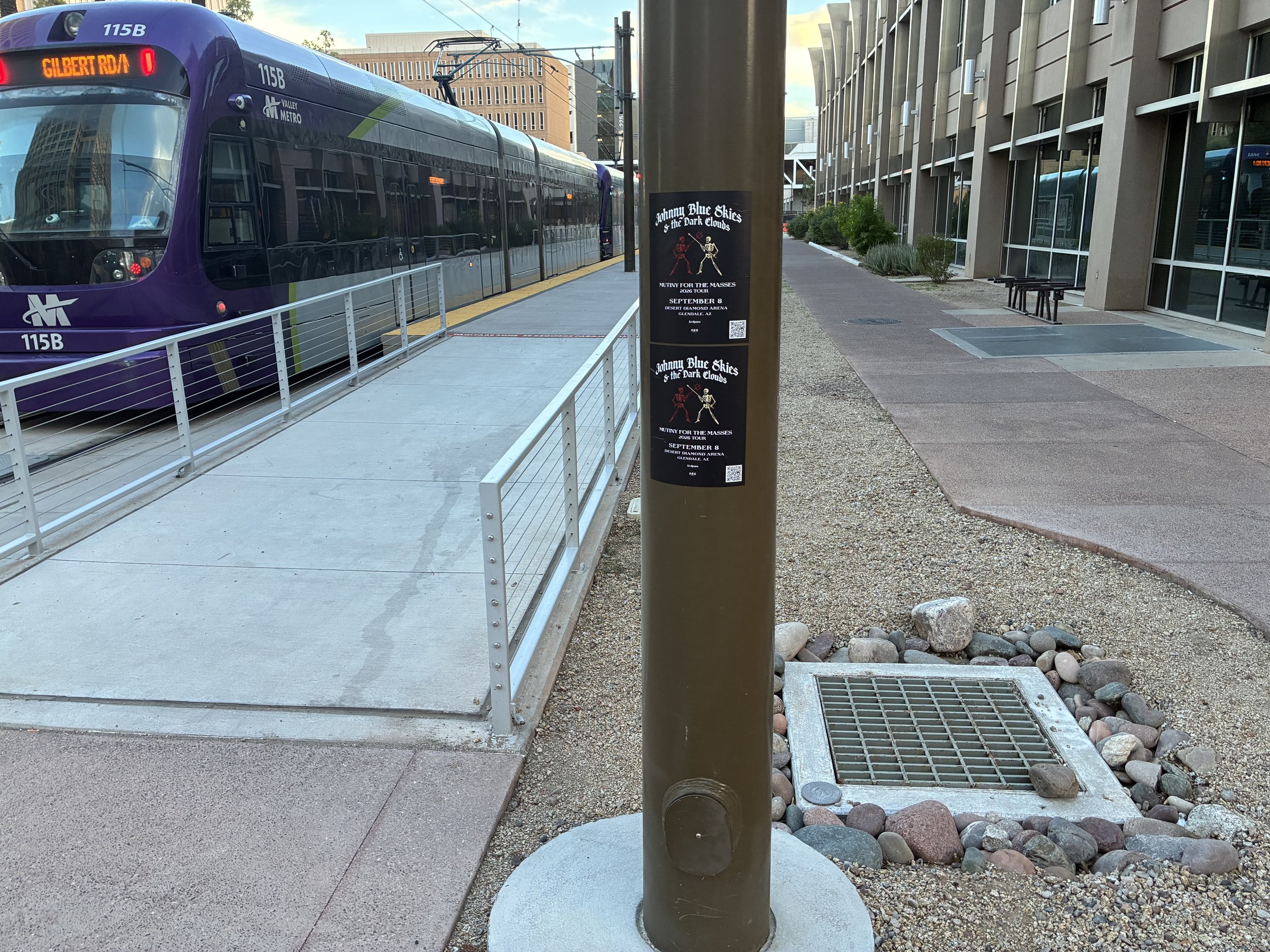
Two Johnny Blue Skies pole snipes beside a light rail stop by sidewalktattos
There is a productive irony in promoting a street art exhibit outdoors.
A gallery show may live inside four walls, but the visual language of street art was born in public view, shaped by sidewalks, construction paths, neighborhood rhythm, and the quick glance of a passerby. When the campaign for that exhibit stays trapped in polished digital placements or formal print ads, something gets lost. The message speaks about the street without ever standing on it.
For museums, galleries, and cultural institutions, that gap matters. If the exhibit is about paste-ups, tags, murals, rebellion, texture, and public visibility, the marketing should carry some of that same energy. Street-level media does not just announce the show. It gives people a preview of its attitude.
Why street art exhibit marketing belongs in public space
Street art is contextual. Its meaning changes with the wall, the block, the audience, and even the weather. That is exactly why outdoor promotion feels right for this category of exhibit. A wheatpaste installation on a busy corridor can echo the feel of the work inside the venue more convincingly than a banner ad ever could.
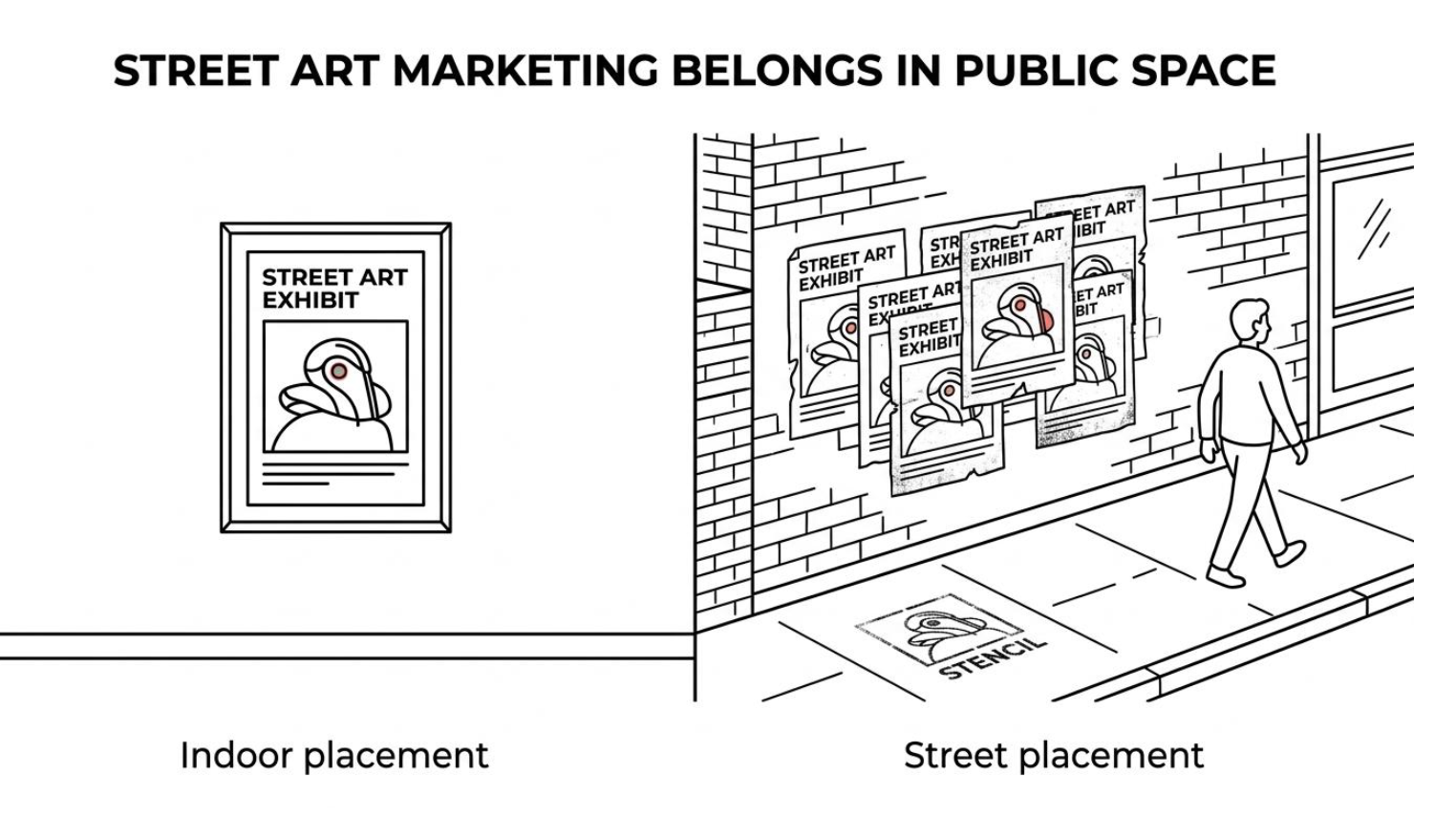
Public space Marketing by sidewalktattos
This is not nostalgia. It is strategy.
Street-level promotion creates a stronger match between subject and medium. When someone encounters a poster takeover near a music venue, a retail corridor, or an arts district, the campaign feels discovered rather than delivered. That feeling matters for attendance because it changes how the event is perceived. The exhibit appears current, culturally fluent, and worth making time for.
A campaign like this can signal several things at once:
Cultural relevance
Urban credibility
Timeliness
Neighborhood awareness
Visual confidence
That effect is especially useful for institutions that want to draw younger audiences, expand local buzz, or reframe themselves as active participants in city culture rather than distant observers of it.
Street-level formats that fit art institution campaigns
Not every outdoor execution does the same job. The strongest campaigns choose a format based on the venue, the city, the installation window, and the kind of response the institution wants.
Wheatpasting is often the natural lead format for street art exhibits. It mirrors the visual DNA of the work itself and can scale quickly across multiple neighborhoods. Sidewalk stencils, on the other hand, create a lower-profile but highly memorable encounter, especially when the copy is short and the route leads toward the venue. Combined campaigns can make the biggest impression because they layer image repetition with directional presence.
Sidewalk Tattoos specializes in wheat pasting posters, sidewalk stencil activations, and combined street campaigns. Those formats are useful for art institutions because they can be mapped by neighborhood, executed quickly, and documented with geo-tagged photos for internal teams, partner agencies, and stakeholders.
The practical range is broad enough to support both compact and high-visibility work. Sidewalk stencil designs may range from 6" x 60" up to 48" x 48", while wheat-paste posters may range from 24" x 36" up to 48" x 72". That flexibility matters when the campaign needs to live across tight downtown blocks, broad warehouse districts, or transit-heavy corridors.
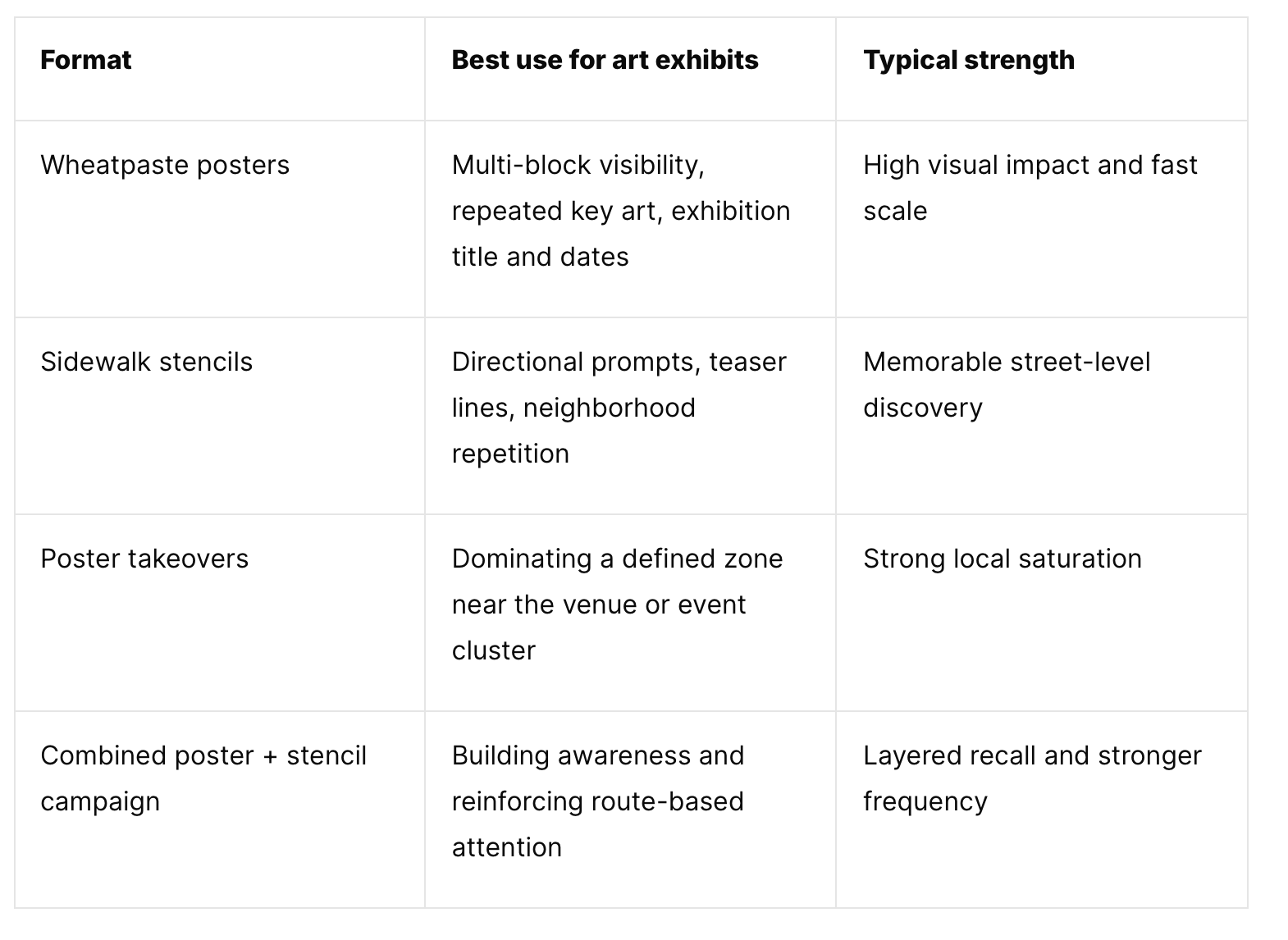
Marketing strategy by sidewalktattos
A museum launching a retrospective may need cleaner, more informational creative. A pop-up gallery or artist-led show may benefit from rougher textures, bolder typography, and fewer words. The point is not to imitate vandalism. The point is to use an outdoor language that respects the exhibit’s subject matter.
Outdoor exhibit marketing is measurable, not just atmospheric
One reason some institutions hesitate with street-level media is the old assumption that outdoor is hard to measure. That assumption is getting weaker.
A 2026 OAAA and Kochava study, based on device-level data across hundreds of campaigns in seven verticals, reported that out-of-home advertising produced a median lift of 20% for in-person outcomes and 14% for digital outcomes. The same study reported roughly 10% for connected TV and broadcast TV on those measures. It also found a 5.3x conversion-rate increase from 1 to 10 ad exposures in OOH-to-digital-action outcomes.
Those numbers matter for exhibit campaigns because they point to a simple truth: repeated public exposure can move both foot traffic and online behavior.
For cultural marketing teams, that means the outdoor layer can do more than create atmosphere. It can support measurable demand, especially when paired with ticketing links, event-specific landing pages, timed promo codes, or location-based social strategy.
Useful campaign tracking can include:
Photo reporting: proof of installation and visual quality
Geo documentation: location-by-location records for recap and internal review
Frequency planning: enough repetition to build recognition across key neighborhoods
Landing page tracking: distinct URLs or QR paths tied to the street campaign
Attendance lift: comparing footfall or ticket velocity before and after activation
A mapped rollout also helps institutions explain the media value internally. Instead of simply saying the campaign “was up around the city,” teams can show where assets appeared, how long they ran, and how the visual system was distributed near target audiences.
That level of documentation is especially useful when the exhibit involves sponsors, city partners, foundations, or multiple departments that all want visibility into campaign execution.
Authentic street art marketing needs discipline, not randomness
The strongest outdoor exhibit campaigns may feel raw, but they are not careless.
A credible street-level activation starts with clear planning: neighborhood selection, route logic, material choices, installation timing, weather tolerance, and a realistic understanding of what surfaces and placements are appropriate. It also requires restraint. If every poster shouts, nothing stands out. If every message tries to explain the full show, the work becomes cluttered.
Street art campaigns work well when the creative system is edited hard. One image. One title. One date line. One strong URL or call to action. Sometimes less copy creates more pull because the city already supplies the texture.
There is also a curatorial dimension here. Institutions that market a street art show outdoors have a chance to extend the exhibit beyond the building, almost like an opening chapter spread through the city. A poster series can feel like part of the exhibition narrative when it is designed with intent rather than treated as generic promotion.
That is where experienced production matters. Fast activation is valuable, but speed without placement judgment can waste budget.
Compliance and city rules shape street campaign execution
Street-level marketing is powerful, though it is never a free-for-all.
Any institution or agency planning this kind of work needs to think about compliance early. Advertising claims should be truthful, not deceptive or unfair, and backed by evidence. That baseline from FTC guidance applies even when the campaign feels artistic or unconventional. Event dates, venue names, sponsor mentions, pricing language, and access details still need to be accurate.
Local rules matter just as much as message accuracy. New York City is a good example. The NYC Department of Buildings states that posting signs, pictorial representations, business messages, or advertising messages on protective structures is prohibited unless required by law. The city also defines a temporary sign on a protective structure as one displayed for 30 days or less, and a permit is required if the sign remains longer than 30 days. Where temporary signs are allowed in front of an obscured lawful business sign, height is limited to 4 feet.
That does not mean street campaigns are impractical. It means they need professional planning around placement, duration, and local restrictions.
Before an activation begins, teams should clarify a few things:
Placement rules: what surfaces are permitted in the target city
Property considerations: whether consent or coordination is needed
Duration limits: how long temporary messaging may remain
Documentation standards: what proof the institution needs after install
The best street campaigns respect the city instead of treating it like an unregulated blank canvas. That mindset protects the brand, the venue, and the work itself.
How wheatpaste installs support museum and gallery promotion
Wheatpasting has a special fit for art institutions because it sits at the intersection of public texture and controlled visual identity.
A well-designed wheatpaste campaign can look bold without looking sloppy. It can feel grounded in street culture while still carrying museum-grade typography, clean exhibition details, and sponsor-ready presentation. That balance matters when the goal is to attract both serious art audiences and broader city traffic.
This is also where Temporary materials and thoughtful installation practices can help institutions pursue public visibility without adopting a disposable mindset. For organizations that care about sustainability and reputation, that is part of the value, not a side note.
A strong wheatpaste exhibit campaign often includes:
A hero image pulled directly from the show
Repeated placements across art-forward neighborhoods
Date and venue details kept concise
Geo-tagged recaps for reporting
A short activation window tied to opening momentum
When institutions want a more layered public presence, wheatpaste can be paired with sidewalk stencils to create route-based reinforcement. Posters build recognition. Stencils create street contact at eye-down level, often closer to where foot traffic makes a decision to stop, scan, search, or share.
Building a street campaign that feels worthy of the exhibit
If the exhibition is about public art, the marketing should not feel timid.
That does not mean louder is always better. It means the campaign should respect the source material. Street art asks for visibility, placement intelligence, repetition, and nerve. A generic media plan rarely captures that.
Sidewalk Tattoos builds street-level campaigns with wheat pasting, stencil activations, mapped execution, and photo documentation across U.S. cities and international markets. For institutions planning an exhibit about street art, that combination makes practical sense. The format belongs to the subject, the rollout can happen fast, and the campaign can be reported clearly back to internal teams.
A museum wall can hold the art. The street can announce why it matters.
If the upcoming show is rooted in public visual culture, the launch can meet people where that culture actually lives. Wheatpaste installs built for art institutions make that possible. Contact Sidewalk Tattoos to get started.
Reach out for more information :
929.678.0235
