
Why Some of Our Best Campaigns Come Through Marketing Agencies
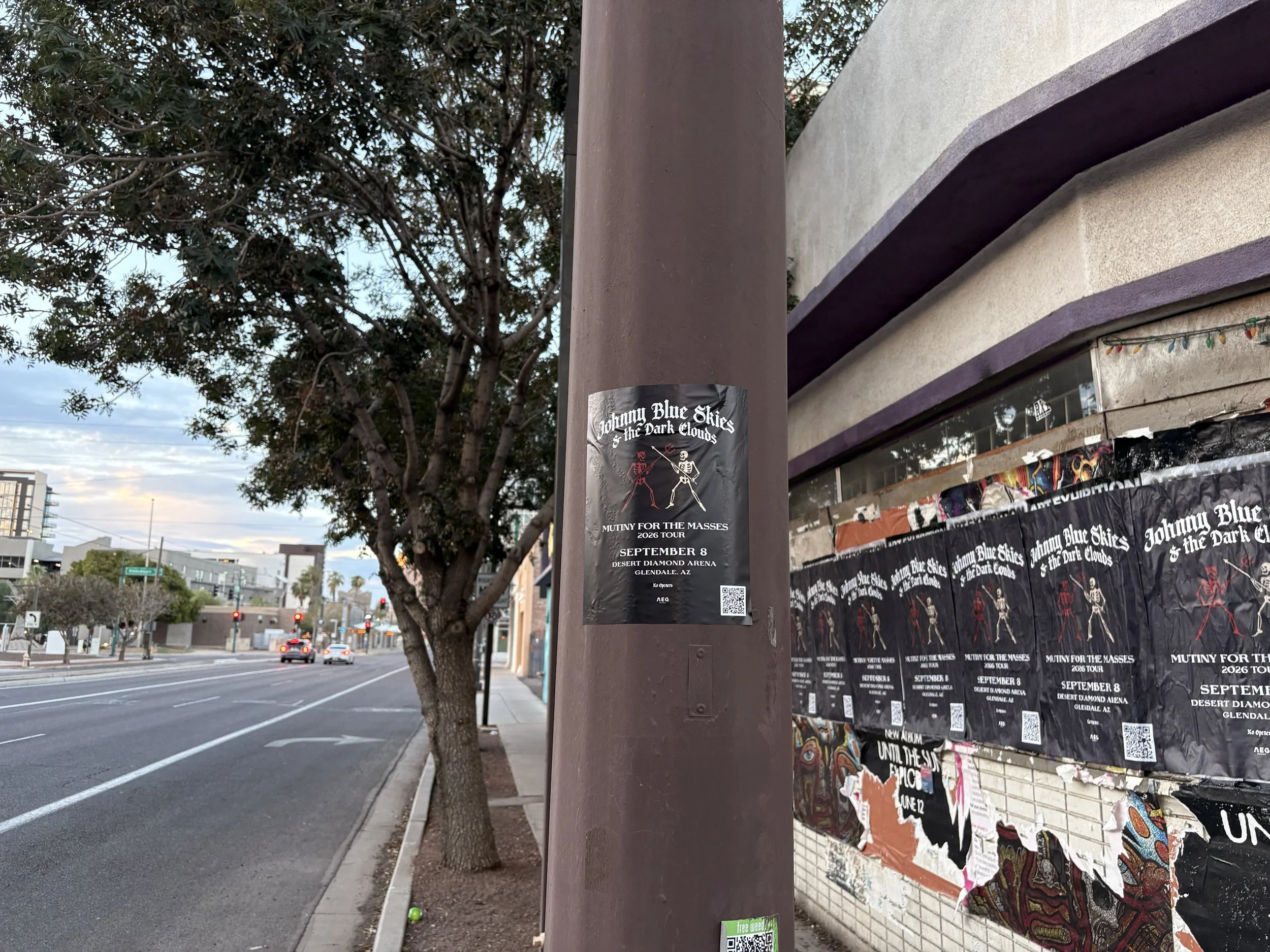
Johnny Blue Skies pole snipe beside a wall of concert posters by sidewalktattos
Some of the strongest street campaigns come through agency partners, and that is not an accident. When an agency manages a client’s wheatpaste installs or sidewalk stencil rollout, the campaign usually arrives with a sharper brief, a clearer audience, and a stronger connection to the bigger media plan.
That combination tends to produce better work.
Agencies are often balancing brand standards, launch timing, city selection, approvals, reporting, and budget accountability all at once. A street activation partner that can fit neatly into that process gives the agency room to focus on strategy while the field execution stays organized, visible, and well documented. That is where the partnership can become especially productive for wheat pasting and other out-of-home street media.
Why agency-managed wheatpaste campaigns often produce stronger results
A good agency brief usually comes with context that makes the street work better. Instead of treating wheat pasting as a one-off tactic, agencies often place it inside a larger push that may include social, PR, retail, influencer work, events, or product drops. That broader view helps determine where installs should go, how fast they should appear, and what visual language will feel right in the neighborhood.
That planning discipline matters in street marketing, where timing and placement can shape the impact just as much as the artwork itself. A poster series that lands in the right areas during the right week can feel immediate and culturally relevant. An agency team is often well positioned to make those calls because they are already managing campaign timing across channels.
Just as important, agencies tend to bring decision-makers together early. That lowers the risk of late-stage confusion around creative revisions, flight dates, city counts, or documentation needs.
A few traits show up again and again in successful agency-led street campaigns:
Clear audience targeting
Faster approval flow
Better launch synchronization
Stronger brand consistency
Built-in reporting expectations
How Sidewalk Tattoos fits into the agency campaign workflow
When agencies manage street media, they do not need another layer of complexity. They need a field partner that can take a brief, translate it into executable city-level plans, and report back with proof that the work landed where it was supposed to land.
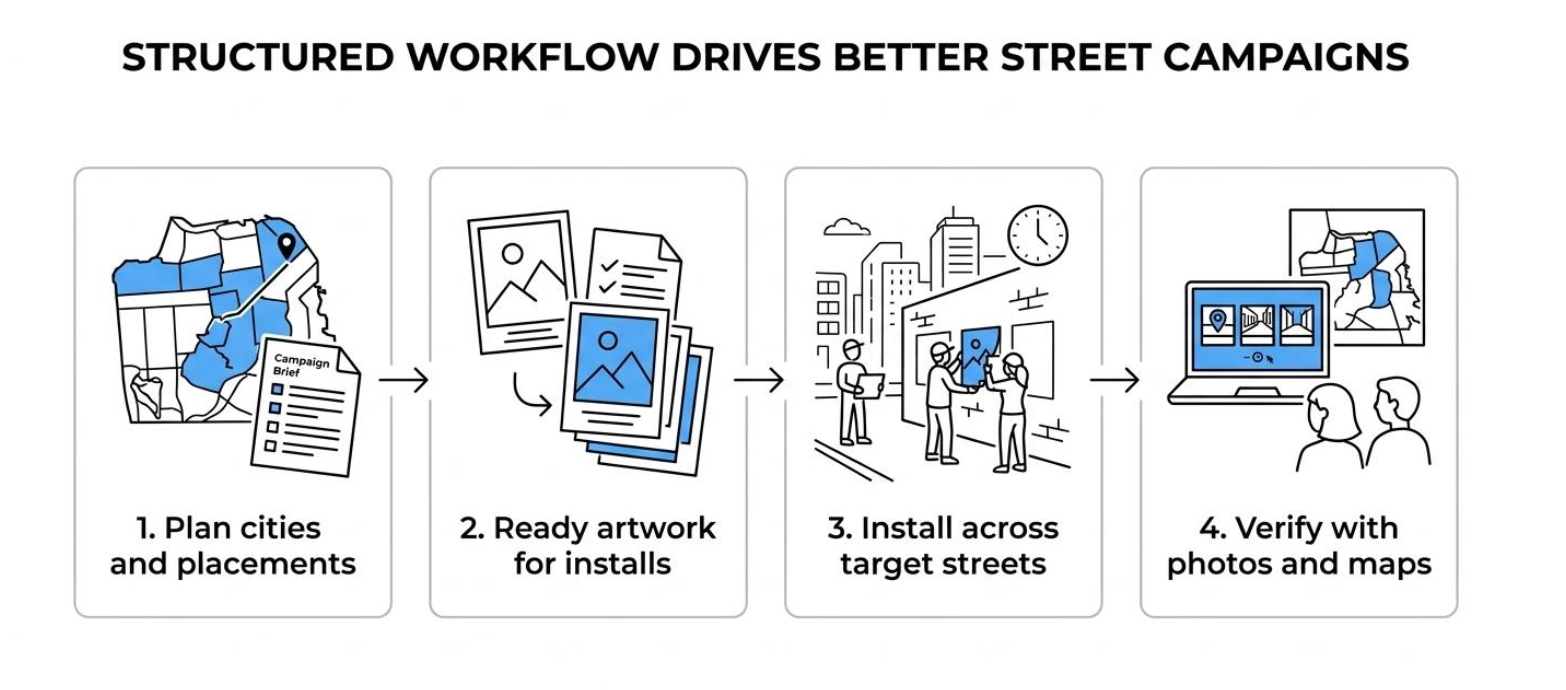
Wheatpasting workflow by Sidewalktattos
That is a big part of why agency relationships often work so well with Sidewalk Tattoos. The work is built around mapped placements, documented installs, and fast activation timelines. For agencies handling multiple stakeholders, that kind of structure can save time at every step.
Street campaign support from planning to proof of install
Before deployment, placements can be mapped against the campaign’s goals, city priorities, and neighborhood fit. After installation, teams receive geo-tagged photos and a placement map that show where the work was posted. That record is useful for the agency team, the brand team, and the client team because everyone can review the same set of verified results.
This becomes even more helpful when a campaign includes physical elements beyond posters alone. If a build involves custom poster installations or takeaway samples, the reporting gives agencies a straightforward way to account for what was installed and where it appeared.
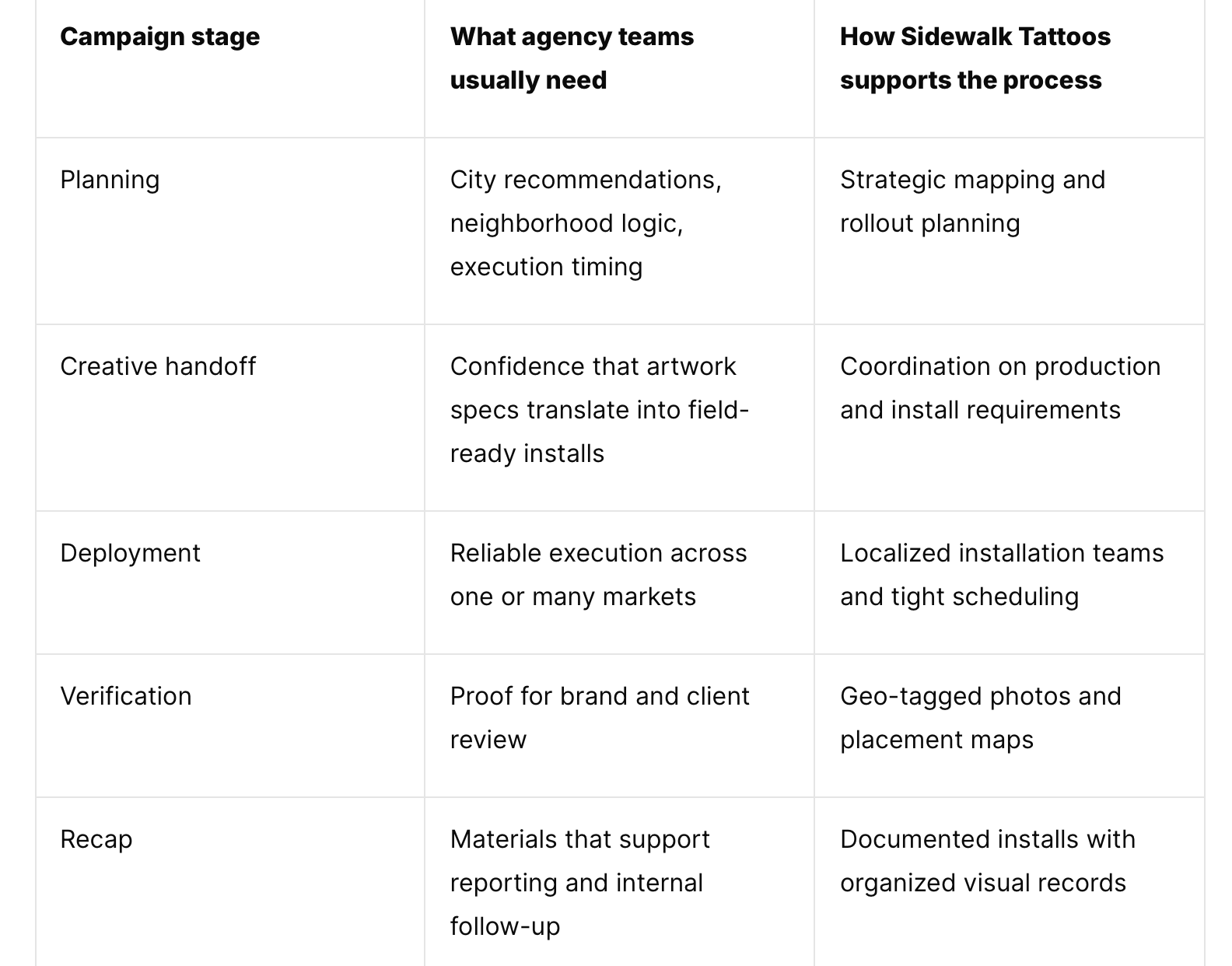
Campaign use by Sidewalktattos
Why geo-tagged photos and placement maps matter for media transparency
In out-of-home, transparency is not a minor detail. It is part of the value. Agencies need to know that placements happened, that the media appeared in the intended areas, and that client reporting is grounded in real documentation.
That expectation is especially reasonable given the industry’s long-running attention to media transparency. ANA discussions around transparency issues in advertising helped push the market toward clearer documentation and stronger accountability across media categories, including out-of-home. Street campaigns benefit from that same standard.
A mapped and photographed install record gives agencies something concrete. It helps during client check-ins, internal status meetings, billing reviews, and post-campaign recap decks. It also reduces the friction that can come from vague reporting or partial proof.
When agencies say they want street campaigns to run smoothly, they usually mean a few very specific things:
Clear verification: proof that the posters or stencils were installed
Shared visibility: records the agency team and client team can review together
Placement accuracy: a documented match between plan and field execution
Faster recap prep: ready-to-use visuals for reporting and presentations
How multi-city wheatpaste installations stay organized
Some agency assignments move fast because they have to. A launch date is locked. Creative approval comes in late. The brand wants visibility across several markets at once. In those moments, the quality of coordination matters as much as the quality of the install itself.
One Sidewalk Tattoos case study describes a True Religion campaign that was executed across 18 cities within 24 hours of receiving final artwork. That kind of rollout depends on interagency coordination, local print support, installation crews, and city compliance awareness moving in sync. It also depends on reporting that keeps pace with the fieldwork.
Speed only helps when it is paired with control.
For agencies, that control often looks like one point of contact, one execution plan, and one reporting structure, even when the campaign itself spreads across many neighborhoods and markets. Instead of managing a patchwork of local vendors, the agency can move through a more unified process.
That is especially useful when the campaign includes a mix of formats. Wheat pasted posters, sidewalk stencils, and custom poster installations each have different production and placement needs. A coordinated execution partner can keep those parts connected without slowing the timeline.
How out-of-home street activations support measurable consumer action
Street media is often valued for presence, memorability, and cultural credibility. It also supports action.
Broader out-of-home research points in that direction. OAAA reported Harris Poll findings showing strong favorability for digital out-of-home advertising, with 73% of consumers viewing those ads favorably. The same research tied digital out-of-home to foot traffic, brand visibility, customer engagement, and sales.
That research focused on digital place-based formats, not wheatpaste campaigns specifically, so it should not be treated as a one-to-one performance claim for every street activation. Still, it gives agencies a useful signal: people respond to out-of-home media, and they often continue that interaction on their devices.
The same study reported that 78% of recent digital place-based ad viewers took at least one device action. Among those actions, 47% searched for the advertiser online, 41% visited the advertiser’s website, 33% visited the advertiser’s social media, and 15% posted about the ad or product on social media or a blog.
For agency teams, that matters because street work rarely sits alone. A wheatpaste campaign may be designed to support a larger pattern of behavior:
branded search lift
social profile visits
launch-week buzz
foot traffic near retail or event locations
What agencies can measure around a wheatpaste campaign
The most effective agency teams usually define success before the first poster goes up. They know whether the street campaign is meant to create awareness in key neighborhoods, support a timed release, amplify earned media, or drive online curiosity that shows up in search and social behavior.
That gives the activation a clearer role in the campaign mix.
A smart measurement approach may include both direct proof and directional performance signals:
Install verification: geo-tagged photos and placement maps
Timing analysis: activity around launch dates and city-by-city deployment
Digital response: branded search, website traffic, and social visits
Local market signals: store traffic, event attendance, or neighborhood buzz
What makes agency partnerships work well on street campaigns
The best agency relationships are usually grounded in clarity. The agency knows the brand voice, the client’s pressure points, and the campaign’s business goal. The street marketing partner knows how to translate that into physical presence in the real world.
When those roles are clear, decisions happen faster. Creative approvals move with less back-and-forth. City lists become easier to finalize. Documentation expectations are defined before launch instead of after the campaign is live.
Trust also grows when reporting is consistent. If the agency knows it will receive mapped placements and geo-tagged photos, it can plan client communication with confidence. That confidence carries through the whole campaign, from kickoff call to final recap.
There is also a creative benefit. Agencies tend to bring strong campaign narratives, and street specialists bring placement instincts, production reality, and neighborhood-level execution knowledge. Together, those perspectives can turn a simple poster push into something more intentional and more visible.
How agency teams can start a wheatpaste or sidewalk stencil campaign quickly
The fastest starts usually come from simple inputs: target cities, timing, artwork status, budget range, and campaign goals. Once those are clear, it becomes much easier to map neighborhoods, select formats, and build an execution plan that matches the brief.
Agencies do not need to arrive with every detail solved. A strong street activation partner can help shape the rollout, recommend markets, and build a practical path from concept to install.
If your team is managing a client’s wheatpaste campaign, sidewalk stencil activation, or a combined street takeover, this is a good time to put a clean process behind the creative idea. Sidewalk Tattoos supports agency teams with mapped planning, fast execution, and documented installs across U.S. cities and international markets.
Contact us to get started.
Reach out for more information :
929.678.0235
