
sidewalk stencil advertising in Boston, Massachusetts
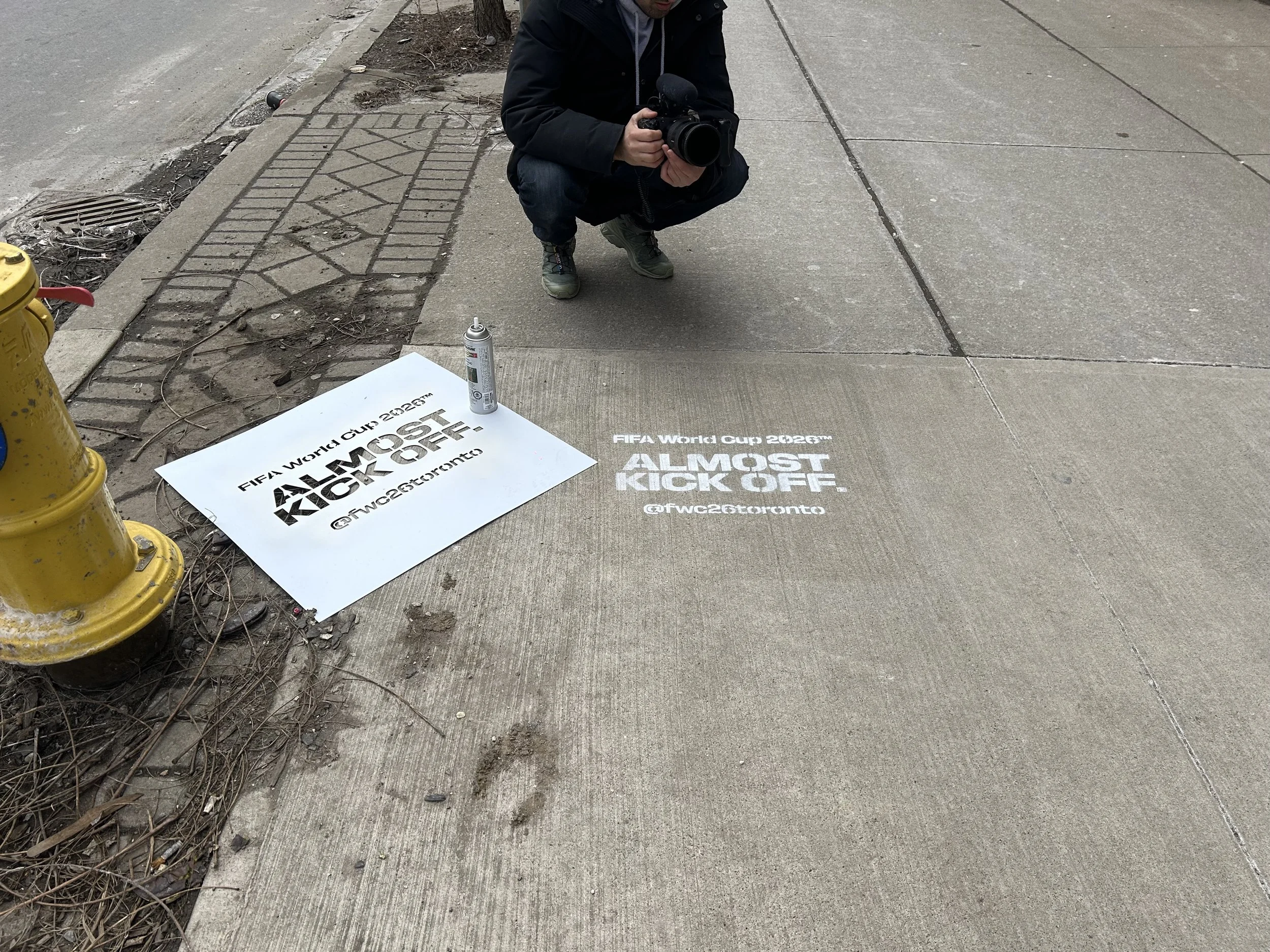
Boston is built for street-level visibility. People move through the city on foot, by transit, and through dense commercial corridors where attention is split across storefronts, traffic, phones, and public space. A well-placed stencil meets that audience at ground level, right inside the path of travel, where a message can feel immediate, local, and hard to ignore.
For brands that want presence in Boston without relying only on screens, sidewalk stencil advertising offers a direct and memorable format. It can support retail openings, pop-ups, concerts, product drops, brand launches, and neighborhood takeovers with messaging that feels tied to the city instead of pasted onto it.
Why Boston Works So Well for Sidewalk Stencil Campaigns
Boston has the density that street media needs. Back Bay, Fenway, Seaport, Downtown Crossing, the South End, and campus-heavy areas all create steady pedestrian movement throughout the day. Commuters, students, tourists, office workers, and local residents often share the same corridors, which gives a hyperlocal campaign the chance to reach several audience segments at once.
That matters because sidewalk stencils are not passive background media. They live where people already look while walking, crossing, waiting, or turning a corner. A clear visual, a directional cue, or a short phrase can interrupt routine just enough to create recall.
Industry research around outdoor advertising consistently points to strong memory compared with digital ads, and chalk-style street messaging often carries a more authentic feel than polished display media. In a city that values culture, neighborhood identity, and visual character, that can translate into stronger curiosity and more social sharing.
What This Format Can Help You Achieve
Sidewalk stencil advertising works best when the goal is local action. That may mean getting people into a store, pushing foot traffic toward an event, building buzz around a launch, or repeating a message across a concentrated area so it becomes part of the streetscape for a limited time.
It also works well when speed matters. A brand can move quickly around a campaign window, activate near key districts, and create visible repetition without the long lead times that come with many traditional out-of-home buys.
Common Boston use cases include:
retail openings
concert and nightlife promotion
product launches
fashion drops
restaurant traffic drivers
event wayfinding
campus-area awareness
neighborhood brand saturation
Planning for Boston’s Regulatory Climate
Boston requires care. Commercial advertising on public sidewalks is tightly regulated, and unauthorized markings on public surfaces can lead to removal, citations, and added cost. There is no widely used, standard permit path for ordinary sidewalk advertising in the city, which means planning cannot start with design alone. It has to start with location review, permissions, and risk screening.
That is why a responsible stencil campaign in Boston should be built around approved surfaces, private property opportunities, event partnerships, or other authorized placements where the brand message can appear without crossing legal lines. Material choice matters too. Temporary, low-impact applications are often the right fit when a campaign needs visual punch without leaving a lasting mark.
A strong process usually includes a few non-negotiables:
Surface review: ownership, pedestrian flow, texture, visibility, and cleanup needs
Approval path: written permission, event authorization, or site-specific access confirmation
Material choice: washable chalk formulas or water-based options selected for duration and conditions
Placement standards: clear of crosswalk markings, accessibility routes, and traffic-control elements
Removal plan: natural fade, scheduled cleanup, or post-event restoration
This is where experience matters. A campaign that looks simple on the street can involve a lot of coordination behind the scenes.
Materials That Fit the City
In Boston, temporary and low-impact materials are usually the smartest starting point. Chalk-based applications and water-washable formulas are often preferred because they can create high contrast while remaining easier to remove. They are well suited to shorter campaign windows, especially in spring, summer, and early fall.
For campaigns that need more staying power, water-based paint systems may be considered on approved surfaces, with cleanup planning built into the schedule. Stencils themselves are typically cut from durable mylar or similar materials so repeated applications stay crisp and legible across multiple placements.
Weather is a real part of campaign planning here. Rain can shorten the life of chalk, heavy foot traffic can wear down lighter applications, and winter conditions make many sidewalk programs impractical. Timing, material selection, and refresh strategy all have to match Boston’s climate and the exact surface being used.
Design for the Glance
The best sidewalk stencil is understood almost instantly.
Boston pedestrians are moving. They are heading to the T, crossing intersections, grabbing coffee, walking between classes, or leaving a game or venue. Long copy does not help. Strong campaigns use concise language, bold typography, clean iconography, and layouts built for a one- or two-second read.
Direction also matters. A stencil can point people toward a storefront, a pop-up, a block party, an entrance, or a limited-time activation nearby. When several placements are mapped together, they can create repetition that feels intentional rather than random.
Good creative often includes a simple next step, not a wall of information. That may be a brand name, a short URL, a QR code, a date, or a location cue. The goal is clarity first, then curiosity.
Execution at Street Level
A Boston stencil campaign should not rely on guesswork. The value comes from smart mapping, disciplined placement, and proof that the work was completed where it was intended. That is especially important for agencies, multi-location brands, and teams managing launch schedules across several cities.
Sidewalk Tattoos approaches stencil campaigns as field operations, not just design projects. That includes planning the route, producing custom stencils, deploying fast, and documenting the rollout with photo and geo-tagged reporting. When timing is tight, campaigns can often move from approval and production into activation within 48 to 72 hours.
Deliverables often include:
location mapping
custom stencil production
on-site installation
photo documentation
geo-tagged proof of placement
recap reporting
For brands that want broader street presence, stencil work can also be paired with wheat pasting posters or custom poster installations. That creates a stronger neighborhood footprint and gives the campaign more visual repetition across walls, sidewalks, and pedestrian paths where approvals and placement strategy support it.
Where This Approach Fits Best in Boston
This format is especially effective for consumer-facing brands. Restaurants, cafés, apparel labels, music events, nightlife campaigns, tech launches, cultural programming, and pop-ups tend to benefit most because the message is tied to physical attendance, foot traffic, and local buzz.
Boston’s event rhythm makes that useful. Marathon season, college move-in periods, festivals, game days, conferences, and summer waterfront programming all create moments when a temporary street media push can capture attention at the right time and in the right place.
Neighborhood context matters too. A campaign near Seaport may call for a cleaner, modern visual approach. A rollout near Fenway may need energy and event timing. In Back Bay or the South End, design may need to feel more restrained and editorial. The medium stays the same, but the tone should fit the block.
A More Visible Street Presence, Built With Care
When sidewalk stencil advertising is planned properly, it can turn ordinary pavement into high-frequency local media. It gives brands a way to show up where people are already moving, looking, and making decisions about where to go next.
Sidewalk Tattoos builds Boston activations with strategy, temporary materials, fast rollout capability, and documented execution. For brands looking to create street-level visibility in Boston, the strongest campaigns start with smart placement, sharp creative, and a plan grounded in the realities of the city.
How long do sidewalk stencil campaigns usually last in Boston?
Boston’s weather can vary, so stencil lifespan depends on conditions. In dry weather, visibility can last several days, but rain and dense foot traffic near universities may shorten duration.
What kinds of brands benefit most from sidewalk stencils in Boston?
Education, tech, retail, and event-based brands perform well due to Boston’s large student and professional population.
Can sidewalk stencils be paired with other street media?
Yes, especially posters near campuses and transit areas.
Do stencil campaigns work during major Boston events?
Yes, including sports events, college activities, and festivals.
What should the stencil design include?
Clear, concise, and easy-to-read messaging.
Is documentation available after installation?
Yes.
Do you handle production and installation?
Yes, in all stencil sizes.
Boston’s density and student presence make repetition key for effective campaigns.
SIdewalk stencil ADVERTISING in the following cities :
sidewalk stencil advertising in Atlanta, Georgia
sidewalk stencil advertising in Austin, Texas
sidewalk stencil advertising in Boston, Massachusetts
sidewalk stencil advertising in Charlotte, North Carolina
sidewalk stencil advertising in Chicago, Illinois
sidewalk stencil advertising in Los Angeles, California
sidewalk stencil advertising in Miami, Florida
sidewalk stencil advertising in Milwaukee, Wisconsin
sidewalk stencil advertising in New Orleans, Louisiana
sidewalk stencil advertising in Philadelphia, Pennsylvania
sidewalk stencil advertising in Phoenix, Arizona
sidewalk stencil advertising in Portland, Oregon
sidewalk stencil advertising in San Francisco, California
sidewalk stencil advertising in Seattle, Washington
sidewalk stencil advertising in Washington, District of Columbia
sidewalk stencil advertising in Houston, Texas
sidewalk stencil advertising in Montreal, Canada