
Sidewalk Stencil Advertising in Toronto, Canada
Toronto is built for street-level attention. Dense foot traffic, active nightlife, transit-heavy corridors, and neighborhood identities that feel distinct block by block make it a strong market for sidewalk stencil advertising. When a campaign is planned well, the city itself becomes the media channel, placing the message directly in the path of the audience.
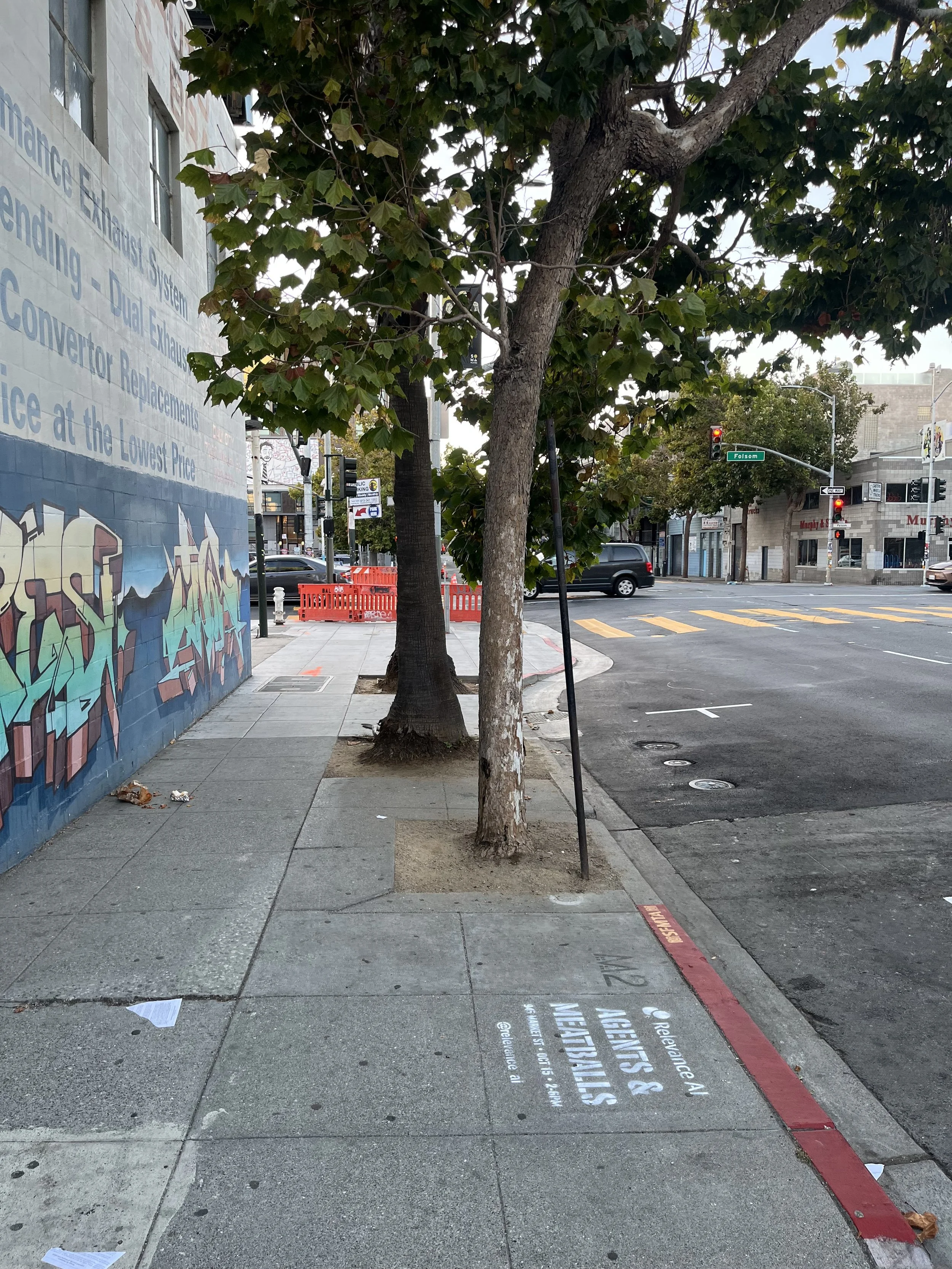
Sidewalk stencil advertising works especially well for brands that want cultural relevance, speed, and repeat visibility. A sharp stencil placement near retail clusters, venues, campuses, or event zones can create the kind of daily exposure that digital ads rarely match in physical space. It feels immediate, public, and tied to the rhythm of the city.
Why Toronto is a strong fit for sidewalk stencil campaigns
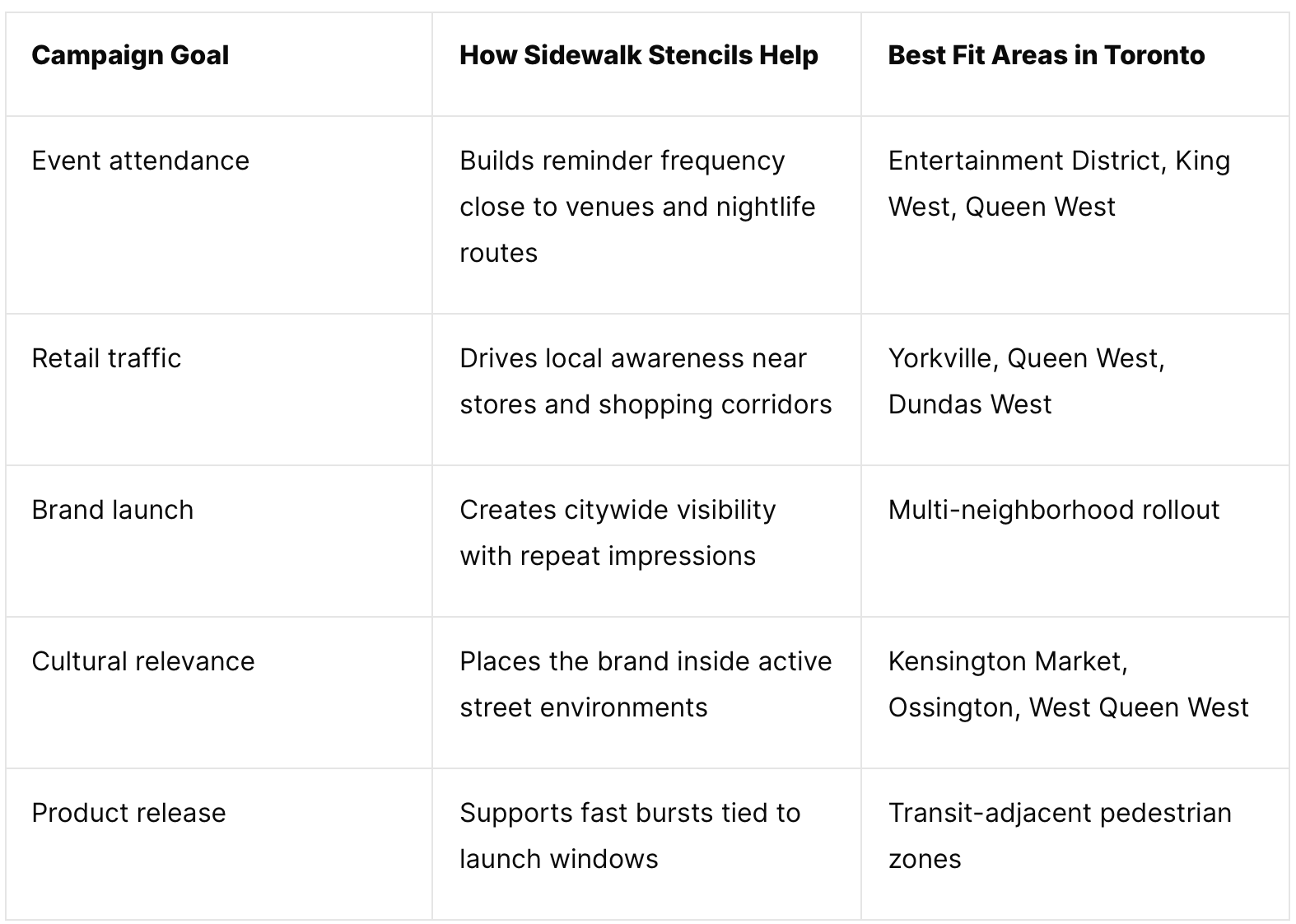
Toronto gives advertisers range. A launch aimed at fashion and nightlife can focus on Queen West, King West, Ossington, and the Entertainment District. A campaign built for students, creators, and early adopters can be mapped around campus zones, cafés, record shops, and transit corridors. A consumer brand seeking broad awareness can spread placements across several neighborhoods to build frequency rather than relying on a single hotspot.
That flexibility matters because sidewalk stencil advertising is not only about being seen once. It is about repeated visual contact in places where people are already walking, waiting, meeting, and sharing. The format is simple by design, which is part of its strength. A clear symbol, phrase, product cue, or event message can register in seconds.
Toronto also supports campaigns that need a street-culture feel without losing structure. With the right planning, stencil activations can be mapped with purpose, documented with photos and geotags, and executed quickly across key areas.
After the strategy is defined, campaigns often focus on goals like these:
Launch awareness
Event promotion
Retail foot traffic
App downloads
Streetwear and music releases
Neighborhood saturation
What sidewalk stencil advertising can do for a brand
Stencil advertising turns sidewalks into repeated touchpoints. A person may see one placement on the way to work, another near a café later in the day, and a third outside a venue that night. That kind of repetition builds memory. It also gives the campaign a lived-in quality that feels more connected to the city than many traditional placements.
This format works well for brands that want visibility without the distance of a billboard. The audience encounters the message at ground level, inside real routines. That creates a different kind of presence, especially in markets where cultural credibility matters.
It can support several campaign types at once. A film screening, product drop, pop-up store, startup launch, gallery opening, festival, or local brand collaboration can all benefit from stencil placements placed near the right pedestrian flows.
How campaign planning works on the ground
Good stencil advertising starts with location logic. Not every sidewalk is equal. Surface condition, pedestrian volume, surrounding businesses, event timing, and neighborhood tone all shape performance. A campaign aimed at late-night crowds should not be mapped the same way as one targeting office workers or students.
That is why strategic route planning matters. Sidewalk Tattoos builds campaigns around where attention naturally accumulates, then documents execution through mapped reporting and geo-tagged photos. For brands and agencies, that means the campaign is not a vague street effort. It is organized, visible, and accountable.
In Toronto, planning often balances concentrated takeovers with distributed presence. A concentrated approach can own a few high-energy pockets. A distributed approach can move across several districts to build reach and repetition.
Key planning factors usually include:
Audience fit: Which neighborhoods match the brand, event, or product
Foot traffic pattern: When people pass through and how often
Surface quality: Whether the ground supports clean, readable application
Timing: Launch windows, weekends, nightlife peaks, and event calendars
Coverage style: Dense saturation in one area or wider spread across multiple zones
Documentation: Photo proof and geotagged records for review and reporting
Temporary materials, real-world impact
One reason sidewalk stencil advertising remains attractive is its balance of impact and flexibility. Campaigns can be bold without feeling permanent. Materials can be selected with temporary use in mind, which supports activations that need urgency, visibility, and a lower long-term footprint.
That matters in a city where campaigns often move fast. A music release, pop-up announcement, fashion activation, or app launch may only need a short and concentrated burst of attention. Temporary stencil work is well suited to that pace.
Sidewalk Tattoos also combines stencil execution with eco-conscious material choices where possible, helping brands create street presence while staying mindful of how the activation is produced.
Pairing stencil work with wheat pasting for wider coverage
Some campaigns are strongest when they combine formats. A stencil can act as the repeated street-level cue, while wheat pasted posters carry deeper messaging, stronger visuals, or a call to action. Together, they create a layered campaign that people encounter at different scales.
In Toronto, that combination can be especially effective in neighborhoods where visual culture already shapes the atmosphere. A poster wall can create a destination moment. Sidewalk stencils can extend that presence outward into surrounding blocks, keeping the campaign visible along the route rather than only at one point.
This integrated model is useful for:
Brands launching in a new market
Event promoters building city buzz
Fashion labels seeking street credibility
Tech companies pushing awareness fast
Speed matters when timing is tight
Campaign windows are often short. Product drops, performances, premieres, openings, and brand collaborations do not wait around for long approval cycles and slow-moving production. Street activations need a team that can move quickly, map clearly, and execute at scale.
That is one of the reasons many brands turn to specialists rather than trying to coordinate street media piecemeal. Sidewalk Tattoos handles stencil campaigns, wheat pasting, installation planning, and documentation across major cities in the U.S. and internationally, including Toronto. Fast activation timelines are often possible, sometimes within 48 to 72 hours depending on scope, artwork readiness, and location conditions.
Quick execution does not mean rushed thinking. The strongest campaigns still start with a smart brief, clear creative, and a practical deployment plan.
What reporting should look like
Street advertising should be visible not just to the public, but to the client as well. Clear post-installation documentation helps internal teams, agency partners, and stakeholders verify placement, assess coverage, and measure consistency across zones.
A solid reporting package often includes geotagged photos, mapped placement records, and organized campaign summaries. That gives the activation more staying power inside the marketing process because the work can be reviewed, shared, and connected to broader campaign goals.
Useful reporting elements often include:
Geo-tagged installation photos
Neighborhood-by-neighborhood mapping
Timestamped documentation
Coverage summaries
Visual proof for stakeholders
Toronto rewards brands that show up in public with confidence and clarity. Sidewalk stencil advertising brings the message into motion, into neighborhoods, and into the daily paths of the people who matter most. With smart mapping, strong creative, and disciplined execution, a sidewalk campaign can feel immediate, city-specific, and hard to ignore.
Frequently Asked Questions
How long do sidewalk stencil campaigns usually last in Toronto?
Visibility typically lasts several days depending on weather and pedestrian activity.
What kinds of brands benefit most from sidewalk stencils in Toronto?
Retail, events, entertainment, and lifestyle brands.
Can sidewalk stencils be paired with other street media?
Yes.
Do stencil campaigns work during major Toronto events?
Yes.
What should the stencil design include?
Bold, simple visuals.
Is documentation available after installation?
Yes.
Do you handle production and installation?
Yes.
Toronto’s density and diversity make it ideal for high-frequency stencil campaigns.
SIdewalk stencil ADVERTISING in the following cities :
sidewalk stencil advertising in Atlanta, Georgia
sidewalk stencil advertising in Austin, Texas
sidewalk stencil advertising in Boston, Massachusetts
sidewalk stencil advertising in Charlotte, North Carolina
sidewalk stencil advertising in Chicago, Illinois
sidewalk stencil advertising in Los Angeles, California
sidewalk stencil advertising in Miami, Florida
sidewalk stencil advertising in Milwaukee, Wisconsin
sidewalk stencil advertising in New Orleans, Louisiana
sidewalk stencil advertising in Philadelphia, Pennsylvania
sidewalk stencil advertising in Phoenix, Arizona
sidewalk stencil advertising in Portland, Oregon
sidewalk stencil advertising in San Francisco, California
sidewalk stencil advertising in Seattle, Washington
sidewalk stencil advertising in Washington, District of Columbia
sidewalk stencil advertising in Houston, Texas
sidewalk stencil advertising in Montreal, Canada